Posted in Backstory, Book promotion

Do I really need a Facebook presence? Or does any author, for that matter…

Let me begin by telling you what I did last month.  I removed everyone from my Facebook ‘friends’ list except close family.  “Why in the world would a writer do such a thing?” you ask.   And it is no small thing to rid oneself of ‘friends.’  It takes time, so you really do need to be committed to the task and why you’re doing it.

I’m sick of Facebook.  Every time I open my news feed, there among the interesting updates from pages that I’ve liked is the constant stream of narcissistic stream of consciousness from my so-called friends.  And I’d bet my next (day job) pay check that not one of those people gives a rat’s a## about what I’m doing, either.  But it’s not just that.  I often have to bite my cyber-tongue when I see posts.

Sad little Facebook fan page...
Sad little Facebook fan page…

Here are some of the things that I wanted to write but didn’t over the past few months:

  • “Get over it.”  I cannot tell you how many times as a response to so many different status updates that I wanted to say this to someone.
  • “If you post one more ultra-left-wing piece of propaganda, I’ll tell the world what I really think of your politics.”  Ooh, this one could really get me into cyber-trouble.
  • “I don’t actually care what you’re making for dinner tonight.”  Need I say more?

So, you’ve probably come to the conclusion that I’m not really that interested in my ‘friends.’  If so, you’d be right, because a Facebook friend is not a friend.  A friend doesn’t need to keep in touch on Facebook with public posts of anything and everything.  But if I’ve sabotaged my Facebook presence, am I not endangering potential book sales?  Isn’t this the fear of writers who are on Facebook?

I’m a ‘fan’ of a number of writers and their fan pages on Facebook.  It appears to me that the only writers on Facebook who have a real and compelling presence are those who had a name before they put up their Facebook pages.  In other words, if you’re already a best-selling writer and you put up a fan page on FB, your fans will, indeed, flock to you.  However, if you are an unknown writer (as are the majority of writers on Facebook), Facebook is probably a great time suck.

I’ve been trying to find some hard data on the extent to which Facebook really helps writers build their ‘brand’ and sell books to those readers who might actually enjoy/need them.  Despite the fact that everyone and his or her dog seems to be writing about the need to build your ‘platform,’ these exhortations are long on rhetoric and short on hard data.
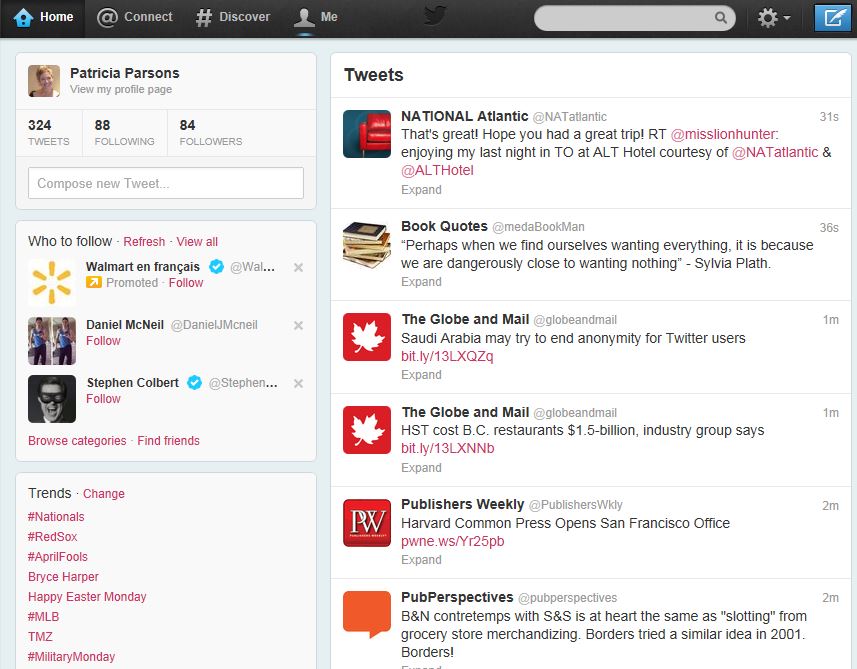
Sad little Twitter feed!

The truth is these days that publishers don’t seem to understand that one of their roles is to actually help the author to build an audience for a book they believe in.  Rather than taking a lead in the marketing arena, traditional publisher today will often not even touch a book if the writer doesn’t already have a’ platform.’ Of course the platform consists largely of a presence in cyberspace comprising (but not limited to) a Facebook page, a LinkedIn profile, a Twitter feed, a blog etc.  The strength of the platform is a function not only of this presence, but presumably some kind of engagement.  That means that you have thousands of Twitter followers who actually read and reply or retweet your messages.  You have thousands of Facebook fans or friends who post to your wall telling you how distraught they are that your new book won’t be out for another month or two.  You have thousands of blog followers who regularly post pithy comments to which you respond diligently, or who click ‘like’ and you go immediately to their blog and tell them that you’re happy they stopped by.

If you think about it, we could be spending twice as much time ‘engaging’ with people who might or might not buy and/or read our books than actually writing.

So, back to the hard data.  Where exactly is it?  I need evidence people!

Earlier this year Fauzia Burk, president of a digital publicity and marketing firm specializing in creating awareness for books and authors wrote a piece for the Huffington Post titled: Does Social Media Sell Books?.  Burk interviewed a best-selling author’s agent – an author who is not and has never been active on Facebook or any other piece of the platform.  Surely the agent would have some data.  Nope.

?????????????Here’s what this agent said, “…it’s critical that no matter how active an author is online, the conversation about them and/or their book must be picked up and carried on by others for it to truly have an impact on sales. It can’t be ONLY about the author talking (blogging/tweeting)…” and later, “…For nonfiction authors with a specific expertise, being out there in the community that has interest in that expertise will most likely be effective in selling their book.”[1]

Most likely be effective?  Most likely?  I’m shouting now.  This is not the data I’m looking for.  It’s something that seems like a good idea, but the return-on-investment (of time in this instance) just doesn’t seem to have legs.

I’ve moved my attention from Facebook which annoys me no end, to Twitter.  I only have so much time in the day.  And to tell you the truth, I’d rather be writing on my blogs or working on those two new books that I’ve plunged into than check out photos of someone’s cat hanging upside down from a Christmas tree.  But that’s just me.

Posted in Book publishers, Publishing, Self-Publishing

Self, main, hybrid, co-op: Publishing may be publishing but you have to follow the money

booksI’ve come to the conclusion that the single most important defining feature of each of the publishing models that I’ve personally tried, or that I’ve explored, comes down to one important question: Who is paying?

Way back when vanity publishing was that icky, underbelly of the publishing world (at least that’s how mainstream publishers and many I-wouldn’t-stoop-that-low self-described literary writers thought), the main defining feature of the genre, if you will, was the question of who pays.  And of course, as we all know, in vanity publishing the author pays.  So, if it is vain for a writer to pay for his or her work to be published, and self-publishing smacks of the same defining feature, they are one and the same – we’ve just sanitized our vocabulary for the sake of appearances.  And the truth is if you begin to protest that there is a difference: availability of editing blah blah blah, you’re really missing the point.

Good ideas, followed by good writing, followed by good editing, followed by good marketing is the formula for a really great piece of writing and getting it into the hands of readers who might appreciate it/learn from it/ be entertained by it.  There is no reason at all why this formula can’t work – and work well – regardless of who is paying.  It’s just publishing snobbery.  The problem of course remains that many indescribably bad books are published by mainstream/traditional publishing models where the manuscript is acquired by a publisher who pays for the publishing (there is no guarantee that the publisher knows a good book from a bad one, nor is there any guarantee that the editing will be done well); just as many unspeakably ghastly volumes are published by authors who are paying out of their own pockets.  The digital age with its consequent ease of publication is what has contributed to the sheer volume of bad books regardless of who is paying.  So, I got to thinking about this notion of following the money.

Last month The National Post’s Mark Medley published an article “Words from their sponsors: Can authors cash in on crowd-sourced funding sites?”[1]  In it he explores the vast new world of online crowd-sourcing for funds for a variety of projects zeroing in on writing.  I had been peripherally aware of the phenomenon – evidently even the saintly and storied Margaret Atwood has used crowd-sourced funds – but I had never really taken the time to look closely.  I think that if you are the funder, there may just be a lot of money to be made on the backs of people with hair-brained ideas who can persuade others to give them seed money.

In general, here’s how it works: you, the writer sign up for one of these funders online (indiegogo, for example), describe your project in a way that entices others to believe that it’s a project that should see the light of day, and wait for the money to flow in.  You then use the money to make it happen.  You can hire an editor (if you want), hire a book designer (if you want), hire a book publicist (if you want), and if you have enough money.  I suppose you could also offer the money to a traditional publisher to defray the cost of publication – but of course since that would be like marrying traditional publishers with the author-pays, vanity approach (there’s a word in academic publishing for that: co-publishing), you’ll probably get an icky I’d-never-touch-that-project kind of response – unless, of course, the project is fantastic and the publisher can see past the end of his or her metaphorical nose.  But there’s another kind of crowd-sourced funding publishing model that I found more fascinating.

I’m talking about the UK online funder Unbound.  Here’s how they work:

“… instead of waiting for [writers] to publish their work, Unbound allows you to listen to their ideas for what they’d like to write before they even start. If you like their idea, you can pledge to support it. If we hit the target number of supporters, the author can go ahead and start writing (if the target isn’t met you can either get your pledge refunded in full or switch your pledge to another Unbound project)…”[2]

When a selected project is funded, the writer then completes it and Unbound designs, edits and prints the book.  The funders get copies and even sometime lunch with the author.  So, the author doesn’t pay.  So it’s not vanity publishing and it’s not self-publishing.  It’s a new model.   In my view it’s an innovative idea that adds to the richness of the publishing approaches.  But does it make for better books?

In the end, I doubt very much that it is the publishing model that has much to do with the success of a book project.   It has more to do with a book that resonates with its readers that is somehow is able to connect with.   Just look at 50 Shades of Grey and its story.  When it comes to commercial success in book publishing, sometimes the writing is fantastic, and other times it’s epically flawed.

But it’s really the writer who is at the heart of it in any case.  If the author pays, what difference does it make?

Posted in Backstory, Writing

Mining the wisdom of the ‘crone’

Senior woman contemplatingCrone.  What an awful word.  And yet I’ve been thinking about her this week, and how I might tap into my own inner crone to see if she has any wisdom that might inform both my writing and my day job these days.

Some definitions of the word suggest that it refers to an old woman who is ugly, thin, withered, cranky.  Wikipedia’s entry on the crone says she’s “…disagreeable, malicious, or sinister…”—a  folkloric character.  But it also suggests that crones are magical, and that they are the archetypical wise woman.

Some years ago I spent a lot of time reading and listening to Clarissa Pinkola Estes (who famously wrote Women Who Run with Wolves) and her stories about the archetypal crone, or as she sees her, the wise old woman.  She conceptualized the three stages of a woman’s life as maiden, mother, crone, implying that if we live long enough, we’ll all enter that final stage.  The crone.  But Dr. Estes doesn’t see it as so bad.  In fact, listening to her tell stories about crones often made me look forward to the day when some of the following might be a part of my life.

  • Not caring what anyone else thinks about what I do…
  • …but tempering that lack of care with the wisdom to know when not to hurt others…
  • …coupled with the accumulated years of decisions, choices, and knowledge that when mixed together and applied judiciously result in wisdom.

And so, I’m thinking about how much wisdom I might have accumulated at this point in my life.  Do I have enough wisdom to be able to stand back and let my younger colleagues make their own mistakes, to let them take the view that older is not better, to let them believe that their considerable erudition is a match for wisdom?  Do I have enough wisdom to apply it to my writing?  Can I mine those choices, that knowledge (of myself and others), those decisions?

The website Crones Counsel says this about the crone:  “Crone women fly directly into the face of ageism and sexism. They refuse to be put down. They do not walk meekly on the road to old age. They are keen to assert their presence if not their influence.”[1]

I guess the part of this that I have had the most difficulty with in recent years is asserting presence without asserting influence.  I’m not sure what happened this week, but I seem to have had an epiphany.  I seem to no longer feel the need to influence external factors.  Perhaps that will serve me well in my interior life where my writing lives before it gets out onto the page /computer screen.

Crones Counsel also says: “…a Crone is an older woman who has learned to walk in her own truth, in her own way, having gained her strength by acknowledging the power and wisdom of the totality of her experience. She is “a wise old woman.”[2]

I’m going to do as they suggest and celebrate the place I am in my life.  It’s time to let go of a few things so that I can embrace my own truth.