Posted in Professional Associations

The Canadian Public Relations Society and its Canadian PR Idol Contest

About a month ago, I responded to a call for proposals for presentations/workshops/panels for the 2013 meeting of the Canadian Public Relations Society.  The title of my presentation is: Did you really say that? The truth about bulls**t and PR.  Here is what I submitted:
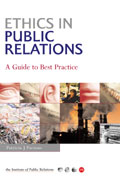
The first edition of my ethics book which is more popular in Europe than in North America.  Wonder why...
The first edition of my ethics book which is more popular in Europe than in North America. Wonder why…

When Prof. Harry Frankfurt, a Princeton philosophy professor published his essay “On Bullshit” in 1986, he started a discussion that could only be interpreted as a serious indictment of the ‘truthfulness’ or lack thereof of our field. This presentation will “inspire participants to challenge norms and live beyond the status quo” by understanding what constitutes BS and how PR messaging can avoid contributing to it. Together we will explore the definition of BS and examine instances of BS in PR & marketing campaigns in Canada. It is only through an ethical lens that we can begin to reframe the conversation.

I opened my email this evening to discover correspondence from one of the conference organizers.  Here is what it said, “Thank you for submitting a presentation abstract for the Canadian Public Relations Society’s conference Conversations 2013. Your submission has made it to the next round of review, where we will be asking for the communications community to vote on the sessions they are most interested in seeing at next year’s event. ..”

I read it again.  I shook my head, and the feeling of being professionally insulted started making its way up the back of my neck.  A professional organization is holding a popularity contest to determine what presentations ought to be on the conference agenda?  Well, what a creative idea.  Voting will begin on Friday.

Here is what I said to the conference organizers:

I can appreciate the desire to take a creative approach to planning a conference, however, I did not sign up to be part of “Canadian PR Idol.”  At this point in my career I have no desire to be part of a popularity contest.  My submission was genuine and submitted with integrity.  I had hoped that selections would be made in kind. 

Clearly transparency and its ethical underpinnings are not part of the CPRS conference mandate.  If this information was on the call for proposals, I seem to have missed it. It seems that my take on PR and BS was right on the money.

I thus withdraw my submission…”

Public relations as a field has been the butt of many a joke about its methods and its ethics for a very long time.  As I wrote in my 2009 book Ethics in Public Relations: A Guide to Best Practice (London: Kogan Page), “There is little doubt that, even today, public relations as an industry still suffers from a bad reputation. Consider journalism professor Stuart Ewen’s 1996 book PR! A Social History of Spin, where he describes what he calls a ‘foundational conceit’ in the field of public relations – conceit born of the notion that the public mind can and should be manipulated…”  Well it seems to me that having a popularity contest to select presentations at the annual conference smacks of this conceit because I can assure you that the popular offerings will not be about ethics.  What they’ll be about his year depends on the trend-du-jour.  Whenever I speak at CPRS about ethics, as I have on many occasions before, the same people are always in the room.  I am constantly preaching to the choir.

I thought that the professional association to which I have belonged for many years was supposed to set the highest standards of practice – I thought that the professional association was supposed to concern itself with what the members of its profession need to learn about – rather than what they want to learn about.  I thought that this professional association might take seriously its responsibility to evaluate proposals and accept the best of them (whether or not mine would be counted among those is immaterial: at least the process would have been professional, and I would have been convinced that some set of quality criteria were being applied to the selections rather than the results of popular vote).  I guess I thought wrong.

But make no mistake; most of the submitters will like this approach.  After all, who can argue with the popularity of the competition where the public gets a say in the results regardless of any measure of objective quality?

It’s clearly time for me to retire.  Time to stop talking about ethics, writing about ethics, teaching about ethics.  As far as I can see, it’s pretty much a lost cause.

[Apologies to my subscribers who tune in to read about my writing – this is only peripherally connected, but I had to get it off my chest.]

Posted in Plagiarism, Writing

Plagiarism—The scourge of the writer… Part 2: Self-Plagiarism

My foray into academia began when I was hired almost 25 years ago to teach a writing course to undergraduates in public relations & corporate communication in a 4-year degree program (at the university where I still teach).  The mantra that I taught – and that I continue to believe in – recycle your research.  You never know when you’ll be able to re-package material for a different audience, in a different genre, with a different purpose.  Is that self-plagiarism?  Well, let’s examine it.

After my first post on plagiarism, one of my former students posted on my Facebook page that she had been taught in university the perils of plagiarism, and now that she was out in the work world, she suggested that she was expected do so on a relatively regular basis.  I wondered whether or not she was really defining plagiarism accurately, or perhaps there was a different crime that needed consideration (the notion of making up quotes in media releases is a topic for another time).  Indeed, we consider it plagiarism at the university when a student recycles a paper from one course with a few changes into another.

Last month, a University of Toronto researcher made news when he was censured for self-plagiarizing passages of text from his previously published work.  The retraction notice published on the journal’s web site says the following about the paper:

One of the conditions of submission of a paper for publication is that authors declare explicitly that their work is original and has not appeared in a publication elsewhere. Re-use of any material should be appropriately cited and quoted. As such this article represents a severe abuse of the scientific publishing system.[1]

So the lesson here is that if you are going to use verbatim passages from previous work they should be appropriately attributed just as you would attribute material from sources that you did not produce yourself.  Whew!  I’m glad to have that out of the way.  From time to time I have referred to my previous work, but always with a citation.  I always thought I was just being egotistical.  Evidently I was being ethical.

So, once we have that approach to self-plagiarism out of the way – where it is clear that material is directly removed from one piece into another – is there, in fact, a grey area through which we must draw a black line?  Precisely when are we wading into the quagmire of moral turpitude?

Jonathan Bailey writing online in Plagiarism Today calls it ‘double-dipping’ and offers five scenarios where we might consider the concept of self-plagiarism and its ethics.  He offers the scenarios for consideration and asks the question of where to draw the boundaries.

One of the commenters on his site suggests that self-plagiarism is an oxymoron.  This is a perspective that needs consideration since by definition, plagiarism usually refers taking material or ideas that belong to someone else and passing them off as your own.  If it’s your own to begin with, then can it be plagiarism?

Well, strictly speaking, self-plagiarism is different from plagiarism by definition.  Self-plagiarism in practice means passing off your own previous work as if it were new and original to the situation.  So, if we accept this as the definition of self-plagiarism, then we have to accept that when new and original work is expected, it is not okay to use what you’ve written previously.  But in my mind that doesn’t preclude you from reusing your research.  And ethically, I believe that this is where that black line has to be drawn.

Reusing research that you’ve used before – even using your own writing as a reference – seems to be completely acceptable.  However, writing what is supposed to be – and is understood by your readers to be – an original piece (whether it’s for a magazine, a newspaper, a blog, an academic journal or a book) without referencing material that was actually written previously is in my view lying.  You are essentially passing it off as original when it clearly isn’t.  If someone is paying you for original work (payment might not be in money as in the case of academic writing – rather it is for recognition of a sort), then original work he or she should have.

But what about when you’re not being paid?  Like right now – I’m writing this but no one is paying me to do so.  Do you, as the reader care?  Do you expect it to be new and original?  If I write a post about self-plagiarism for someone else’s blog, the owner of that blog will tell me if he or she wants original work.  If I reuse something I’ve blogged before, I would be lying.  It would also be lying if I wrote it somewhere else before – like a magazine article – and passed it off as original material for the host blog.

It seems to me that the bottom line is to do what you say you’ll do:  if you say you’ll produce original material, then original it ought to be.  If the journal expects original material, then original material they ought to receive.  If you need to reuse some of your old writing, then cite it!

But of course, that’s just me!

Posted in Plagiarism, Writing

Plagiarism: The scourge of the writer, part 1

I’ve been thinking a lot about plagiarism lately as I make my way through another fall semester at the university – my excuse for neglecting my blog. My undergraduate ethics students have discussed it, as have my grad students (although I hope that since most of them are experienced public relations professionals they have a good handle on it — but I’ll get to that), and yet the topic keeps rearing its ugly head.  If I may — a couple of anecdotes…

A couple of years ago, just as IPads made their first appearance on campus, a new wrinkle was added to the increasingly complex topic of how to avoid plagiarism, given the plethora of new and juicy sources for information just begging to be ‘stolen.’  I was conducting that one task dreaded by every single university professor I know: I was marking.  I had just read one student’s submission, thinking that it had some unusual phrasing when I picked up the very next one on the pile.  I was then treated to precisely the same wording in at least two paragraphs of the next submission.  So, I did what all good university Profs do these days: I plugged the offending phrase into Google.  Then, as if by magic, its source appeared before my eyes on the screen.  No wonder it had looked familiar, it was from a document whose URL I had provided to students as a resource.

I emailed the offending students immediately, telling them that we needed to talk about this problem.  Within hours, one of them sent a sobbing email to me ensuring me that whatever happened had not been her fault, not intentional, not like her, blah, blah, blah. And then she cried in the office.  And I believed her insofar as it had not been her intention, it was not like her…but it had been her ‘fault.’  The other student had not yet contacted me at that point thinking that it was a trivial matter.

Here’s what had happened: The student with her shiny new IPad had taken notes during class that day.  She had been so taken with the subject, she immediately surfed over to the site during class and copied and pasted a bit into her notes.  Without referencing the source.  Then she lent her offending notes to her friend who had missed class (another lesson here, perhaps?).  In any event, they both used the material in their submissions thinking it was their own work.  Now, of course the second student was then doubly at fault since she used the other student’s notes verbatim without referencing it, adding insult to injury.

More recently, I marked a feature article a student had written when it occurred to me that not only had he referenced too few, weak sources, they were both on the internet and were both from the same online publication.  I surfed over to the site and found that much of the piece had been plagiarized (oh, it is so easy to copy and paste, isn’t it?).  I was then curious about the rest of the piece, so I again plugged a few sentences into Google and presto!  I came up with the sources — the same online publication, but this one he had hidden from me.  Busted.

When confronted, he freely, if not happily, admitted to doing it.  He had been busy; he knew it was wrong; he almost reconsidered, blah, blah, blah.  This instance particularly angered me because he had to have thought one of two things: Either he thought that he could get away with it (or he would not have done it and risked his complete degree), or he thought I was an idiot (which was probably the part that made me especially angry), both of which I shared with him.  In any case, he said that just before he clicked ‘send,’ he did have second thoughts.  But he did it anyway.

Both of these situations are slightly differently ethically, since in one situation there was no intention to deceive, whereas in the second, there was clear intention to pass off someone else’s work as his own.  Although I don’t believe these two are ethically equivalent, they are both academic offences.   The result was that there had to be consequences for both.  Those among us who plagiarize inadvertently might be ethically less treacherous than those who do it with intention to deceive, but it’s a practice that has to be curtailed – or they might end up with a copyright infringement charge at some point in their lives.

The first two nitwits lost a considerable number of marks, but there was no permanent scar on their academic record.  The second required a bit more thought and more than a passing glance at the university regulations on plagiarism and cheating.  I had to fill out forms and lodge a formal complaint against the student, including a recommendation for penalty.  I had the option of either giving him a failing grade with a notation of an academic offence on his permanent record, or asking that he be summarily dismissed from his degree program.  I took the former route, and he did not lose his place in the program.  This decision did not come without considerable thought and later reflection on whether I had done a good thing for the greater good or not.

This student was studying to be a public relations practitioner.  Should I have had him kicked out of our field?  Or at least the program: he could still have worked in the field if he could find someone to hire him.  Should people in public communication fields be held to a higher standard?  I sometimes think that we should.  Research indicates that those who will lie and cheat in their student days are more likely to lie and cheat in their professional careers.

So, I’m going to consider plagiarism I public communication fields the next time I get around to blogging – that’s after I finish marking the next batch of papers.  Wish me luck!