Sentences make up your paragraphs. Paragraphs make up stories and chapters. Chapters make up books. However, the most basic component of writing is your choice of words. Choosing the right word to convey the right meaning is an essential part of writing well. This is a topic we’ve covered before, but using the right form of a word is a stylistic writing issue that divides the pros who care about getting it right from the amateurs who don’t. Agents, editors, and readers all care about professionally written work, which shows that a writer cares about accuracy.
A few months ago, one of my regular viewers on my YouTube channel, WRITE. FIX. REPEAT. suggested that a video on compound words would be helpful, and that’s the topic of today’s video. What makes compound words especially tricky is that their forms often evolve with our language, requiring writers to keep up. Understanding the structure and usage of compound words helps ensure proper grammar and clarity.
Need a bit of guidance? A few examples? You’re welcome.
Why is writing correctly so important? It doesn’t matter whether you write ad copy, corporate blog posts or novels; it’s important because it provides us with a set of shared understandings of the meaning of words, phrases and sentences. And those are the building blocks of writing.
A proper grasp of grammar, punctuation, syntax (all the elements of style) makes you appear more professional and more knowledgeable. On another level, it’s important because poor grammar pegs you as an amateur in the eyes of editors, agents and, yes, readers.
Can you ever break the rules? But you do it consciously, for a reason, and only after you’ve learned what those rules are.
Some errors are broken so often that they drive editors (and many readers) crazy. I’ve identified five errors that editors (and agents and often readers) hate so much. Are you making any of these errors?
Can you figure out the correct answer? For answers and explanations, the video is live.
I versus Me
Which one of these is correct?
The coach asked Jim and I to stay late.
The coach asked Jim and me to stay late.
Dangling Modifiers
Which of these is correct?
*After declining for three months, book sales began to revive after Susan’s new marketing approach.
*After declining for three months, Susan’s marketing approach started to revive book sales.
That versus Who
Which of these is correct?
*She’s a woman who knows what she wants.
* She’s a woman that knows what she wants.
Parallelism
Which of these is correct?
*We went skiing in the mountains, swam in the ocean, and drove in the desert.
* We went skiing in the mountains, swimming in the ocean, and driving in the desert.
That versus Which
Which of these is correct?
*The sweater that has a moth hole is in the drawer.
*The sweater, which has a moth hole, is in the drawer.
You know it when you see it, but if someone were to ask you what makes a piece of writing great, what would you say? And not just in a single genre. In general, across all genres, what are the characteristics of great writing? Perhaps even more important to those of us who write is this question: How can I use an understanding of these characteristics to improve my own writing?
The question of great writing is often considered to be subjective. Many readers will suggest that it depends on the style. No, it really doesn’t. And just because you like a piece of writing, doesn’t mean it’s great. The reverse is also true. Just because you don’t particularly care for a piece of writing doesn’t make it bad writing. (I am really not a fan of Ernest Hemingway at all, for example, but I have to concede that the writing itself is pretty good!) The more I’ve thought about it and read what others more erudite than I am on the subject have to say about it, though, I can identify five features that are the hallmarks of truly great writing. And it occurs to me that if all of us who write focus our efforts on improving these aspects of our writing – regardless of whether we write medical nonfiction, romance, dystopian fantasy or anything in between – our writing is sure to improve.
Studying the characteristics of great writing can help you to become a great writer – or at least, a better one.
So here are my “Five C’s of Great Writing” …
Clear: Great writing is clear. Clear writing means that there is no misunderstanding between writer and reader. Some might say that it means the writing is “easy” to understand, but I think that’s too simplistic. Sometimes the writing is above someone’s reading level. That is hardly the fault of the writer. On the other hand, if the writer considers who might read a particular piece of writing, then readability is a component of clear writing. For example, way back at the beginning of my own writing career, I was a medical writer. Some of what I wrote was for health professionals (such as textbooks), other writing was for the lay public (such as women’s magazines). I might focus on the same content area, but my writing necessarily has to be at different levels if my audience is going to understand. This is a lesson I learned a long time ago!
Concrete: The use of concrete language in writing follows from (and could, arguably, be a part of) clear writing. This doesn’t mean that you can’t present abstractions, it only suggests that the words you choose and the style you employ to string them together, need to be precise and specific. Sometimes, new writers overdo the admonition to provide details. How many times have you read a piece by a newbie writer that describes a glass of wine as “ruby red cabernet sauvignon from the XYZ winery with the gold label”? Someone who teaches romance writing must have hammered this into the heads of romance writers because this kind of excessive verbiage is all over the place. Precision doesn’t mean that the reader needs every detail. Keep your research in the background! The bottom line is writing that isn’t concrete is overly vague and ambiguous when it should be precise and specific. It is this precision that begins to set your writing apart from the writing of others.
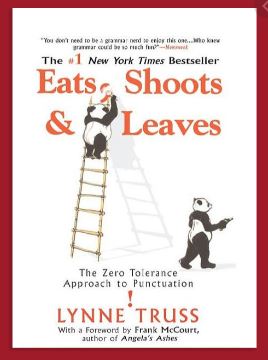
Correct: This is a big one these days. Since the advent of self-publishing, there seems to be an odious and increasing sentiment that writing correctly is unimportant. If you read a passage that is riddled with grammatical errors, typos, stylistic problems – this is assuredly not great writing, no matter how good the story idea is. Correct writing is tied to the number one “C” above: clear writing. Even something as simple as punctuation makes a huge different in the clarity of writing. Who doesn’t remember Lynne Truss’s terrific book, Eats, Shoots & Leaves? Or perhaps she could have said, “Eats shoots & leaves,” Or even “Eats shoots, & leaves.” Different punctuation, different meaning. My own personal downfall in the punctuation arena is my lack of commas. No breathing space! I’m working on it. Great writing is correct.
Creative: This seems to be a no-brainer. Great writing presents innovative ideas. It is often said that there are no new ideas. That’s nonsense. You better hope there are. Ask a scientist. If they had no new ideas, so many things in our lives would be very different. So, why would a creative individual like a writer accept that there are no new ideas? There are. And there are new ways of telling old stories. The uniqueness of the story and/or the voice in a book is a very important part of what makes it great.
Compelling: Great writing affects the reader. It makes the reader think, or laugh, or cry, or get so angry he or she tosses the book across the room. One of the things I’ve noticed as my own fiction writing has improved (at least I hope it has improved – just saying!), is that it seems to be more evocative. Recently, I’ve had readers say that they laughed and even cried a bit when they read my most recent novel. When they send me a note and say it “resonated” with them, that’s so much better, in my view, than simply saying they enjoyed it. I want to know how it affected them. That makes me feel terrific. But, and here’s the most important part from your perspective as a writer – if your own writing moves you to tears when you’re writing it, you will compel the reader to do so. If you don’t cry a little (or laugh, or get a bit angry) while you are writing, your readers won’t, either. It isn’t compelling enough.
Okay. I’ve said my piece. Now I have to get back to the new manuscript. But I’m going to think about these aspects of great writing, not necessarily as I write, but certainly as I edit. I’m not quite there on the new one, though! Happy writing.
BTW, if you haven’t read Lynne Truss’s book, maybe now’s the time!


 Patricia J. Parsons