Posted in Journals, Writing, Writing craft

A tale of two modes: Paper versus digital

My beloved notebook and my even more beloved computer!

The irony was not lost on me.  As I downloaded Natalie Goldberg’s new book The True Secret of Writing: Connecting Life with Language I knew I was treading on sacred ground: you see (if you are not familiar with Natalie Goldberg, which you should be if you think you’re a writer) Natalie’s writing philosophy is deeply underpinned by the notion of the writing flowing from the heart, through the arm and out the pen as you move your hand across the paper.  Although she acknowledges the utility of the computer, and no doubt uses it herself, the paper clearly has the upper hand in the paper versus digital divide for writing practice.

Last week I changed offices again at the university.  Yes, my time chained to my desk toiling away at chairman-type duties has finally come to an end.  Few people understand the concept of peer governance in university departments: that’s when we all take a turn at being “in charge” and spend a year or two or three with all the responsibility and no authority.  I have done my duty now three times – one for a full three-year term and twice to fill in for year-long sabbaticals for others – and now return to doing what I do best and prefer.  That would be teaching and writing.  However, changing offices is not without its substantial benefits.

true secret of writing natalie goldbergThe requirement to take files out of cabinets and books off shelves gives one a moment to pause and consider whether or not one actually needs all that paper.  And that question refers equally to one’s creation as much as to one’s consumption.

First I’m thinking about my consumption – of books, documents, pamphlets (does anyone actually produce these things today?), newspaper clippings, print-outs of academic articles, notes, and the list goes on.  It’s only recently that I succumbed to the eBook mania and began downloading books on my IPad.  What I’ve discovered is that I actually read faster on the IPad – although I still love that feel of a real book in my hands.  Now, though, I can have a whole library in the space of one IPad.  Who can argue with that notion?

So, I’ve taken the view that anything on paper that needs to be kept should be digitalized and saved on a hard drive.  I’ve been doing this both at work and at home.  As I move ever closer to early retirement, and my husband and I move ever closer to right-sizing our living accommodation, we have purged all manner of paper – photos being the number one culprit.  Even all those old photos of our ancestors just after the advent of the widespread use of photography from the early 20th century.  Yup, all scanned and digitalized, and the paper products recycled.  It’s such a feeling of a burden of paper being lifted off our shoulders.  So those are some consumption thoughts.  What about creation?

I create a lot of paper.  All I have to do is open the bottom file drawer in my desk to see that I do love to keep paper copies of my writing.  I write on a computer and I print out everything.  And I do love my writing journals.  I won’t go on about them now – since I’ve done that before – but it does bear repeating that there is nothing quite like a new journal and a pen that glides smoothly over the pages.  If you can get that just right, you can be in writing heaven.  But my hand gets a cramp these days.

Does this mean that I’m confined to the computer forever?  As I’ve begun to read Natalie Goldberg’s book (on my IPad), I begin to get excited again about the possibilities of those ideas truly flowing from head to heart to hand in just that physical way.  I actually dug out one of my hard-backed journals and did some writing practice.  The ideas did flow – but the unfortunate result was a severe hand cramp.  So, I’m back at the computer this morning as I embark on two months of writing.

There was a tie when I’d do a ten-minute timed writing as Natalie suggests every morning before I stared what I considered to be my real writing.  To me that’s a bit like sitting meditation before beginning work: something I should do but often neglect.  Like my return to my daily meditation, perhaps writing practice on paper is something I should get back to.  My only question that still remains though is what to do with all that paper!

I have a list of half- and quarter-completed writing projects, and one that isn’t started but has to be finished by August 1 (only 1500 words for that one, so no problem).  So, pe or keyboard, I better get at it.

What are your thoughts on pen and paper for writing practice?

Posted in Backstory, Book covers, Publishing, Self-Publishing

Finding a home for the next book: Traditional or self-publishing is the question

Film StripI received an email yesterday from my editor at the University of Toronto Press with the news that we’re now embarking on the cover design for my new book.  Although this is good news (I had been wondering where we were in the process after I sent him the final edits back in January before I went on vacation, it got me thinking yet again about the traditional book publishing process .

This marks the ninth time (ten if you count a second edition) that I’ve been through this traditional publishing process where control is largely given over to the publisher.  The truth is that I’ve been more or less happy with the outcomes as I look at them winking at me from the top shelf above me; the process, however, has not been without considerable frustration.  I’ve also gone the self-publishing route three times now, and I’m kind of at a crossroads.  I have a new book ready to make the rounds – and have queried a couple of agents already – but I’m still wondering if I should do it myself.

This reflection on my publishing adventures resulted this time from my editor’s simple statement in his email: “…Time and budgetary restraints being what they are, we’re unable to ask our designers to come up with a cover completely from scratch. Rather, it falls to you (and to me)…” and then we’re to send this to the so-called designers.  It seems to me that a designer should be doing the designing, and if he or she isn’t doing the designing, what in the world is he or she being paid to do?

This might seem to you to be the moment in time when I make that decision to move to self-publishing for that next book, but I’m also reeling from yet another telephone call from iUniverse – an attempt to sell me yet more services thinly disguised as a wonderful opportunity for me.

Here’s what happened earlier this week.

At dinner time one evening (they are always at dinner time when I’m feeling just ready to punch the next telemarketer who calls despite being on the do-not-call list) the phone rang.  The caller was a “marketing specialist” or consultant or manager or some such thing; iUniverse seems to either have an enormous staff or massive turnover since this is the third or fourth such person to whom I have evidently been assigned.  Several incarnations ago I asked them not to call me with marketing ideas ever again.

Grace Note Cover PaperbackIf you’ve read my blog for a while, you know that my avocation is writing historical fiction – I do love that research and the need to shed everyday life to get into the head of characters from long-ago times and places.  Grace Note: In Hildegard’s Shadow was published by iUniverse a couple of years ago now.  It was selected as an Editor’s Choice book (meaning that since I’d paid to have it professionally edited and I didn’t sound like a moron it would get this stamp), and thereafter chosen as a “Rising Star” (not sure how high up the scale of non-moronic a book has to be to receive this elevation).   All of the editing etc. that was done made the book more polished and professional to be sure, but it did not come cheap.  And make no mistake, every time anyone called after that to extol the virtues of my book, they were indeed trying to sell me services.  This time it was that it is so good that it should be a movie.  Would you be interested in having it shown to Thruline Entertainment?

I told him to send me an email and hung up (I was more polite than that, but that’s the edited version of the story).

The email arrived in due course (read; immediately).  Here’s what he said in part:

I called in earlier today to inform you that your book, “Grace Note” can be adapted into a motion picture.

Hollywood Coverage: Your book has all the elements Hollywood wants — an exciting plot, well-developed characters and fresh content — yet there’s still a crucial piece you need in order to be taken seriously by established entertainment executives.

We would like to know if you’d be interested to have your books presented to our newly acquired partner, THRULINE Entertainment. THRULINE is a Hollywood production company and they are basically looking for good books to adapt into a movie.

The contract has just been sealed last August and basically we want to impress our new partner. We don’t want to provide them with a “just-an-ordinary” material. We are putting our best foot forward because we want to prolong this contract.

If you’re interested, your book just needs a Script coverage in order for us to present this to production companies and producers. That is the basic tool that they would look for instead of reading the whole book.

He then went on to tell me that the two-part script coverage would be done by a professional who has done this before etc.  What he did not tell me was the price or any reference to the fact that he wants to sell me a service, but I knew that this was precisely what was happening.  And indeed research on Thruline uncovers a company with self-described ties to the Hollywood machine that works with self-publishing companies to part authors from their money.  Well, they didn’t’ say it that way but I can read between the lines!

Of course, if your book is really adaptable as a movie, you can send it to an agent who does this kind of thing.  Options on books can and are taken from the book itself.  And doesn’t it make sense that someone who is actually interested in adapting your book might actually have to read the book?  Yes, script “coverages” are done, but really?  I actually had an earlier book optioned and learned that the vast majority of optioned books never even make it to treatment phase.

The iUniverse price for this script coverage is $859.00.

This is what I said in my response to the email:

Thanks for this.  Don‘t bother telephoning me.  I’m not paying upwards of $900 for any more service from iUniverse.  If you think the book is good enough to be sold to “Hollywood” then I think you should be willing to put up the money for a percentage on the back end.  Otherwise, we have nothing to talk about.  I’m an accomplished writer – I can do this myself.

I think it’s time iUniverse took a different tack when it comes to ‘services’ for writers.

But call he did.  This time I didn’t answer. So where does this story lead me?  Well, this morning as I checked my Twitter feed I came across a link to a blog post titled “Publishing 101 – Money” on The Passive Voice blog whose author considers whether or not the price of self-publishing is worth it.  She and I agree that it is, but it does seem to me that there is a limit to what one should reasonably spend.

Self-publishing requires an author to be a writer, editor, interior book designer, cover designer, marketer and promoter.  So is this so different from traditional publishing these days?

When an editor at a traditional publishing house tells me that he is “unable to ask [their] designers to come up with a cover completely from scratch…” it seems that the two publish models are getting closer together.

So, am I any closer to a decision about my next book’s home?  Not really.

Posted in Backstory, Book promotion

Do I really need a Facebook presence? Or does any author, for that matter…

Let me begin by telling you what I did last month.  I removed everyone from my Facebook ‘friends’ list except close family.  “Why in the world would a writer do such a thing?” you ask.   And it is no small thing to rid oneself of ‘friends.’  It takes time, so you really do need to be committed to the task and why you’re doing it.

I’m sick of Facebook.  Every time I open my news feed, there among the interesting updates from pages that I’ve liked is the constant stream of narcissistic stream of consciousness from my so-called friends.  And I’d bet my next (day job) pay check that not one of those people gives a rat’s a## about what I’m doing, either.  But it’s not just that.  I often have to bite my cyber-tongue when I see posts.

Sad little Facebook fan page...
Sad little Facebook fan page…

Here are some of the things that I wanted to write but didn’t over the past few months:

  • “Get over it.”  I cannot tell you how many times as a response to so many different status updates that I wanted to say this to someone.
  • “If you post one more ultra-left-wing piece of propaganda, I’ll tell the world what I really think of your politics.”  Ooh, this one could really get me into cyber-trouble.
  • “I don’t actually care what you’re making for dinner tonight.”  Need I say more?

So, you’ve probably come to the conclusion that I’m not really that interested in my ‘friends.’  If so, you’d be right, because a Facebook friend is not a friend.  A friend doesn’t need to keep in touch on Facebook with public posts of anything and everything.  But if I’ve sabotaged my Facebook presence, am I not endangering potential book sales?  Isn’t this the fear of writers who are on Facebook?

I’m a ‘fan’ of a number of writers and their fan pages on Facebook.  It appears to me that the only writers on Facebook who have a real and compelling presence are those who had a name before they put up their Facebook pages.  In other words, if you’re already a best-selling writer and you put up a fan page on FB, your fans will, indeed, flock to you.  However, if you are an unknown writer (as are the majority of writers on Facebook), Facebook is probably a great time suck.

I’ve been trying to find some hard data on the extent to which Facebook really helps writers build their ‘brand’ and sell books to those readers who might actually enjoy/need them.  Despite the fact that everyone and his or her dog seems to be writing about the need to build your ‘platform,’ these exhortations are long on rhetoric and short on hard data.

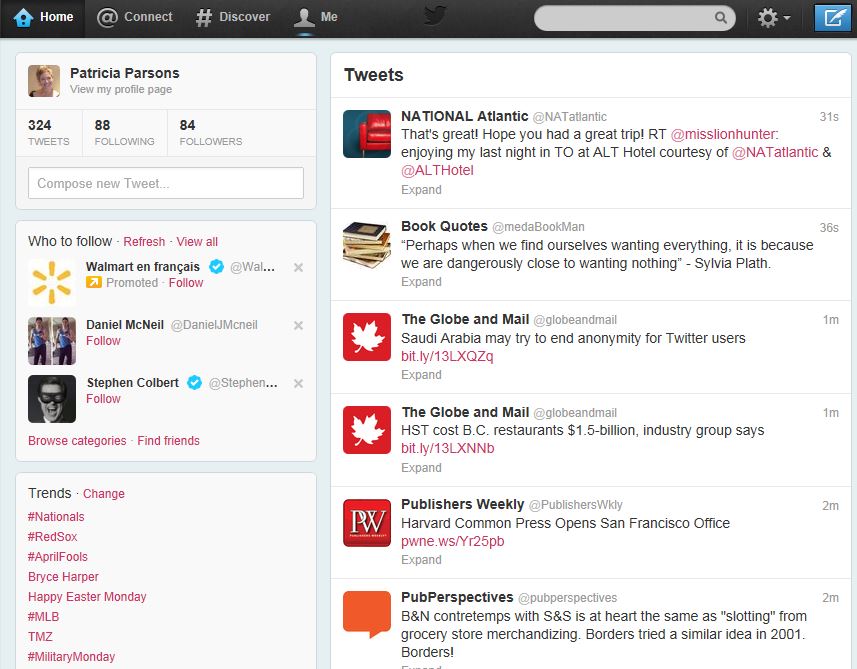
Sad little Twitter feed!

The truth is these days that publishers don’t seem to understand that one of their roles is to actually help the author to build an audience for a book they believe in.  Rather than taking a lead in the marketing arena, traditional publisher today will often not even touch a book if the writer doesn’t already have a’ platform.’ Of course the platform consists largely of a presence in cyberspace comprising (but not limited to) a Facebook page, a LinkedIn profile, a Twitter feed, a blog etc.  The strength of the platform is a function not only of this presence, but presumably some kind of engagement.  That means that you have thousands of Twitter followers who actually read and reply or retweet your messages.  You have thousands of Facebook fans or friends who post to your wall telling you how distraught they are that your new book won’t be out for another month or two.  You have thousands of blog followers who regularly post pithy comments to which you respond diligently, or who click ‘like’ and you go immediately to their blog and tell them that you’re happy they stopped by.

If you think about it, we could be spending twice as much time ‘engaging’ with people who might or might not buy and/or read our books than actually writing.

So, back to the hard data.  Where exactly is it?  I need evidence people!

Earlier this year Fauzia Burk, president of a digital publicity and marketing firm specializing in creating awareness for books and authors wrote a piece for the Huffington Post titled: Does Social Media Sell Books?.  Burk interviewed a best-selling author’s agent – an author who is not and has never been active on Facebook or any other piece of the platform.  Surely the agent would have some data.  Nope.

?????????????Here’s what this agent said, “…it’s critical that no matter how active an author is online, the conversation about them and/or their book must be picked up and carried on by others for it to truly have an impact on sales. It can’t be ONLY about the author talking (blogging/tweeting)…” and later, “…For nonfiction authors with a specific expertise, being out there in the community that has interest in that expertise will most likely be effective in selling their book.”[1]

Most likely be effective?  Most likely?  I’m shouting now.  This is not the data I’m looking for.  It’s something that seems like a good idea, but the return-on-investment (of time in this instance) just doesn’t seem to have legs.

I’ve moved my attention from Facebook which annoys me no end, to Twitter.  I only have so much time in the day.  And to tell you the truth, I’d rather be writing on my blogs or working on those two new books that I’ve plunged into than check out photos of someone’s cat hanging upside down from a Christmas tree.  But that’s just me.