Posted in Backstory, Book promotion

Do I really need a Facebook presence? Or does any author, for that matter…

Let me begin by telling you what I did last month.  I removed everyone from my Facebook ‘friends’ list except close family.  “Why in the world would a writer do such a thing?” you ask.   And it is no small thing to rid oneself of ‘friends.’  It takes time, so you really do need to be committed to the task and why you’re doing it.

I’m sick of Facebook.  Every time I open my news feed, there among the interesting updates from pages that I’ve liked is the constant stream of narcissistic stream of consciousness from my so-called friends.  And I’d bet my next (day job) pay check that not one of those people gives a rat’s a## about what I’m doing, either.  But it’s not just that.  I often have to bite my cyber-tongue when I see posts.

Sad little Facebook fan page...
Sad little Facebook fan page…

Here are some of the things that I wanted to write but didn’t over the past few months:

  • “Get over it.”  I cannot tell you how many times as a response to so many different status updates that I wanted to say this to someone.
  • “If you post one more ultra-left-wing piece of propaganda, I’ll tell the world what I really think of your politics.”  Ooh, this one could really get me into cyber-trouble.
  • “I don’t actually care what you’re making for dinner tonight.”  Need I say more?

So, you’ve probably come to the conclusion that I’m not really that interested in my ‘friends.’  If so, you’d be right, because a Facebook friend is not a friend.  A friend doesn’t need to keep in touch on Facebook with public posts of anything and everything.  But if I’ve sabotaged my Facebook presence, am I not endangering potential book sales?  Isn’t this the fear of writers who are on Facebook?

I’m a ‘fan’ of a number of writers and their fan pages on Facebook.  It appears to me that the only writers on Facebook who have a real and compelling presence are those who had a name before they put up their Facebook pages.  In other words, if you’re already a best-selling writer and you put up a fan page on FB, your fans will, indeed, flock to you.  However, if you are an unknown writer (as are the majority of writers on Facebook), Facebook is probably a great time suck.

I’ve been trying to find some hard data on the extent to which Facebook really helps writers build their ‘brand’ and sell books to those readers who might actually enjoy/need them.  Despite the fact that everyone and his or her dog seems to be writing about the need to build your ‘platform,’ these exhortations are long on rhetoric and short on hard data.
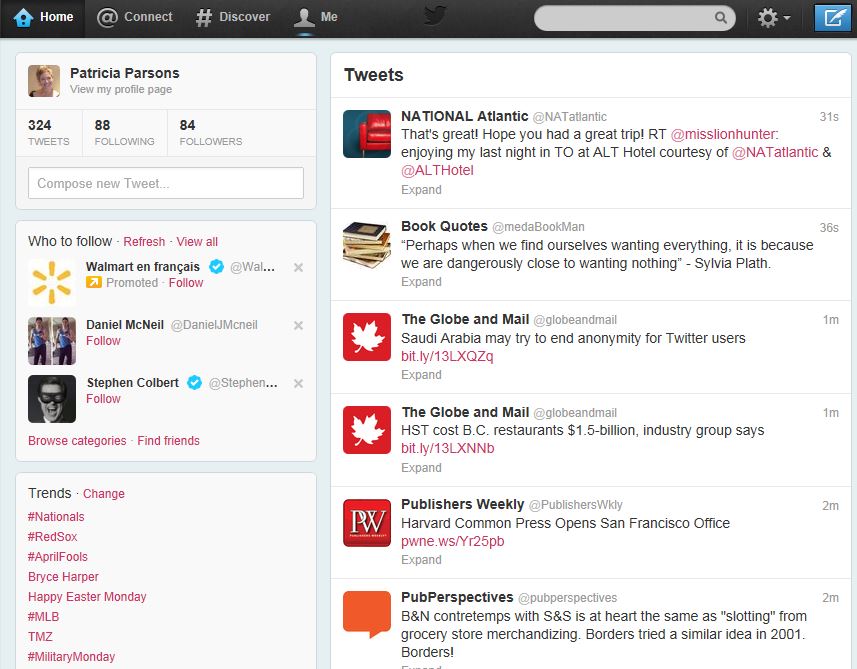
Sad little Twitter feed!

The truth is these days that publishers don’t seem to understand that one of their roles is to actually help the author to build an audience for a book they believe in.  Rather than taking a lead in the marketing arena, traditional publisher today will often not even touch a book if the writer doesn’t already have a’ platform.’ Of course the platform consists largely of a presence in cyberspace comprising (but not limited to) a Facebook page, a LinkedIn profile, a Twitter feed, a blog etc.  The strength of the platform is a function not only of this presence, but presumably some kind of engagement.  That means that you have thousands of Twitter followers who actually read and reply or retweet your messages.  You have thousands of Facebook fans or friends who post to your wall telling you how distraught they are that your new book won’t be out for another month or two.  You have thousands of blog followers who regularly post pithy comments to which you respond diligently, or who click ‘like’ and you go immediately to their blog and tell them that you’re happy they stopped by.

If you think about it, we could be spending twice as much time ‘engaging’ with people who might or might not buy and/or read our books than actually writing.

So, back to the hard data.  Where exactly is it?  I need evidence people!

Earlier this year Fauzia Burk, president of a digital publicity and marketing firm specializing in creating awareness for books and authors wrote a piece for the Huffington Post titled: Does Social Media Sell Books?.  Burk interviewed a best-selling author’s agent – an author who is not and has never been active on Facebook or any other piece of the platform.  Surely the agent would have some data.  Nope.

?????????????Here’s what this agent said, “…it’s critical that no matter how active an author is online, the conversation about them and/or their book must be picked up and carried on by others for it to truly have an impact on sales. It can’t be ONLY about the author talking (blogging/tweeting)…” and later, “…For nonfiction authors with a specific expertise, being out there in the community that has interest in that expertise will most likely be effective in selling their book.”[1]

Most likely be effective?  Most likely?  I’m shouting now.  This is not the data I’m looking for.  It’s something that seems like a good idea, but the return-on-investment (of time in this instance) just doesn’t seem to have legs.

I’ve moved my attention from Facebook which annoys me no end, to Twitter.  I only have so much time in the day.  And to tell you the truth, I’d rather be writing on my blogs or working on those two new books that I’ve plunged into than check out photos of someone’s cat hanging upside down from a Christmas tree.  But that’s just me.

Posted in Backstory, Writing

Mining the wisdom of the ‘crone’

Senior woman contemplatingCrone.  What an awful word.  And yet I’ve been thinking about her this week, and how I might tap into my own inner crone to see if she has any wisdom that might inform both my writing and my day job these days.

Some definitions of the word suggest that it refers to an old woman who is ugly, thin, withered, cranky.  Wikipedia’s entry on the crone says she’s “…disagreeable, malicious, or sinister…”—a  folkloric character.  But it also suggests that crones are magical, and that they are the archetypical wise woman.

Some years ago I spent a lot of time reading and listening to Clarissa Pinkola Estes (who famously wrote Women Who Run with Wolves) and her stories about the archetypal crone, or as she sees her, the wise old woman.  She conceptualized the three stages of a woman’s life as maiden, mother, crone, implying that if we live long enough, we’ll all enter that final stage.  The crone.  But Dr. Estes doesn’t see it as so bad.  In fact, listening to her tell stories about crones often made me look forward to the day when some of the following might be a part of my life.

  • Not caring what anyone else thinks about what I do…
  • …but tempering that lack of care with the wisdom to know when not to hurt others…
  • …coupled with the accumulated years of decisions, choices, and knowledge that when mixed together and applied judiciously result in wisdom.

And so, I’m thinking about how much wisdom I might have accumulated at this point in my life.  Do I have enough wisdom to be able to stand back and let my younger colleagues make their own mistakes, to let them take the view that older is not better, to let them believe that their considerable erudition is a match for wisdom?  Do I have enough wisdom to apply it to my writing?  Can I mine those choices, that knowledge (of myself and others), those decisions?

The website Crones Counsel says this about the crone:  “Crone women fly directly into the face of ageism and sexism. They refuse to be put down. They do not walk meekly on the road to old age. They are keen to assert their presence if not their influence.”[1]

I guess the part of this that I have had the most difficulty with in recent years is asserting presence without asserting influence.  I’m not sure what happened this week, but I seem to have had an epiphany.  I seem to no longer feel the need to influence external factors.  Perhaps that will serve me well in my interior life where my writing lives before it gets out onto the page /computer screen.

Crones Counsel also says: “…a Crone is an older woman who has learned to walk in her own truth, in her own way, having gained her strength by acknowledging the power and wisdom of the totality of her experience. She is “a wise old woman.”[2]

I’m going to do as they suggest and celebrate the place I am in my life.  It’s time to let go of a few things so that I can embrace my own truth.

Posted in Plagiarism, Writing

Plagiarism—The scourge of the writer… Part 2: Self-Plagiarism

My foray into academia began when I was hired almost 25 years ago to teach a writing course to undergraduates in public relations & corporate communication in a 4-year degree program (at the university where I still teach).  The mantra that I taught – and that I continue to believe in – recycle your research.  You never know when you’ll be able to re-package material for a different audience, in a different genre, with a different purpose.  Is that self-plagiarism?  Well, let’s examine it.

After my first post on plagiarism, one of my former students posted on my Facebook page that she had been taught in university the perils of plagiarism, and now that she was out in the work world, she suggested that she was expected do so on a relatively regular basis.  I wondered whether or not she was really defining plagiarism accurately, or perhaps there was a different crime that needed consideration (the notion of making up quotes in media releases is a topic for another time).  Indeed, we consider it plagiarism at the university when a student recycles a paper from one course with a few changes into another.

Last month, a University of Toronto researcher made news when he was censured for self-plagiarizing passages of text from his previously published work.  The retraction notice published on the journal’s web site says the following about the paper:

One of the conditions of submission of a paper for publication is that authors declare explicitly that their work is original and has not appeared in a publication elsewhere. Re-use of any material should be appropriately cited and quoted. As such this article represents a severe abuse of the scientific publishing system.[1]

So the lesson here is that if you are going to use verbatim passages from previous work they should be appropriately attributed just as you would attribute material from sources that you did not produce yourself.  Whew!  I’m glad to have that out of the way.  From time to time I have referred to my previous work, but always with a citation.  I always thought I was just being egotistical.  Evidently I was being ethical.

So, once we have that approach to self-plagiarism out of the way – where it is clear that material is directly removed from one piece into another – is there, in fact, a grey area through which we must draw a black line?  Precisely when are we wading into the quagmire of moral turpitude?

Jonathan Bailey writing online in Plagiarism Today calls it ‘double-dipping’ and offers five scenarios where we might consider the concept of self-plagiarism and its ethics.  He offers the scenarios for consideration and asks the question of where to draw the boundaries.

One of the commenters on his site suggests that self-plagiarism is an oxymoron.  This is a perspective that needs consideration since by definition, plagiarism usually refers taking material or ideas that belong to someone else and passing them off as your own.  If it’s your own to begin with, then can it be plagiarism?

Well, strictly speaking, self-plagiarism is different from plagiarism by definition.  Self-plagiarism in practice means passing off your own previous work as if it were new and original to the situation.  So, if we accept this as the definition of self-plagiarism, then we have to accept that when new and original work is expected, it is not okay to use what you’ve written previously.  But in my mind that doesn’t preclude you from reusing your research.  And ethically, I believe that this is where that black line has to be drawn.

Reusing research that you’ve used before – even using your own writing as a reference – seems to be completely acceptable.  However, writing what is supposed to be – and is understood by your readers to be – an original piece (whether it’s for a magazine, a newspaper, a blog, an academic journal or a book) without referencing material that was actually written previously is in my view lying.  You are essentially passing it off as original when it clearly isn’t.  If someone is paying you for original work (payment might not be in money as in the case of academic writing – rather it is for recognition of a sort), then original work he or she should have.

But what about when you’re not being paid?  Like right now – I’m writing this but no one is paying me to do so.  Do you, as the reader care?  Do you expect it to be new and original?  If I write a post about self-plagiarism for someone else’s blog, the owner of that blog will tell me if he or she wants original work.  If I reuse something I’ve blogged before, I would be lying.  It would also be lying if I wrote it somewhere else before – like a magazine article – and passed it off as original material for the host blog.

It seems to me that the bottom line is to do what you say you’ll do:  if you say you’ll produce original material, then original it ought to be.  If the journal expects original material, then original material they ought to receive.  If you need to reuse some of your old writing, then cite it!

But of course, that’s just me!