Everyone has an opinion about movie trailers. If the trailer is foisted on you without your consent at the beginning of a movie in a theater, and it’s a genre you hate, you probably don’t hold a high opinion of trailers. On the other hand, if you actively seek out movie trailers on sites like YouTube, you’re a fan. And then don’t get me started about movie trailers that show you the only interesting/funny/scary parts of a movie you hope will be interesting/funny/scary only to find out (after paying to see the movie) that those were the only interesting/funny/scary bits in the entire film!
With all of that in mind, I’m fairly certain that you are not quite as familiar with book trailers since they are a relatively new phenomenon. As you might have figured out, a book trailer is a short video clip that presents a small sample of a book in a similar format to that of a movie. As a reader, when I first heard about book trailers I thought that the concept was odd. After all, isn’t part of the attraction of reading its ability to trigger readers’ own internal imaginative processes to create their own internal visual interpretations of characters, places and environment? At least that’s how it works in fiction – non-fiction is another story.
A book trailer, then, although intended to entice us to read the book, seems to give the imaginative reader too much outside opinion of the visuals that a writer wants a reader to develop for him or herself. However, in my view, that depends on the visuals presented and on whether or not there is narration or only titles. In my mind, titles are more genuinely connected to a book (after all, we read a book, we don’t watch a book – that would be a movie. Sometimes we listen to an audio book, but then we still create our own images).
This leads me into my backstory for this week.
My new book, Grace Note, (Grace NoteUS version) whose full backstory is interesting, is just out and the book trailer, a seemingly de rigeur part of book marketing in the cyber age, is now live.
Next week we’ll talk about the effectiveness (or lack thereof) of book trailers to entice readers to buy and read books.
It’s September again. That usually means some new school supplies and back to the classroom for a hard-working university prof. But not this year. This semester I’m on sabbatical. It’s funny how people respond when you tell them you’re on sabbatical. Usually they say something like: “Gee, must be nice.” (With just that slight edge of sarcasm.) Or they say, “You university people have all the perks.” Well, let’s just say that there are few people who would not like to be in my shoes right now regardless of how much they like their jobs. So, what’s a sabbatical for anyway?
Naturally, the web is full of definitions. Let’s start with the etymology of the word (where the English word has its source).
The word itself derives from and is related to a bunch of words in other languages. The Latin sabbaticus, the Greek sabbaitkos, and even the Hebrew Shabbat, all have similar meanings. They refer to a hiatus from work. This is interesting to a university professor, I’m sure, since a sabbatical does mean a break from one’s regular teaching and administrative responsibilities, but the requirement to produce work related to the other components of a prof’s contract is even higher. That part, of course, is the research and writing part. A university professor on sabbatical is supposed to be researching and writing. The idea, though, that one can be freed up from other daily responsibilities to focus more fully on the kind of work that really is done better with single-minded focus from time to time, is a forward-thinking one. Everyone should have a sabbatical once in a while. But not to lie around slothfully and vegetate, in my view. So, what kind of productive work can a writer produce when she is on sabbatical from other work?
Believe it or not, there is a web site called YourSabbatical.com that provides services for employers and employees regarding sabbaticals. Who knew? According to their web site they partner “…with businesses to implement customized sabbatical programs that attract, retain, and accelerate top talent through personal and professional enrichment…” They do, however, have a useful blog for people on sabbatical, and I was especially interested in their interview with a “prolific writer” who has the following tips for productive writing when taking a hiatus from your regular work. According to Casey Hawley (author of 10 Make-or-Break Career Moments: Navigate, Negotiate, and Communicate for Success, a book that I cannot recommend since I have not read it), we all need to…
Have a schedule for our writing. To tell you the truth, this is a no-brainer for me. I think that if you can’t even make a date with yourself to write, then you’ll never get a project finished especially when you have so much more freedom than usual.
Reward ourselves. She suggests that if you set a word goal, for example, then you reward yourself – perhaps you can go out to lunch. Whereas I do agree with this suggestion, I also think that you need to revisit tip #1 and add that your goals should be realistic, and also more than the minimum. I can write thousands of words a day but that doesn’t mean they will be the words I should write. On the other hand, if I were to set my goal for 500 words a day and then went out for lunch as a reward, not only would I be under-performing, I’d probably be fat!
Have writing rituals. Lots of creative people tell us this. Twyla Tharp, world-renowned choreographer and author of The Creative Habit(which I can and do recommend), says, “It’s vital to establish some rituals – automatic but decisive patterns of behavior – at the beginning of the creative process, when you are most at peril of turning back…Turning something into a ritual eliminates the question, why am I doing this?” She then provides numerous examples of artists’ rituals. Evidently Igor Stravinsky always did the same thing every morning as he entered his studio: He sat down and played a Fugue by Bach. Then he got to work. These days we’re more likely to check email or a Facebook site – but that little ritual can get you into a whole lot of trouble as the act itself begins to consume ever larger portions of your day. I suggest leaving the online rituals until later. Perhaps make them the reward! (see #2 above)
So, those are the three tips for being more prolific in your writing. I better move on and set my goal for the day which will be followed by my reward, but not until I perform my ritual. That ritual is setting my goal for the days and deciding on what kind of a reward I’ll have if I produce. A bit circular, non?
Off to San Francisco tomorrow for a wedding and a bit of a reward for all this writing.
Whenever you hear that question directed toward you, what do you think? For anyone who isn’t a writer, it’s simple. The question is asking if you have an opinion, a perspective, a personal take on something. When a writer is faced with that question, it takes on a whole new meaning – and it’s something that I’ve been thinking a lot about lately as I consider my next major writing project.
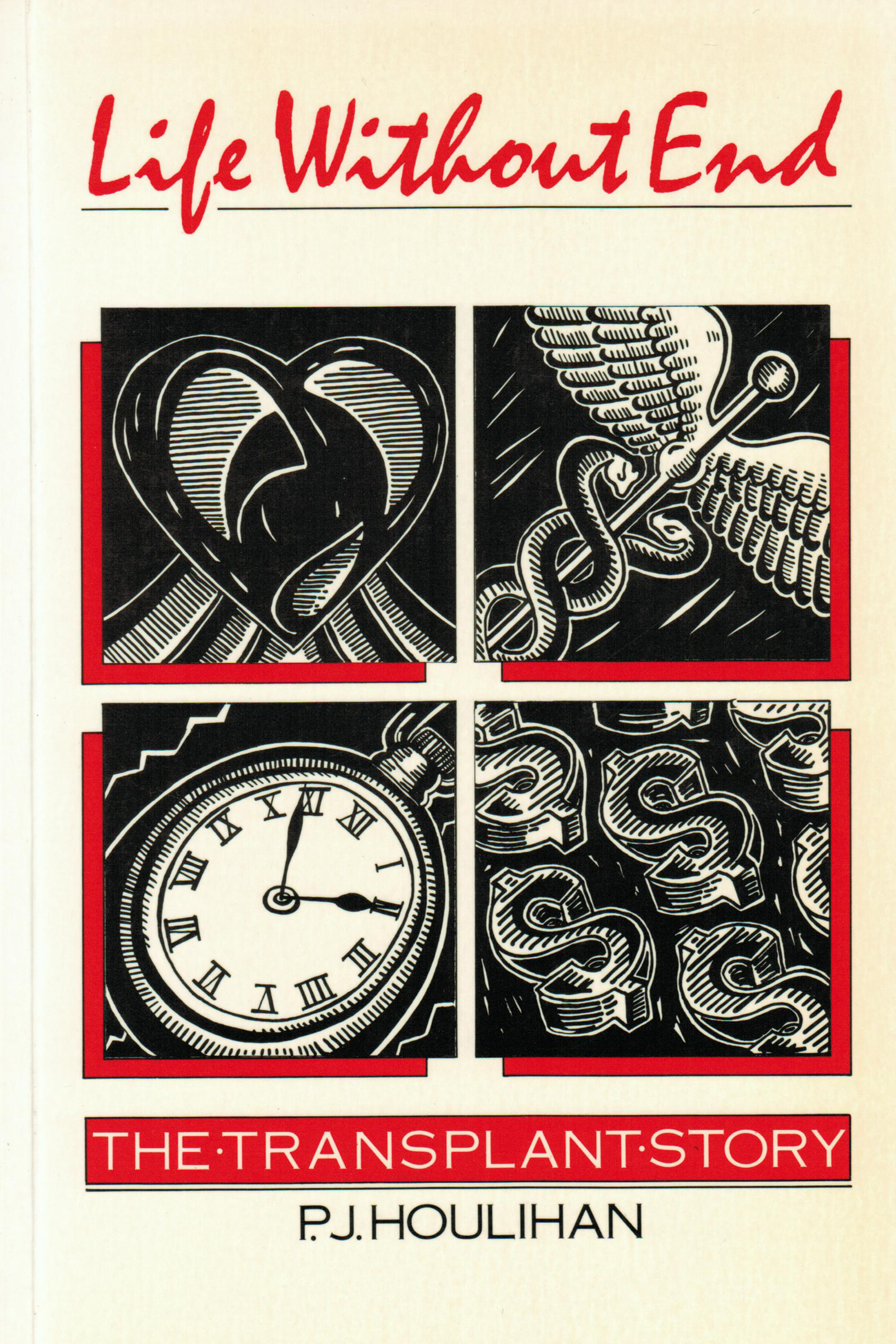
For many years as a non-fiction writer, it was fairly straightforward: my writer’s point of view was my bias. When I wrote my first-ever-published book way back in the dark ages, it was about the ethics and politics of organ transplantation.
My point of view, or my bias, was clear from the outset. The book began with a section called “A Parable.” My story-within-a-story was about a Transplant Surgeon who presents himself to St. Peter at the Pearly Gates. St. Peter tells the Transplant Surgeon that an unusual situation has developed: God would like a few one-on-one personal words with him before a decision about granting him access to heaven is made. God has a few questions for the Transplant Surgeon.
My First Book
“Who decides if a person needs an organ?” God says.
“Well, I do,” says the Transplant Surgeon.
“Who decides which person gets the organ when there are not enough to go around?”
“Well, I do.”
“Who decides if someone’s life should be saved with this organ?”
“Well, I do.”
“Who decides when technology has been stretched to its limit?” This is God’s final question.
The Transplant Surgeon is becoming increasingly uncomfortable.
Finally God says, “I am afraid that I am going to have to find another place for you other than Heaven…I just can’t afford the competition.”
…and with that, the author’s point of view is clear and sets the stage for the pages that follow.
It is true that a non-fiction author can try to be objective (that’s the purview of the journalist, I think, although objectivity in reporting these days is a bit difficult to find), but usually there is a purpose to the writing and that purpose as articulated from the outset sets up the bias. If I want to write a story about what happened on September 11, 2001, I have to decide on a “slant.” Will I tell a survivor’s story? A firefighter’s story? A victim’s story? My selection of that viewpoint will dictate the kind of research that I’ll have to do and eventually the bias that the story will hold. But, the story is still circumscribed by the facts – even if I choose which ones I’ll use. The same is not true for fiction.
Fiction writers have a lot more leeway. I don’t have to be reined in by facts when I write fiction. I can choose the ones I want to incorporate and even change ones that need changing to fit the story. There’s something a bit freeing about that, don’t you think? The problem when beginning to tell a story, however, is that a writer has to make a decision about point of view. The decision has to be deliberate, and then the voice has to be consistently used throughout the story if it is to hold any plausibility for the reader.
We all learned about the difference between first and third-person story telling when we were in fourth grade or thereabout. But there are other considerations. Here’s my current dilemma.
I have an idea for my next historical novel. The inspiration came from a picture of an object that I think would be interesting to follow through an historical journey. I could take on the role of narrator myself with an omniscient viewpoint and tell the story through generations. Or I could make it a first-person account; however, since I plan for it to cover several centuries, the first person will have to change from one character to another since people inevitably have to die. Or will it? What about first-person, inanimate-object perspective? Inanimate objects can endure through the ages and we’ve often said, “If only [it] could speak.” Well, why can’t it speak and be that narrator for us?
Obviously, this is not a new idea. Others have done it before. What I’m not entirely sure about, though, is if it works. Can a reader suspend his or her disbelief long enough to really believe that this object is telling a story? Does the inanimate narrator have to break through that fourth wall and speak directly to the reader? If so, is there anything wrong with that?
As you can see, the selection of point of view is an important one. It’s almost as if I can’t even complete the research until I know how my head is viewing the material. If I’m going to be a character (a person) in the story, I’ll have to think about the material in one way. On the other hand, if I’m going to be that object (if anyone asks, I might tell you what the object is), I’ll be thinking about the material I uncover quite differently. It’s time I decided.

 Patricia J. Parsons