Backstory Blog

Posted in Books, Writing craft

Five Essential Books Every Writer Should Own

For most of my life, I’ve believed you could learn just about anything short of brain surgery from a good book. (My husband, a doctor, says you could probably learn a lot, even about brain surgery with the right book, too!). When you consider the rise of such book series’ as “Books for Dummies,” it seems clear that you can distill even the most complicated material into essential elements that just about anyone could understand. This observation is probably more accurate for writing than anything else.

Most of us who write these days don’t hold MFA degrees in fiction writing or journalism degrees if we’re nonfiction writers―and neither did most well-read writers throughout history. That doesn’t mean that you don’t have to learn about your craft. I believe it’s important to continually learn and improve even as your writing career achieves success. But, where to begin?

Courses, in-person and online, are often terrific ways to learn your craft. However, the most accessible place to start is with a growing library of your favourite writing reference books. And it’s not good enough that these books sit on your shelf to impress your dinner party guests. They should be read again and again, highlighted, underlined, dog-eared.

There are many well-crafted writing books that both inspire and instruct. There are also increasing h=numbers of books penned by writers who probably know little more about writing than you do. How can you decide which ones to choose to begin your collection?

I have five tips for five of what I consider to be essential writing reference books, most of which have stood the test of time.

Here they are…
Posted in Backstory, Writing craft, YOuTube

Improving Your Writing…5 Tips at a Time

I started my writing career over thirty years ago. I began with a writing passion that had burned brightly since I was a teeny-bopper (does anyone use that word anymore?). I remember being twelve years old and wondered why a kid my age couldn’t write a book. Of course, anyone can write anything. As a writer matures, though, the question becomes not whether I can write but whether I should write. My answer was always a resounding yes. I had to write. What’s next, then?

For everyone who writes, there comes a time when we begin to think about getting what we write published. I started as a freelance health and medical writer because my educational background led me in that direction. But I wanted to do more. So, I wrote a book.

What did I know about writing a book? I did a lot of research. In those days, that research involved lots of writing books. There was no internet to browse, no other writers to connect with online. I was on my own. So, I read a lot of books and writing magazines, and I took a few courses. I learned a lot by trial and error. After my first book was picked up by a publisher and finally made it to trade paperback, I started teaching writing.

Along the way, I had also picked up a graduate degree in strategic health communication (like you do!). I began consulting in corporate communications alongside my writing, which led a corporate communication program at a local university to ask me to teach. I started teaching print media, essentially a writing and design course for print communication tools. That began an unexpected twenty-six-year academic career, ending up as a full Professor of Communication Studies. All along the way, I never stopped writing―both as a job requirement and for myself.

Most of my books were published by traditional publishers. Still, along the way, I took several forays into self-publishing, even publishing teaching materials that eventually became a book that I sold to a large American textbook publisher. Now, I write only for myself―women’s and historical fiction. (and the odd writing reference book when I have time_.

Over the years, I’ve learned a lot from a lot of people―readers, editors, students, book authors, YouTube video presenters, among them. Now, it’s time to give back.

I’ve also learned one more thing: time is a precious commodity. So, I thought, what if I could provide bite-sized pieces of writing advice to budding writers―and others who want a fresh perspective―in a format they could easily access?

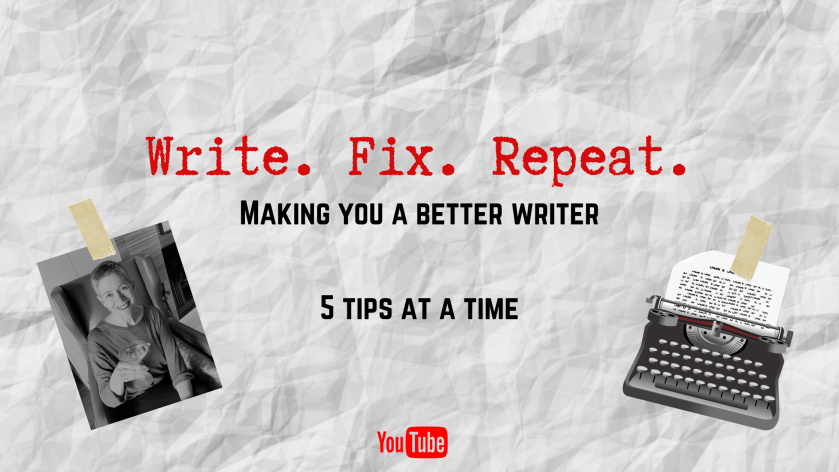
Born from that idea is my newly launched series on YouTube. Write. Fix. Repeat. Making you a better writer, five tips at a time.

I’ve just uploaded the first episode based on a blog post I did last year on the five characteristics of great writing. I thought it might be a good way to get started.

If you’d like five tips a week, subscribe and come along with me on this journey. I guarantee we’ll all learn something―especially me!

Posted in Book marketing, Book promotion

Five Tips for Better Book Trailers

I don’t know about you, but I love a good book trailer. And by “good,” I don’t mean expensive. By “good,” I mean a book trailer that concisely captures my imagination for fiction or beckons me to learn more when it comes to nonfiction. In both cases, it has to be tight and visually stimulating.

Over the years, I’ve come to the conclusion that book trailers can accomplish a few things, despite the lack of hard evidence that they increase book sales in any significant way. But a great book trailer can be your book’s calling card to book bloggers, reviewers, agents and yes, even to some readers. But it has to be good.

Here are my five tips for better book trailers:

  1. Make sure you set out a specific goal for your book trailer. Trailers without purpose are not focused. Your goal should say what you want to realistically accomplish with these marketing tools and precisely who you want to reach. What and who are essential drivers for what you will put in that book trailer. See tip #2.
  2. Write a script. I cannot tell you how soul-sucking it is to see a book trailer that is clearly unscripted. These pieces of crap are meandering commercials that appear to have been crafted by children. (Scratch that: children these days can generally do better with an iPhone and iMovie.)
  3. Plan the visuals. You know what a script like this ought to look like, don’t you? Your script should resemble a documentary script more closely than a script for a movie. This kind of script layout means that you have two columns: the voice-over (if you’re using one―which I recommend) on one side and a column for visuals opposite it. The visuals should be carefully connected to the voice-over or on-screen titles or the script’s visual direction.
  4. Avoid anything campy or kitschy unless that’s what your book is. Too many writers (and their book trailer makers) seem to think that the more gimmicks they put in, the better. Not so. It can be very off-putting to viewers or even misleading if that approach doesn’t represent the book’s genre, story, voice and message.
  5. Keep it the right length. So, how long should a book trailer be? There are no hard and fast rules about this, but in my experience, I’ve found a kind of sweet spot. A 20-second trailer isn’t a trailer―it’s a teaser. A 4-minute trailer is bordering on a movie.

I suppose the cardinal rule for book trailers is the same as the cardinal rule for writing: never bore your readers (or, in this case, your viewers).

If you’re no expert in video production and editing, find someone who is. The final edit is what we’ll see and what we’ll use to judge your book― and you. Make a good first impression!

For some samples…