Book sequels and a subsequent series seem to be all the rage these days – and not always for the better. The current conventional wisdom seems to be that the best way to sell books is to write lots of them. And what could be easier than a series of books where the writer doesn’t have to create new characters every time? Well, from a reader’s perspective, it’s a bit hit and miss. Just like with movies, the sequel is often forced and not quite as good as the original. And it’s worth remembering this…
…The only thing the easy way has going for it is that it’s the easy way…
Tweet
So, why would I consider a sequel?

Unlike other so many other writers these days, my primary motivator in writing a particular book is not determining what can make money. My motivator is that I’m a writer. I’ve always been a writer (at least since I was about 13 years-old). I’m a writer because I write, and I have stories to tell. If those stories resonate with readers, then that’s just terrific. If they don’t, at least I’ve gotten the story out of my head and onto paper (or a computer). If this is the case, then why am I embarking on writing a sequel? Same reason as why I write in the first place – there’s a story there, and I have to tell it.
When I was writing my most recent book, I didn’t have any plan to make a sequel (and no, it won’t be a series – at least I don’t think it will!). However, as I neared the end of the writing, as I could see the light at the end of the tunnel, I realized that there was another story that had to be told. There was another character – not the main one as in book one, but a character nonetheless – whose story was just aching to be told. So, I decided I’d have to tell it. But, because I am who I am, I thought I’d try to figure out how to go about this before I actually got myself stuck in, as my British friends say.
I have a kind of method for harnessing the creative process when I start a project.
- First, I buy a new notebook that will stay by my side until the bitter end. Once I knew what the story would be about, I could choose a notebook. Hokey, I know, but it works for me.
- Then I begin to fill it with my very first notions of how the story might unfold. This is usually in point form, identifying a kind of timeline. The I look for visuals relevant to the story that begin to speak to me. Then I need a title. Oh, yes, I cannot write a book without a working title.
- After the title comes the hard-core research and character building. But for this sequel, I’m not quite there yet. And the process that I’ve been developing is a bit different.
I realized a couple of things.
- First, sequels don’t have to – and probably shouldn’t – pick up where the first book ended. This is gong to be interesting for me since this book is, in reality, a prequel of sorts. We’re going back in time.
- Second, there must be new characters. Although there will be a few familiar people, let’s face it: if I’m going back in time, there have to be new people and older characters seen in all new ways.
- Third, there have to be all-new settings. This is a must as far as I’m concerned.
- Fourth revelation: since this is going to be a prequel, there are actually quite a few details that were mentioned in the first book that will have to be introduced in the prequel. That’s where re-reading my own book and highlighting those details will be crucial.
When I created the new timeline in the new journal, I took up a new colour pen (hot pink in this case, if you must know) and wrote in those details from the first book that have to be included in the prequel. In fact, it was those details that truly propelled me to write another one – entirely ignoring the 25,000 words I’ve already written on a completely different story. That one will still be there when I’m finished with these characters who have gotten into my head.
Here’s what I know so far about prepping to write a sequel:
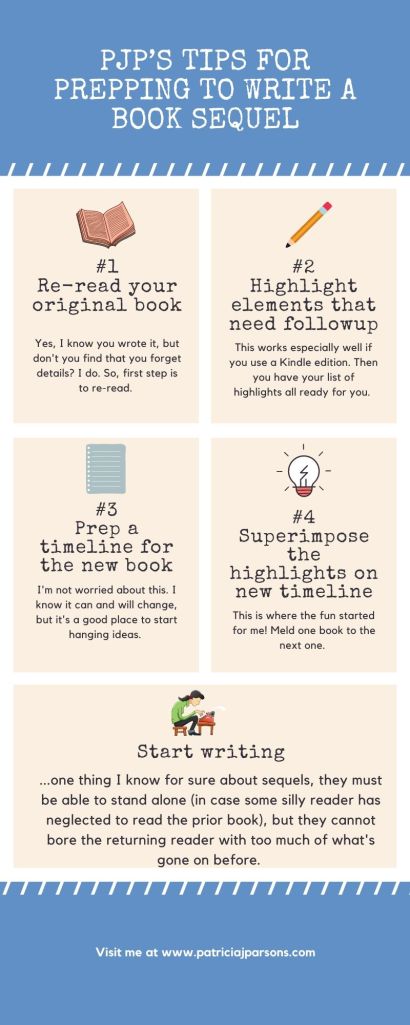
And I’ll remind you that this piece isn’t titled “How to write a book sequel.” It’s “How to prep for writing a book sequel.” I don’t ‘know squat about how to write one – yet. But I will!


