Posted in Book trailers, Books, Writing, Writing books

When a story takes over – a writer hangs on for the ride

In modern parlance, I’m what might be called a “plotter” when it comes to my writing. This is in contrast to those of you who are called “pantsers,” although I’m not sure why anyone would accept that slightly dubious moniker. Anyway, plotters plan things – characters, timelines, settings and, yes, plots. Pantsers go “by the seat of their pants” evidently. I plan.

I think my planning comes from my background as a nonfiction writer. To sell a nonfiction book to a publisher, a writer has to learn to write a dynamic book proposal. An, what is a book proposal except for a big, detailed plan? That’s what it is. So, when it comes to fiction, my tendency is to take the same approach. Up to a point.

I have a new book out this past week. I think it’s the best book I’ve ever written – but, as my mother used to say, “Self-praise is no recommendation.” Thanks, Mom. The thing about this new book is that I started out with a plan, but something or someone took over. I think it might have been Charlie. Let me introduce you to her in a minute. First, I want to talk about this writing process.

I started this book with a thin outline and an idea for a character. This character would make a discovery that would take her on a journey of discovery. I just didn’t know at the time that it would be a journey of self-discovery – for both her and for me. Charlie was supposed to be a kind of wise-cracking, sarcastic thirty-something with a penchant for seeing humour everywhere she went. Sort of like Jenn, the main character in my novel Plan B. I suppose the universe must be telling me that I need to diversify my contemporary women’s characters a bit because Charlie is not much like Jenn!

(When I write historical fiction, characters don’t seem to be wise-cracking, sarcastic women – but I suppose that’s an idea!)

As I began writing this book, it took on a whole different dimension – a whole different kind of disposition. It felt different to me as I was writing, and it looked very different when the story was out there in front of me.

Here’s what happened.

The book is The Year I Made 12 Dresses: The almost-but-not-quite-true story.

A struggling writer, an enigmatic shop clerk, an old sewing machine and an inspirational journey of discovery – where every dress is more than it appears to be.

After her mother’s unexpected death, struggling writer Charlotte (Charlie) Hudson moves into her family house after her older, mostly absent sister Evelyn instructs her to empty the family home of objects and memories to ready it for sale.

When Charlie stumbles on a dusty old sewing machine hidden away among the clutter of detritus in the basement, she has no idea of the journey it will take her on, or of the secrets it might reveal about her mother, her family and herself. If only she will let it.

With the help of an enigmatic fabric-guru named Al, Charlie discovers how little she really knows about anyone – especially herself.

So that’s it. And here’s the trailer…
Posted in Book launches, Books

So, who will really read your book?

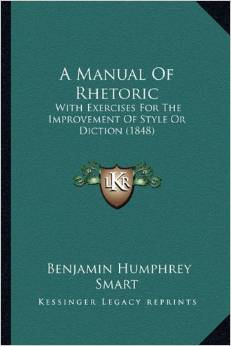
In 1848 a writer named B.H. Smart produced a book quite improbably titled: Manual of rhetoric: with exercises for the improvement of style or diction, subjects for narratives, familiar letters, school orations, &c.: being one of two sequels to “Grammar on its true basis”.  It was published in London by Longman, Brown, Green and Longmans and is reputed to be the oldest publication that could be reasonably described as a writing manual.  Since then, manual after manual has been produced with the objective of improving writing everywhere.

The first writing manual

Today, all you need to do is plug the search term “writing manuals” into Amazon’s search function and you’ll be greeted with almost 12,000 hits; if you plug in “writers’ guides” you’ll be rewarded with almost 19,000.  Within these search results there are the direct successors of Smart’s manual such as the Chicago Manual of Style (originally published in 1906) which, along with the Publication Manual of the American Psychological Association, is one of the go-to, required writing manuals for academic and scholarly writers throughout the English-speaking world.  In addition to these specific style guides there are books for poets, science and technical writers, novelists, memoirists, romance writers, creators of creative non-fiction and every other conceivable type of writer one could imagine.  From the style guides and how-to manuals for specific genres the writers’ guides begin to become more esoteric with books like Anne Lamott’s Bird by Bird: Some Instructions on Writing & Life, and Natalie Goldberg’s iconic Writing Down the Bones: Freeing the Writer Within, to the more recent offering from Stephen King, On Writing: A Memoir of the Craft where writers weave their personal stories around writing advice to inspire would-be writers.  If you’re a writer or aspiring writer yourself, you probably own a few of these – or at least in my view, you should!  All of this seems to be in spite of American journalist and writing guru William Zinsser’s pointed comment in his own best-selling writing guide On Writing Well, that most people have no idea how poorly they write.

Poor writing or not, the rush to publish in the 21st century is more like a torrent where the flood-gates, in the form of agents and editors, are no longer needed to stop the outpouring of book-length publications, for better or for worse.  Writers are flocking to self-publishing with a vengeance.  A quick troll through the social media communities, groups and networks of “writers” suggests that the era of co-dependency is upon us in a way never before imagined as writers look to one another for guidance and moral support in their publishing endeavors.  Rather than being connected to publishers, mentors or readers, they are connected to other writers – all as unknown as they are.

What’s truly puzzling, though, is how no one seems to notice their members who are spelling, grammar and stylistically-challenged, not to mention devoid of talent.  At least they’re not admitting it with their continual five-star reviews of every piece of drivel produced by their peers.  Yet, within all of this publishing-related noise, there are truly unique and important voices that need to find a way out of the slush.  What they all need is a reality check.  I’d like to help to provide that. And help those unique and important voices find their way out of the noise.  So, I’ve written yet another manual – well it’s sort-of a manual.

WWRYB CoverThe purpose of my new book is to provide a tough-love reality check on the vagaries of the new publishing models for aspiring writers while at the same time providing you with a kind of road map based on my experience as a writer, writing teacher, traditionally-published author and indie author.

For my blog readers who have been here a while, you might recognize some of the foundational material in the book – it did evolve from this blog (there’s a whole other story, isn’t it?  Turning blogs into books.  I could tell you…).   There is a whole lot more, though, and I’ve tried to tell readers my own story of making it onto the traditional publishing merry-go-round, and then dabbling in self-publishing.  Along the way, I learned a lot and this experience, coupled with my  research over the years as as a university prof, has resulted in this book.

Here’s the book trailer.  Let me know what you think.

Posted in Backstory, Books

Books we keep, books we toss: Helen Gurley Brown’s is a keeper

Unlike most book lovers I know, I have culled my bookshelves mercilessly over the years.  I always think that someone else could be enjoying those books that just sit there on the shelves for so long, so I donate them to used book stores, libraries and anywhere else that might appreciate those books.  I hope that my own books have found new audiences in these ways.  But when I look at my shelves and see those books that I’ve actually kept for the long haul, one jumped off the shelf at me this morning.

It is a pocket-book version of Helen Gurley Brown’s 1982 classic Having it All.  You can have her Sex and the Single Girl, but I’ll take Having it All.  Of course it jumped out because the venerable Ms. Brown died yesterday at 90.

I graduated from Cosmo to Vogue and now More (for women over 40) many years ago, but I always appreciated Helen Gurley Brown’s fundamental feminist advice – despite the fact that Gloria Steinem and Betty Friedan (among many others) thought of her brand of feminism more as the “lipstick” type than the ‘real’  type as Simon Houpt wrote this morning in the Globe & Mail.  Give it a rest, all you militant feminists; Helen had a thing or two to say about female empowerment and equality, even if it was framed by thoughts of sex and beautiful clothes.

As the editor of a widely –circulated and wildly successful young women’s magazine, Ms. Brown was a powerful woman if ever there was one, and I can’t help but wonder the extent to which all those things that influence us in our younger years are there in our older minds when we contemplate our writing.  My main characters in my novels all do seem to emerge as women ahead of their time, with interests in pursuing lives that were not supposed to be women’s territory.  And these are women who make their mark.

Earlier this summer Anne-Marie Slaughter stirred up the “having it all” squabble in a big way with her (extremely wordy) piece in The Atlantic.  In “Why Women Still Can’t Have it All” she wrote, “I still strongly believe that women can ‘have it all’ (and that men can too)…But not today…” as a consequence of the way “…America’s economy and society are currently structured…”[1]

Ms. Brown, back in 1982, with her brand of lipstick feminism, suggested that “having it all” meant the following:

  • “To love and be loved by a desirable man or men;
  • To enjoy sex;
  • To be happy in your work – and maybe even famous;
  • To make money — possibly a lot;
  • To look great;
  • To have wonderful, loyal friends;
  • To help your family;
  • To be free from most anxiety;
  • Never to be bored
  • Maybe leave the world a better place”[2]

I don’t know about you, it may be a bit simplistic, but this is as good a description of women having it all as I have ever seen (of course having or not having children was not part of Helen’s equation). Hmm…it also seems like the formula for her Cosmo magazine, Oprah’s everything, and chick lit.  Maybe that’s one of my influences.  Now back to my “women’s novel” manuscript and a few new ideas that spring to mind this morning.