Posted in Writing, Writing craft, YOuTube

5 Great Writing Tips from Five Great Writers

In these days of social media, it seems that new and wannabe writers often look to other newbie writers for advice and direction. This behaviour always seemed odd to me. In most other fields, people would look to those who have mastered their craft.

Over the years, I’ve often looked to the great writers for their best advice for writing and the writer’s life. The truth is that not all of their advice is applicable, but there is much to be learned from what they have to say.

This week, I have five tips from five great writers.

Summary

  1. Always stay a student to your craft. If you ever feel as if you’ve mastered writing and fail to focus on ways to continually improve, you are fooling yourself―but you won’t fool the readers. 
    1. “We are all apprentices in a craft where no one ever becomes a master.” —Ernest Hemingway
  2. Never fool yourself into thinking that your contribution (or potential contribution) to the world of books and writing is irreplaceable.
    1. “If I had not existed, someone else would have written me, Hemingway, Dostoyevsky, all of us.”—William Faulkner
  3. Reading is the lifeblood of writers. If you don’t read―a lot―don’t write. Ever.
    1. “The greatest part of a writer’s time is spent in reading, in order to write; a man will turn over half a library to make one book.”—Samuel Johnson
  4. If you think writing success is a simple result of knowing the rules for creation, you might as well stop writing now. There are no rules.
    1. “There are no laws for the novel. There never have been, nor can there ever be.”—Doris Lessing
  5. Write because you have to, not because you care what others will think of you.
    1. “Literature is strewn with the wreckage of men who have minded beyond reason the opinions of others.” —Virginia Woolf

Extras

If you don’t have time to read, you don’t have the time (or the tools) to write. Simple as that.” Stephen King

One day, I will find the right words, and they will be simple.” Jack Kerouac, The Dharma Bums

No tears in the writer, no tears in the reader. No surprise in the writer, no surprise in the reader.” Robert Frost

And my personal favourite

“How vain it is to sit down to write when you have not stood up to live.”

~ Henry David Thoreau

Posted in Ideas generation, Writing, Writing craft

Five Tips for Generating New Writing Ideas

if you’d prefer to see me talk about this, scroll to the bottom and click to the video at Write. Fix.Repeat.

People often say that there are no new ideas, only regenerated ideas- that everything is some kind of a rehash of what’s already been done. I don’t see it this way. What’s more, if you don’t have any new and innovative ideas or are not interested in the mental gymnastics of attracting new ideas, you should stop writing. No one wants to read the same old thing over and over again.

Okay, you might use familiar frameworks (mysteries often have similar frameworks), but your story doesn’t’ have to be in any way the same as someone else’s. So, if you’re having trouble with new ideas, let me help you turn on the faucet.

  1. Pay attention to details around you. Be a keen observer. Listen to people talking. Stop walking down the street, gazing into your phone.
  2. Check on what’s trending on social media and make notes. Don’t get caught falling down an SM rabbit hole, though. This misstep can be a time suck. Be focused. Pass right on by anything that doesn’t ‘grab you sufficiently to compel you to write a note about it.
  3. Read feature stories in the news. The odder, the better. Don’t just stick to the main news stories. (I’m making the reasonable assumption that writers read the news daily.)
  4. Journal about what you see and hear. Then play “what if” with yourself in your journal.
  5. Go on an “artist date” with yourself. Plan what writer Julia Cameron[1] calls an “artist date.” Go to an art gallery, a fabric store, a museum, a free concert. Eat at a restaurant that serves ethnic food you’ve never eaten, 

Writing prompts: Best left for writing practice (not idea generation).

Here’s a link to “Inspiration Snips,” video writing prompts for all you visuals out there.

Watch this topic on Write. Fix. Repeat.

[1] Julia Cameron. 1992. The Artist’s Way: A Spiritual Path to Higher Creativity. Tarcher Perigree.

Posted in Book launches, Publishing, Writing

My new book launches today: Is it historical fiction? Not so much

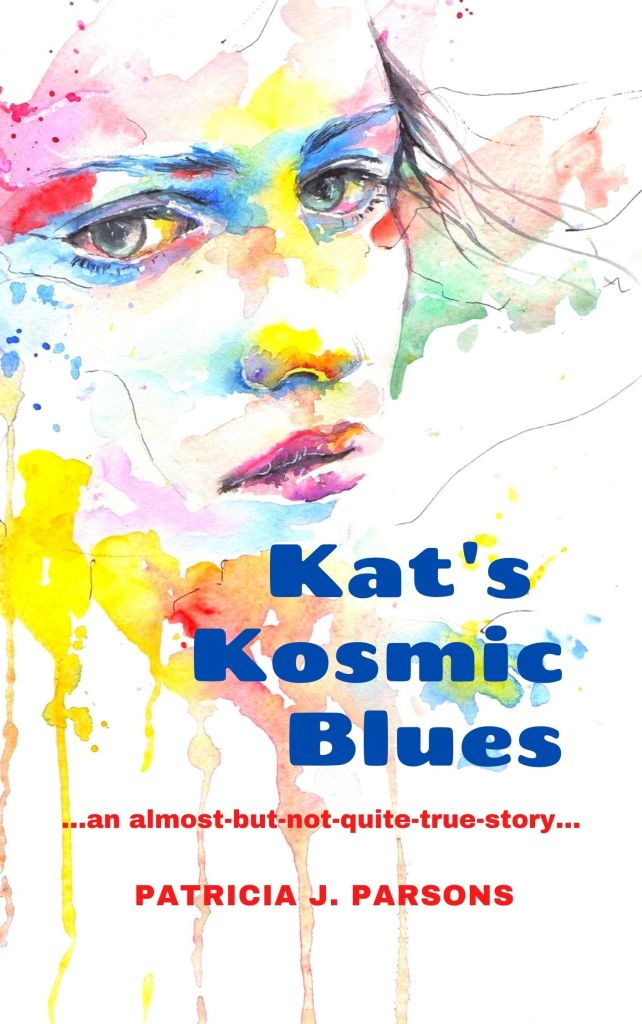
Historical fiction seems to be a trendy genre these days. I’ve written my share of historical fiction (Grace Note comes immediately to mind―I mean, if a book set in the twelfth century isn’t historical fiction, I’m not sure what is!).I’m launching my newest book today―Kat’s Kosmic Blues―and I’m wondering if it’s historical fiction to some people. The question is: when does a story qualify as historical fiction?

It seems clear that if a story takes place in the past and is fictional, it must, by definition, be “historical fiction.” But it seems that it’s not that clear at all.

The blurb on Masterclass that leads into Margaret Atwood’s class on creative writing says the following:

Historical fiction transports readers to another time and place, either real or imagined. Writing historical fiction requires a balance of research and creativity, and while it often includes real people and events, the genre offers a fiction writer many opportunities to tell a wholly unique story.[1]

So, any novel that transports the reader to another time and place is historical―except when it isn’t. There seems to be a notion decreed by some parts of the online community that anything set 50 years ago or earlier is historical fiction. But really? If you’re sixty-five years old and lived through the period in question, then, for you, it’s not historical fiction at all. It may not be contemporary, but a story set fifty years ago won’t feel like it is in any way in the same category as, for example, The Girl with the Pearl Earring or The Thornbirds (to mention two of my favourites).

It seems then that what is historical fiction is a bit subjective. And what about a story that starts fifty-five years ago (1965) and sweeps you all the way to 1989? Historical fiction? Probably not. And that’s what I’m launching today.

Kat’s Kosmic Blues, the prequel to The Year I Made 12 Dresses, is really a contemporary book.

In these days of COVID restrictions, we really do have to find creative ways to launch books! Please join me here…


[1] https://www.masterclass.com/articles/what-is-historical-fiction-definition-of-the-historical-fiction-genre-and-tips-for-writing-your-historical-novel#quiz-0