Posted in Book promotion, Writing, Writing books

What I’ve Learned About Writing Humour

I had a surreal experience recently. My book, We Came From Away, was a 2025 finalist for one of the most coveted literary awards in Canada. It’s the Stephen Leacock Award for Literary Humour. If you don’t know who Leacock was, then you probably should.

He was only the best-known humourist in the world between 1915 and 1925.

British by birth, Leacock settled in Canada, where he first worked as a professor of economics at McGill University in Montreal and later relocated to a small town two hours north of Toronto. And it was to this town, Orillia (also the hometown of another Canadian great, Gordon Lightfoot, BTW), that he settled, and it was there that the Leacock Medal originated three years after he died in 1944.

So, as a finalist, I spent the weekend hobnobbing with some of Canada’s finest humorists: Wayne Johnston, Cathal Kelly, Terry Fallis. They were all there because they are all past winners. Anyway, at one point in the weekend, when someone said that we write humour because we’re all funny people, I almost swallowed my tongue. I am not funny. Not funny at all.

Here we are…the three finalists, cutting a cake that features the covers of all three short-listed books. (I think this photo is courtesy of Leacock Associates, https://tinyurl.com/2k58vj2n, but there are so many similar ones…)

And most of my writing isn’t funny—unless it is. Clearly, since my book was chosen as one of the three best humour books of the year, I must have done something right. The truth is that I don’t set out to write humour. Humour creeps in through my characters and their experiences. So, I thought I’d share some tips about injecting humour into your writing.

Okay, maybe I’m a bit funny when required to do a dreaded book signing. (photo credit: CG Production Company, via https://tinyurl.com/2k58vj2n)

Of course, there is nothing funny about much of what we write these days. If you’re an unfunny writer, you probably wonder why you’d even think about such a ludicrous idea. Well, there may be reasons you haven’t even thought about. I never set out to write humour, either.

I first thought about why one might even consider injecting humour into one’s writing. Here are some reasons.

  • Humour can make your writing more engaging.
  • Humour can help you build rapport with your readers.
  • Humour can sometimes provide contrast to the darker moments, heightening emotional impact.
  • Humour sharpens insight.
  • It can also help to light your own mood.

So, what have I learned about writing humour?

First, I learned that humour comes best when the writer first finds the truth and then exaggerates it.

Much of the best humour comes from seeing everyday truths in a sharper, exaggerated light. Take something relatable and then push it a little further into the absurd, the awkward, or the ironic.

I also learned that it’s essential to keep an eye on your audience’s sense of humour.

Not everything is funny to everyone, and in these days where so many people choose to take offence at just about anything, you sometimes have to tread carefully. I have an ongoing funny focus on vegans in this book—one of the characters is a vegan and she bears the brunt of the other character’s slightly off-kilter opinions on veganism and its dubious place in their lives. Sorry, not sorry if anyone is offended. It’s humour. 

I also know this to be true: less is funnier. There is no need to over-explain the joke or pile on too many punchlines at once. I learned to trust my readers to “get it.” Often, one well-placed witty line or ironic observation is far funnier than paragraphs trying too hard.

Characters are the foundation of humour in any scene. Humour really shines when it grows organically out of your characters’ personalities or flaws. A character’s inappropriate observations ( my characters are the queens of the inappropriate). Even their deadpan reactions to events can be hilarious—and believable. It’s not about making the scene funny. It’s about following your character’s actions and reactions.

Overall, as I was writing We Came From Away and its sequel Meet Me in Miami, I realized that there’s a difference between writing comedy and writing humour. Comedy writers are going for the gags. Going for the laughs. Humour writers know that there is humour in the mundane. It’s all about how you see it.

Not all my writing is funny, and that’s great for my humour writing because when the characters and situations are funny, it just happens.

Now, when I’m not writing stories that make people laugh, I’m writing mysteries and thrillers. A genre change, you say? Why, yes. Why not?

Posted in Backstory, Writing books

Writing a Book Series: What No One Else Will Tell You

It seems that everywhere you look these days, writers are being told to write a series of books—often before they’ve even written the first one! As far as I’m concerned, this is the dumbest way to write a series or even a book. The thinking seems to be that if you can hook a reader on one book, that reader will buy another one that continues the story or theme.

And this can be either fiction or nonfiction. Bestselling writers like David Baldacci and Michael Connelly are the masters of the book series, so much so that readers lie in waiting for their favourite characters to reappear. But it’s not just for fiction.

If you’re a travel writer, for example, you might write a series of books on a variety of places. The same goes for a health or food writer. Regardless of the topic you’re searching for these days, you can find a series.

There is a lot of advice on writing a book series, and most of it is the same. Most of it starts with the admonition to plan out your series. I’m going to turn that advice on its head because my advice is 180 degrees in the opposite direction from the conventional wisdom. (Although, to tell you the truth, I’m not sure anyone who’s written that advice has ever really written a series).

Here’s what no one else will tell you: Do not, under any circumstances, think of your book as a series until you’ve written the last sentence of the last chapter and the book tells you there’s another one.

Now, I’m going to tell you why and what else you might consider.

What is a book series?

Let’s start by ensuring we’re all thinking about a book series in the same way.

First, a series is not just a number of books written by the same author. In fact, many bestselling series authors have penned several different series. David Baldacci has written something in the vicinity of ten distinct series.

There are also different kinds of series (even publishers can group books by various authors and call them a series―one of my nonfiction books is part of just such a publisher’s series), but I’m talking about a specific type of series.

The definition of a series we’ll use today is this…

“…a sequential group of books by the same author that share specific characteristics…”

My unconventional advice

First—and this is key—do not set out to write a series. No matter what anyone tells you, write one book and see how you feel about it at the end of the process. Could it be the beginning of a series? If it could, the book will tell you.

When I wrote The Year I Made 12 Dresses, I had absolutely no notion of writing a series. But Charlie Hudson, the main character, simply wouldn’t let go of me. She forced me to tell her mother’s secrets, and Kat’s Kosmic Blues was born―and even that wasn’t the last one. She just kept talking.

My second piece of advice is that each book should stand on its own outside the series. Not all readers will find your first book and then proceed sequentially through the series. So, you need to tell enough of the backstory but not too much.

For example, when I wrote book three of the “almost-but-not-quite-true stories,” a reader had to be able to become immersed in The Inscrutable Life of Frannie Phillips without having read Kat’s story. However, the reader also had to be able to think that he or she might like to go back and read the previous two books.

I also recommend that you keep meticulous notes on backstory—characters, places, events, etc.

If you’re writing a nonfiction series, keep a carefully crafted style guide. If it’s fiction, you need a notebook that contains the complete backstory of every character who might reappear. It also needs details on recurring settings, etc.

As you write the first book, let the process become organic. Let one book lead you into the next one. Each well-crafted paragraph in a book contains a transition into the next one. Each well-crafted chapter transitions into the next. It should be the same from one book to the next―even if you have to go back and rewrite the ending of the first book when the character tells you there’s another one that needs to be written.

Finally, think abt your readers. They always need something new, so keep the material fresh by introducing something new in each book,

When I wrote Kat’s Kosmic Blues, the main character was the through-line from one book to another, and the events were sequential. But in this book, although my use of point of view was the same as in the first one, this book came with a Spotify playlist―where each chapter was named for a song from the 60s and 70s, the years in which the book was primarily set.

Of course, there are different kinds of series: ones that have an overarching plot, ones where there is only one plot per book and the anthology kind where the individual books are only loosely tied together by a setting, perhaps. For me, that’s stretching the series definition, but it does exist.

I once saw it written that a series is the meal they keep coming back for. Maybe. But in my view, a series is at least as much a feast for the writer!

Posted in Book launches, Fiction Writing, Writing books

Travel Inspires Writing – Again!

It’s not the first time this has happened, and it’s not likely to be the last. I find myself on an absorbing trip (because I love to travel and even write about it), and the next thing I know, the experience and the locale inspire a story. In my view, travel is one of the most inspiring experiences for writers. But that’s just me.

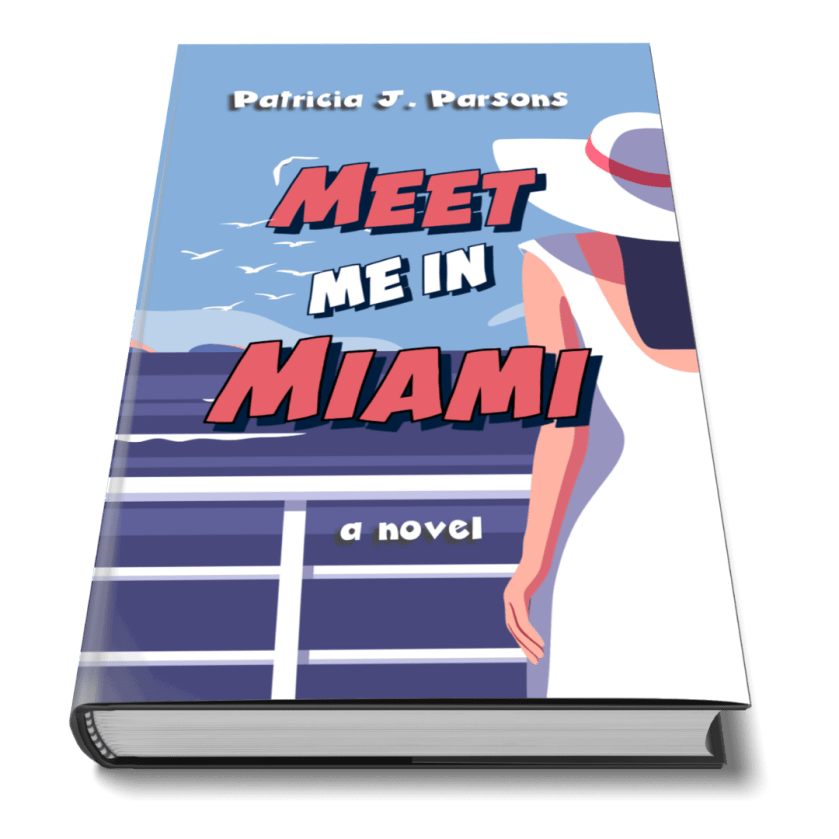
Two summers ago, a ten-day cross-island trip in Newfoundland inspired a book that seems to have started a new series. We Came From Away: That Summer on “The Rock” was inspired by a combination of that trip experience and the fact that my mother turned 100 years old that year. (She’s now 102!). Then, last year, my husband and I spent a month travelling in Brazil on a cruise up the Brazilian coast, into the Amazon River, and onto Miami. It seemed that the characters in We CAme From Away hadn’t finished with me yet. Now there’s a sequel: Meet Me in Miami.

February 1 seems like a great day for some armchair travel to a tropical location, doesn’t it? So, I’m inviting you along for some of that travel. Here’s the new book launching today.

What travels from your past might inspire a story … and a book?

Here’s what it’s about:

Life may not offer do-overs, but it might offer second chances.

Dr. Claire Barrett has it all. At least it seems that way to everyone but Claire. A successful doctor with two almost grown and successful children, an international reputation as one of the world’s finest pediatric surgeons, Claire at age fifty is as beautiful, stylish and driven as ever. She prides herself in making the best decisions to have gotten her where she is today. She did it all herself and from her home base in St. John’s, Newfoundland. But there is one decision that rankles. She should never have allowed Peter O’Brien to get away. She should never have agreed to the divorce. Was it her only mistake? Now she has a plan to fix that. She will win him back.

Eliza Houlihan Cohen, a New Yorker by way of Canada’s east coast, is a successful cookbook author. After years of putting up with her philandering husband Jake and his whining mother, she has finally broken free. And now that she’s met Dr. Peter O’Brien, she wonders if she might take another chance on love.

Eliza hates Miami, but when Peter asks her to take a cruise with him, ending in Miami, and she asks her daughter Izzy to meet her there for a holiday, Eliza decides she can cope. By the time her cruise through the Amazon reaches Miami, Eliza will wish she had never laid eyes on Peter’s ex-wife, Claire. The question is, though, will she feel the same about Peter?

Vanity, conceit and a single-minded pursuit of career goals, though, will only take you so far in this life. There comes a time when you must face the fact that everything is not about you.


It’s available from Amazon (which the cover above is linked to) or any other online retailer you like.

And … if you haven’t read We Came From Away yet …

Nora Houlihan’s children have been long gone from their family home in Newfoundland. Now, she is about to turn 100 and wants her children and grandchildren to find out what they’ve been missing on her beloved island. So, she arranges for her “come-from-away” family members to take a cross-island tour before her birthday party. By the time they are finished, they will be forever changed—and nothing in the family will ever be the same.

They say you can choose your friends, but you can’t choose your family. The question is this. If you could pick your family, would YOU choose yours?