Posted in Cross-writing, Genres, Writing books, Writing craft

Writing across genres

So many genres...so little time.

It may come as something of a surprise to students I’ve had over the years – those who have have sat in my classes to learn about communication ethics or strategy – but I began my unexpected academic career as a writing teacher.  I never intended to be a university professor.

I had always been interested in teaching and thought that it was probably one of my strengths.  I had done it for several years in a previous incarnation – I taught anatomy & physiology, ethics and human sexuality (!) to nursing students before my career evolved into health and medical communication, leading eventually to writing books and teaching in the area of communication (public relations to be specific).  But I went to the university initially as a writer who could teach writing.

The first course I taught (before I ever considered teaching full-time) was called “Print Media.”  There is no such course with that title any longer, but its descendent “Text-Based Media” comes close.  I also taught news and feature writing and persuasive writing after the then-chairman of the department talked me into applying for a full-time job.  But I never intended to stay.

That was 23 years ago!  So, what’s the lesson here?

For me, it means that our skill sets can cross many disciplines – and in writing can cross different genres.  But writing across genres has two different meanings.  First, let’s talk about individual writers writing across genres; then we’ll talk about those genres that cross genres themselves.

When I was trying to create copy for my web site, it occurred to me that this was, in fact the hallmark of my writing: I am a bit of a switch-hitter.  As I say on my home page

…Goethe is said to have opined that every author in some way portrays himself [sic] in his works, even if it be against his [sic] will. For someone who writes in a variety of genres, this is either a symptom of some kind of mental confusion – or perhaps the hallmark of an interesting personality. I’d like to think that, in this case, it’s the latter…

The bottom line is that I started my writing career as a medical writer.  Skills honed there took me into medical communication which morphed into communication in general – most of my past work has been writing about health and corporate  communication.  But, I’m a writer.  To me that means that I can use my skills to write anything that takes my fancy.  I decided to move into creative non-fiction and wrote my memoir, then took my research skills into an area that I love to read – historical fiction.

In my view, writers, like everyone else, have individual strengths – and my strengths are probably not the same as yours.  I think it’s important to know what those strengths are and see how you can use them across genres.  For example, my meticulous research skills, honed in the areas of non-fiction, have been enormously useful to me in moving into historical fiction. Story-telling is also a strength that many of us have – it’s a skill that is important both to non-fiction (creative or otherwise) as well as to fiction writers.

The second way that you can think about the concept of “writing across genres” is the notion that there are discrete categories of writing, and to create  a mash-up, to use the current parlance, is to create a cross-genre genre.  Make sense?

Here’s my example: I have a secret – I sometimes read chick lit and I’m not apologizing for it.  Since I like a bit of escapist reading from time to time, and only if it’s well-written like some chick lit is, I am also interested in creating some of my own.  But I don’t want to be formulaic.  So, I’ve taken my interest in travel and travel writing and put it together with my interest in chick lit and I’m writing a travel chick lit book.  Is this a cross-genre?  Maybe, but who’s to say?  Who is the arbiter of what is and is not a genre?  And who says that because my book is funny, with a young, modern woman as the protagonist, that it’s chick lit anyway?  Maybe it’s just women’s literature – ooh, that sounds a lot better for a university prof-type, doesn’t it?

In any case, cheers to coming up with your own genres and writing whatever moves you.

Posted in Co-authors, Collaborative writing, health care ethics, Writing books

To collaborate or not to collaborate…that is the question

They say that there is strength in numbers.  And if you read a CV of just about any academic around (but it’s not reading that I recommend unless you’re an insomniac), you’ll be struck with the extent to which the books and papers they list as their accomplishments are penned by groups – occasionally rather large groups.  My CV is probably shorter than some, but my list of publications is just that – mine. No one else got tenured or promoted based on the same list of publications.  As I said, they’re mine.

My first co-authored book

A colleague recently suggested that I form a committee to work on a report.  This is what I told him: “I don’t play well with others.”  And the very notion of writing a report by committee – well, let’s just say that I value my time and my sanity, and the little bits of both it would take for me to make nice with the collaborators just are not worth the effort – usually.

If you peer very closely at the descriptions of four of my past books, though, you will, in fact, see that I have on those occasions actually worked with someone else.  I have “collaborated.”  That someone with whom I worked was my husband, and we’re still married.  So, it can work.  But when is a writing collaboration a good idea?

And before you jump to the conclusion that collaborative writing only works in non-fiction, there have, in fact, been novels penned by duos (think: Emma Mclaughlin and Nicola Kraus of Nanny Diaries fame).  The co-authors’ names, however, are sometimes combined into one so that the reader thinks the book has one single author.  Think Judith Michael.   Browse through an online bookstore in the non-fiction sections some time and you’ll see plenty of co-authored books.  Then, if you browse a textbook site, you’ll see an even higher percentage.

There are good reasons to collaborate and publish a co-authored book – such as when the knowledge and skills of more than just you are needed.   There are also reasons that it’s not such a good idea.  One problem relates to the ownership of “the good  idea.”  Every book starts with an idea.  Does a co-authored book originate in the mind of only one of the authors (in which case it will always be her baby and she’ll feel that sense of ownership), or does it come about as a double brainwave?  I can only answer this in my case.

It all started in the very earliest years of our marriage when my husband and I used to go out every Friday night.  It was nothing fancy; it was just a chef’s salad and a carafe of house wine at a harbourfront watering hole.  But sitting there gazing out the window at the harbour lights, sipping a glass of mediocre wine that at the end of a long week tasted like the finest French vintage,  engendered in us a kind of romantic notion of leaving a legacy.  What better way, we thought, than to write a book together. We had compatible – if not equivalent – backgrounds.  I had a graduate degree in health education/communication and he was a physician.  Surely there was a common ground we could explore together. When we hit upon it, it was a Eureka moment – a collaborative one.  I can truly say that neither of us owned the idea. It was ours.

My husband was the chairman of the Ethics Committee of the Canadian Medical Association for ten years, a post he vacated shortly after we married.  I had studied ethics and written about ethics in health care.  He no longer had to stay on message as it were.  He could have personal opinions again.  It was golden.  We’d be the ones to simplify complex ethics issues in health care for everyone.  The public would be smitten and they would see the wisdom in our ideas.  Well… it’s a long story.

But…

This was in fact the subject of our first book.  However, it didn’t come together exactly as we had planned.  You know the old saying: if you want to make God laugh, just tell her your plans.  That was what sort of happened in our case.

As you know, I had developed these incredible book proposal writing skills (no self-promotion here – at all), so I took charge of the book proposal writing.  We put our two perspectives on the topic together and mined our individual knowledge to come up with what we thought was a well-rounded approach to helping the average, interested reader to understand the ins and outs of ethical dilemmas in modern health care.  At the same time, we decided that the same research could be recycled into another book aimed at a different audience.  We’d also write a textbook – an interdisciplinary textbook for all kinds of health professions students, and it would be a book that they would actually read, but that would be for later.  It would be unlike some of the ethics tomes we had to slog through as students.  But our idea was to be sure that the book for the general public – the trade book – would be published first.

I have but a fuzzy memory of how it all came about, but after pitching our ideas to suitable publishers, one small publisher in Toronto was interested in the textbook idea and offered us a contract.  So Healthcare Ethics was born.

Then the real work began.  At least four evenings a week, after our very young son had gone to bed, we’d hole up in our home office and work.  We’d discuss the organization, content, references etc of the book.  Art, my husband the doctor, would keep notes that he added to each day se he saw patients in the office.  We’d talk about each chunk of the book as a team and then I’d write it.  I think that collaborations work best when you are really clear about each person’s skills.  That realization needs to begin with an honest determination of your own skills.  So, I’d write and then it went back to  him.  He’d make copious and substantive notes and I’d rewrite.  This process happened a few times for each chunk of the material until we had a draft we were happy about.

In  the end, the publisher was really happy with the book and we had found our  writing rhythm.  This was the first of four books we would write together (and we’re working on a fifth all these  years later).  The most important lesson we learned is that you have to really like and respect the person you’re working with.

Posted in Pitching books, Writing books

Writing your first book

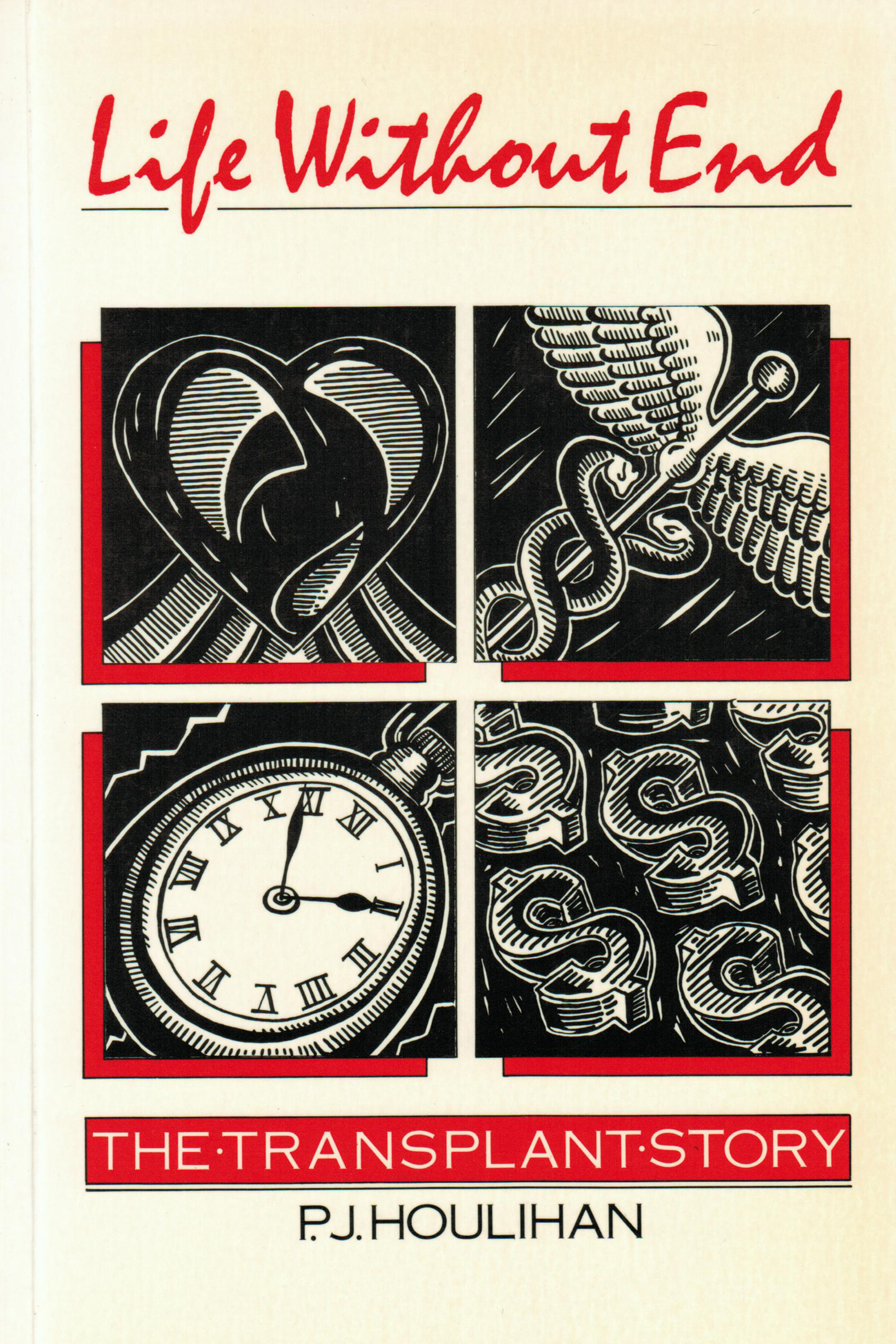
life without end
My First Book

You’ve probably heard it said more than once: there’s a book in everyone.  But for most people, that’s where it stays: inside them.  (And make no mistake, from some readers’ perspectives, that’s where many of them ought to stay!).   Sometimes, though, for some of us, it just has to come out.

There are those among us – and you may be one – who just have to get that book out and onto paper, or at least into a computer.  Some of us just need to write.  We need to write every day and we need to write about all kinds of things that we see, hear about, read about, question and create in our mind’s eye.  Sooner or later, we just need to feel that finished book in our hands.  At least that’s the way it was for me.   So just how did that happen the first time?  How did I get to the point where a publisher said, “Yes”?

The story of my first book started way back in my first career.  I was working as an “organ procurement officer” for a large organ transplant program.  Aside from the snickering often engendered by the term “organ procurement” proudly displayed on my business card (I was in my mid-twenties at the time), it was a job fraught with responsibilities – and ethical landmines.

My duties fell into two general areas: I was responsible for the public communication programming that persuaded people to be organ donors, and taught health professionals to ask the right question at the right time; and I was responsible for coordinating organ donation which is the actual process by which organs are donated from brain-dead people into desperate souls awaiting a new lease on life.  There was no doubt in my mind that there was a story to be told.  So I kept notes – an activity highly recommended for any would-be author.  Then I started to research how one goes about finding an appropriate publisher.

It was clearly very important to be sure that the planned book was not shopped to publishers who had no interest in my kind of book.  I could avoid all those who specialized in fiction, children’s literature, fantasy and science fiction and so on.  I was looking for a publisher who took on health-related non- fiction trade books.  If I tried to sell this idea to the wrong publisher, this would mark me as a rank amateur.

After I figured out what publishers might be in the mix, I learned to write a query letter (more about those in a later post), I thought about what I wanted to accomplish with the book – its purpose.  Then I wrote down a paragraph describing this.  This was my elevator pitch and it would be my calling card.  You have to have an answer when someone inevitably asks you, “What’s your book about?”

Then I did what every book/blog/seminar aimed as aspiring writers tells you not to do: I called a publisher on the telephone.

I happened to be in Toronto.  One of the publishers on the list happened to be in Toronto.  I happened to be stuck in the airport for a couple of idle hours making a connection.  There happened to be a bank of telephones right in front of me in the departure lounge (that was before we were all chained to our cell phones).

This scene happened 20 years ago and I can still recreate the feeling that I had as I walked over to the phone, telephone number on a small piece of paper in my hand, and punched in the number.  I can still feel my heartbeat surging as I listened to the sound of the phone ringing on the other end of the line.  I asked to speak with the editor whom I had identified (having a name is important, I had been told).  When she picked up, I gave her my short speech without stopping, and then ended with the question, “Would you be interested in seeing a full proposal with a view to publishing?”  She said, “Yes.”  Just like that.

That’s when the work started.  I had to learn how to prepare a book proposal.

So…what’s your first book going to be about?