Posted in Writing, Writing craft

Writers (like everyone else) need common sense: Five times they don’t show any

Years ago, one of my students returned from a semester abroad in Australia and brought me a little gift for helping her. It is a coffee coaster, and it has sat on my desk for years. It says, “Common sense is not common at all!” I’m sure you’ve heard it before, but I think it warrants some further consideration.

French writer Christiane Collange once said, “Common sense is perhaps the most equally divided, but surely the most underemployed, talent in the world.” And when it comes to so many people’s writing aspirations, it seems to be so under-employed as to be practically non-existent. Let me explain.

Newbie writers can be intense. They follow the social media feeds of many other wannabe writers and writers who have garnered some success. They take part ins discussions on Facebook sites where everyone else is just as inexperienced and gullible as they are. They hang on every word of encouragement posted by every other writer and wannabe writer, and they seem, so often, to lose their sense of perspective―their common sense. Here are five times when I think writers need to get real and cultivate some common sense.

  1. Sending manuscripts to publishers and agents who don’t publish or represent your genre. Often, not only do they not represent or publish your kind of writing, they actually loathe it. Why would any aspiring writer do this? It shows a significant lack of common sense. And don’t have the audacity to think that your brilliant piece of work will sway them. Not going to happen. Remember, publishers and agents take on only a tiny fraction of the work they’re sent that they do like.
  2. Interacting only with other “writers” on social media to sell books. This makes no sense at all. If you’re trying to connect with readers, connecting solely with other writers isn’t going to get you there. Everyone on those SM sites wants what you want: they want you to read their book, but they’re not likely to read yours.
  3. Interacting on social media writers’ sites to get advice on your writing. If you’re interacting in the hope of improving your writing, unless you know the strengths and credentials of those on the site, you might as well ask you brother for his writing advice (this would demonstrate common sense only if your brother happens to be a well-established writer or writing teacher!). The best writing advice comes from successful, well-established writers not from barely literate members of Facebook groups for beginning writers. Use some common sense!
  4. Not spending every minute you can when not writing or working on whatever else you do reading. If you’re spending more time watching Netflix than reading, you are not demonstrating common sense. We learn to write by reading widely―which means not just in you own genre. Open your mind. If you don’t read, you’re going to be a shitty writer. End of discussion.
  5. Thinking that writing just comes naturally. In what world does it make any sense that you don’t’ have to learn your craft? There is such a thing as talent, but talent is not enough. Talent needs to be cultivated and supported. Many talented writers never get anywhere because they fail to see that there is still a lot they have to learn. There was a learning curve in learning to drive a car, knit, bake cookies, ride a horse. Writing isn’t any different.

“Common sense” is generally defined along the lines of sound judgment applied to practical matters. Apart from the actual writing effort itself, much of what we do as writers is of a practical nature―editing, marketing, searching for agents and publishers, making publishing decisions etc. Don’t you think it’s a good idea to apply sound judgment?

Posted in Writing, Writing craft

What makes writing great? The five “C’s”

You know it when you see it, but if someone were to ask you what makes a piece of writing great, what would you say? And not just in a single genre. In general, across all genres, what are the characteristics of great writing? Perhaps even more important to those of us who write is this question: How can I use an understanding of these characteristics to improve my own writing?

The question of great writing is often considered to be subjective. Many readers will suggest that it depends on the style. No, it really doesn’t. And just because you like a piece of writing, doesn’t mean it’s great. The reverse is also true. Just because you don’t particularly care for a piece of writing doesn’t make it bad writing. (I am really not a fan of Ernest Hemingway at all, for example, but I have to concede that the writing itself is pretty good!) The more I’ve thought about it and read what others more erudite than I am on the subject have to say about it, though, I can identify five features that are the hallmarks of truly great writing. And it occurs to me that if all of us who write focus our efforts on improving these aspects of our writing – regardless of whether we write medical nonfiction, romance, dystopian fantasy or anything in between – our writing is sure to improve.

Studying the characteristics of great writing can help you to become a great writer – or at least, a better one.

So here are my “Five C’s of Great Writing” …

  • Clear: Great writing is clear. Clear writing means that there is no misunderstanding between writer and reader. Some might say that it means the writing is “easy” to understand, but I think that’s too simplistic. Sometimes the writing is above someone’s reading level. That is hardly the fault of the writer. On the other hand, if the writer considers who might read a particular piece of writing, then readability is a component of clear writing. For example, way back at the beginning of my own writing career, I was a medical writer. Some of what I wrote was for health professionals (such as textbooks), other writing was for the lay public (such as women’s magazines). I might focus on the same content area, but my writing necessarily has to be at different levels if my audience is going to understand. This is a lesson I learned a long time ago!
  • Concrete: The use of concrete language in writing follows from (and could, arguably, be a part of) clear writing. This doesn’t mean that you can’t present abstractions, it only suggests that the words you choose and the style you employ to string them together, need to be precise and specific. Sometimes, new writers overdo the admonition to provide details. How many times have you read a piece by a newbie writer that describes a glass of wine as “ruby red cabernet sauvignon from the XYZ winery with the gold label”? Someone who teaches romance writing must have hammered this into the heads of romance writers because this kind of excessive verbiage is all over the place. Precision doesn’t mean that the reader needs every detail. Keep your research in the background! The bottom line is writing that isn’t concrete is overly vague and ambiguous when it should be precise and specific. It is this precision that begins to set your writing apart from the writing of others.
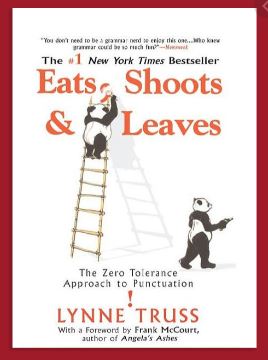
  • Correct: This is a big one these days. Since the advent of self-publishing, there seems to be an odious and increasing sentiment that writing correctly is unimportant. If you read a passage that is riddled with grammatical errors, typos, stylistic problems – this is assuredly not great writing, no matter how good the story idea is. Correct writing is tied to the number one “C” above: clear writing. Even something as simple as punctuation makes a huge different in the clarity of writing. Who doesn’t remember Lynne Truss’s terrific book, Eats, Shoots & Leaves? Or perhaps she could have said, “Eats shoots & leaves,” Or even “Eats shoots, & leaves.” Different punctuation, different meaning. My own personal downfall in the punctuation arena is my lack of commas. No breathing space! I’m working on it. Great writing is correct.
  • Creative: This seems to be a no-brainer. Great writing presents innovative ideas. It is often said that there are no new ideas. That’s nonsense. You better hope there are. Ask a scientist. If they had no new ideas, so many things in our lives would be very different. So, why would a creative individual like a writer accept that there are no new ideas? There are. And there are new ways of telling old stories. The uniqueness of the story and/or the voice in a book is a very important part of what makes it great.
  • Compelling: Great writing affects the reader. It makes the reader think, or laugh, or cry, or get so angry he or she tosses the book across the room. One of the things I’ve noticed as my own fiction writing has improved (at least I hope it has improved – just saying!), is that it seems to be more evocative. Recently, I’ve had readers say that they laughed and even cried a bit when they read my most recent novel. When they send me a note and say it “resonated” with them, that’s so much better, in my view, than simply saying they enjoyed it. I want to know how it affected them. That makes me feel terrific. But, and here’s the most important part from your perspective as a writer – if your own writing moves you to tears when you’re writing it, you will compel the reader to do so. If you don’t cry a little (or laugh, or get a bit angry) while you are writing, your readers won’t, either. It isn’t compelling enough.

Okay. I’ve said my piece. Now I have to get back to the new manuscript. But I’m going to think about these aspects of great writing, not necessarily as I write, but certainly as I edit. I’m not quite there on the new one, though! Happy writing.

BTW, if you haven’t read Lynne Truss’s book, maybe now’s the time!

Posted in Books, Journals, Writing, Writing craft

How to prep for writing a book sequel

Book sequels and a subsequent series seem to be all the rage these days – and not always for the better. The current conventional wisdom seems to be that the best way to sell books is to write lots of them. And what could be easier than a series of books where the writer doesn’t have to create new characters every time? Well, from a reader’s perspective, it’s a bit hit and miss. Just like with movies, the sequel is often forced and not quite as good as the original. And it’s worth remembering this…

…The only thing the easy way has going for it is that it’s the easy way…

So, why would I consider a sequel?

Unlike other so many other writers these days, my primary motivator in writing a particular book is not determining what can make money. My motivator is that I’m a writer. I’ve always been a writer (at least since I was about 13 years-old). I’m a writer because I write, and I have stories to tell. If those stories resonate with readers, then that’s just terrific. If they don’t, at least I’ve gotten the story out of my head and onto paper (or a computer). If this is the case, then why am I embarking on writing a sequel? Same reason as why I write in the first place – there’s a story there, and I have to tell it.

When I was writing my most recent book, I didn’t have any plan to make a sequel (and no, it won’t be a series – at least I don’t think it will!). However, as I neared the end of the writing, as I could see the light at the end of the tunnel, I realized that there was another story that had to be told. There was another character – not the main one as in book one, but a character nonetheless – whose story was just aching to be told. So, I decided I’d have to tell it. But, because I am who I am, I thought I’d try to figure out how to go about this before I actually got myself stuck in, as my British friends say.

I have a kind of method for harnessing the creative process when I start a project.

  • First, I buy a new notebook that will stay by my side until the bitter end. Once I knew what the story would be about, I could choose a notebook. Hokey, I know, but it works for me.
  • Then I begin to fill it with my very first notions of how the story might unfold. This is usually in point form, identifying a kind of timeline. The I look for visuals relevant to the story that begin to speak to me. Then I need a title. Oh, yes, I cannot write a book without a working title.
  • After the title comes the hard-core research and character building. But for this sequel, I’m not quite there yet. And the process that I’ve been developing is a bit different.

I realized a couple of things.

  • First, sequels don’t have to – and probably shouldn’t – pick up where the first book ended. This is gong to be interesting for me since this book is, in reality, a prequel of sorts. We’re going back in time.
  • Second, there must be new characters. Although there will be a few familiar people, let’s face it: if I’m going back in time, there have to be new people and older characters seen in all new ways.
  • Third, there have to be all-new settings. This is a must as far as I’m concerned.
  • Fourth revelation: since this is going to be a prequel, there are actually quite a few details that were mentioned in the first book that will have to be introduced in the prequel. That’s where re-reading my own book and highlighting those details will be crucial.

When I created the new timeline in the new journal, I took up a new colour pen (hot pink in this case, if you must know) and wrote in those details from the first book that have to be included in the prequel. In fact, it was those details that truly propelled me to write another one – entirely ignoring the 25,000 words I’ve already written on a completely different story. That one will still be there when I’m finished with these characters who have gotten into my head.

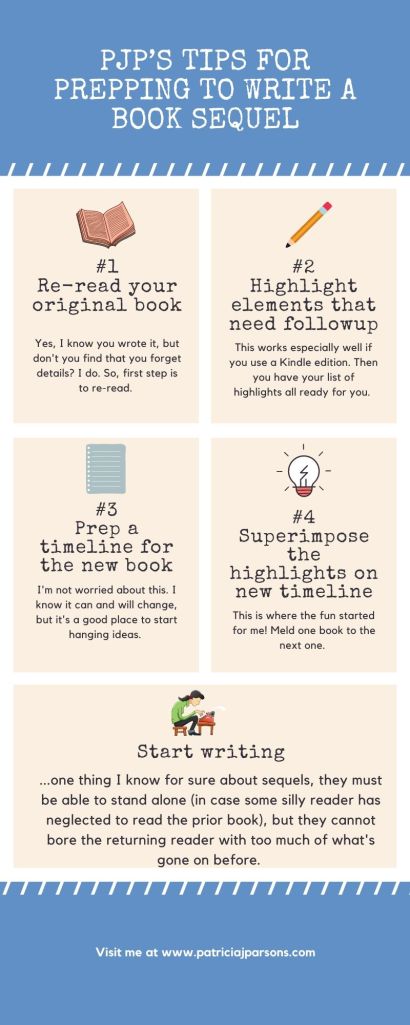
Here’s what I know so far about prepping to write a sequel:

And I’ll remind you that this piece isn’t titled “How to write a book sequel.” It’s “How to prep for writing a book sequel.” I don’t ‘know squat about how to write one – yet. But I will!