Before we went away for Christmas, I cleaned off a few shelves in my office. One of them was the shelf on which I keep copies of my own books. Making the obvious decision that to keep more than one copy of any book on that shelf was using up prime real estate, I piled the extra copies on the floor. When the pile fell over, I noticed the photos on the backs of many of them: I noticed that I seemed to have used the same head shot for several. This started me wondering if they were at all important (and if I should have one more professional one taken).
I want to start this discussion by finding out if any of my fellow readers & writers have given much thought to these photos and the accompanying bio. So…before I continue to write, I offer my completely unscientific poll to any reader inclined to weigh in before I tell you the back story of those author photos on my covers.
[This poll refers only to non-fiction selections: I’ll get to the fiction one in due course!]
J.K. Rowling has quite a web site. It’s flashy; it’s imaginative; it’s just the kind of web site you might think that creator of the Harry Potter brand ought to have. And I have no doubt that her myriad fans visit it when they are in need of all things JKR. However, what’s the point of the unknown author having a personal web site (beyond the obvious ego-massaging aspect?)
In general terms, and in these days of social media, you have to be clear that a web presence is just that – a web ‘presence.’ It is present – no more, no less.
A web presence is usually a static site where organizations or people can hang information. If they seek to be dynamic in nature or to engage others (in the case of authors – presumably your readers), then they need to be connected to opportunities for encouraging this engagement: an author blog (present site included), a forum of some kind (perhaps a Facebook page where discussion can take place on the ‘wall’), a wiki (wherein you might engage your readers to help you create a piece of writing – but that’s a bit odd in my view. (Just odd enough that I might try it.)
The Huffington Post ran an article earlier this year that explores just this question. The article focused on an interview with Anik LaFarge who is the author of The Author Online: A Short Guide to Building Your Website, Whether You Do it Yourself (and you can!) or You Work With Pros. Just as you might imagine, the discussion of the pros and cons is hardly balanced: the interview subject is, after all, in the business of creating author web site, so naturally she thinks that they fall into my “need to have” category. The one thing she does suggest that seems completely useful is this: there’s no point in having a web site if you don’t use it. Couldn’t agree more. I think that the question of using it, though, has two components. First, the author has to use it, and then the readers have to use it.
An author’s use of his or her web site manifests itself in a couple of activities. First, the author needs to ensure that the site has useful information that is updated on a regular basis for those who do happen to stumble upon it. Second, the author needs to get that web site into search engines so that it can actually be found.
As far as readers are concerned, they need to use it to become engaged with the author, something that many authors in days gone by, weren’t really interested in. Times have changed. I suppose readers use authors’ web sites to get the backstory on current work, to find out what’s coming up and to get background on the author. Those would be three kinds of content that could be found. However, how often do you as a reader actually visit the web site for an author you like?
As a reader I never seek out and visit author web sites. Do you?
As a writer, I think that my web site tells certain people that I’m a serious writer and that I have accomplished a few things. Who, though, are those certain people? Agents? Film makers? New publishers? I don’t know the answer.
My own web site caused me considerable soul-searching. Did I need one? What would be its objective? Who would read it (a bit like the question of who will read your book)? Who will design/maintain/update it? Was it worth it?
It seemed like a no-brainer. These days, if your work is in the public view, whether you’re an organization or an individual, if you’re not on the web, in some sense, you don’t exist. Perhaps that’s a bit strong, but it does make a point.
The truth is that an author web site is a place for me to send interested individuals whom I meet at parties etc. who specifically ask if there’s anywhere they can read about me. So, if I meet you at a party and you happen to ask what I do (I usually don’t talk about myself unless asked these days) and then you’re interested enough to ask where you can find out more information, I’ll probably send you to my web site. But do I think thousands of people are visiting it monthlly? I’m smart enough about web sites to be sure of the answer: NO.
There is one thing I know for sure: a web site will not make you a rich and famous writer. But what I don’t know is if you can become a rich and famous author without one. That’s if you want to be rich and famous.
Whenever you hear that question directed toward you, what do you think? For anyone who isn’t a writer, it’s simple. The question is asking if you have an opinion, a perspective, a personal take on something. When a writer is faced with that question, it takes on a whole new meaning – and it’s something that I’ve been thinking a lot about lately as I consider my next major writing project.
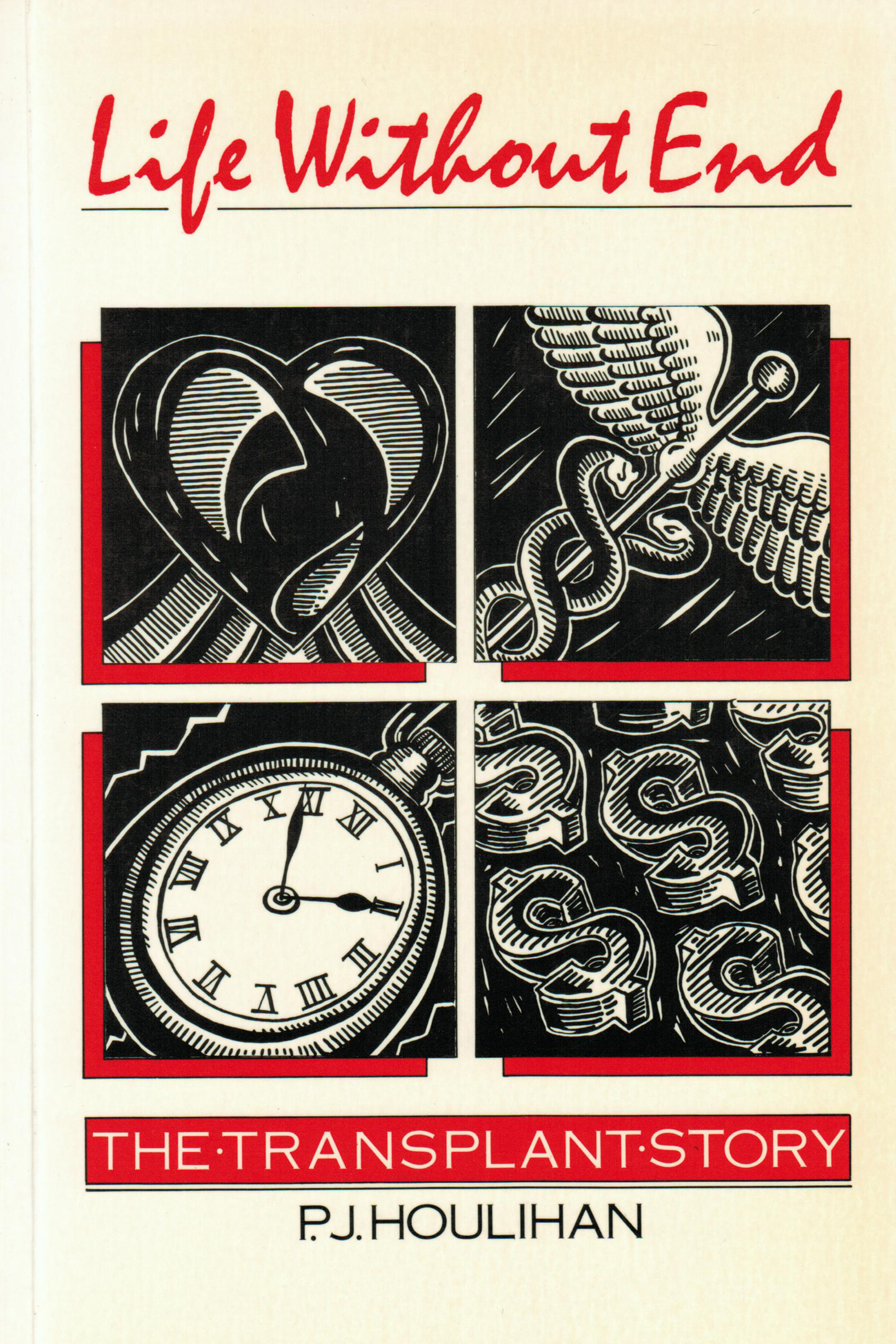
For many years as a non-fiction writer, it was fairly straightforward: my writer’s point of view was my bias. When I wrote my first-ever-published book way back in the dark ages, it was about the ethics and politics of organ transplantation.
My point of view, or my bias, was clear from the outset. The book began with a section called “A Parable.” My story-within-a-story was about a Transplant Surgeon who presents himself to St. Peter at the Pearly Gates. St. Peter tells the Transplant Surgeon that an unusual situation has developed: God would like a few one-on-one personal words with him before a decision about granting him access to heaven is made. God has a few questions for the Transplant Surgeon.
My First Book
“Who decides if a person needs an organ?” God says.
“Well, I do,” says the Transplant Surgeon.
“Who decides which person gets the organ when there are not enough to go around?”
“Well, I do.”
“Who decides if someone’s life should be saved with this organ?”
“Well, I do.”
“Who decides when technology has been stretched to its limit?” This is God’s final question.
The Transplant Surgeon is becoming increasingly uncomfortable.
Finally God says, “I am afraid that I am going to have to find another place for you other than Heaven…I just can’t afford the competition.”
…and with that, the author’s point of view is clear and sets the stage for the pages that follow.
It is true that a non-fiction author can try to be objective (that’s the purview of the journalist, I think, although objectivity in reporting these days is a bit difficult to find), but usually there is a purpose to the writing and that purpose as articulated from the outset sets up the bias. If I want to write a story about what happened on September 11, 2001, I have to decide on a “slant.” Will I tell a survivor’s story? A firefighter’s story? A victim’s story? My selection of that viewpoint will dictate the kind of research that I’ll have to do and eventually the bias that the story will hold. But, the story is still circumscribed by the facts – even if I choose which ones I’ll use. The same is not true for fiction.
Fiction writers have a lot more leeway. I don’t have to be reined in by facts when I write fiction. I can choose the ones I want to incorporate and even change ones that need changing to fit the story. There’s something a bit freeing about that, don’t you think? The problem when beginning to tell a story, however, is that a writer has to make a decision about point of view. The decision has to be deliberate, and then the voice has to be consistently used throughout the story if it is to hold any plausibility for the reader.
We all learned about the difference between first and third-person story telling when we were in fourth grade or thereabout. But there are other considerations. Here’s my current dilemma.
I have an idea for my next historical novel. The inspiration came from a picture of an object that I think would be interesting to follow through an historical journey. I could take on the role of narrator myself with an omniscient viewpoint and tell the story through generations. Or I could make it a first-person account; however, since I plan for it to cover several centuries, the first person will have to change from one character to another since people inevitably have to die. Or will it? What about first-person, inanimate-object perspective? Inanimate objects can endure through the ages and we’ve often said, “If only [it] could speak.” Well, why can’t it speak and be that narrator for us?
Obviously, this is not a new idea. Others have done it before. What I’m not entirely sure about, though, is if it works. Can a reader suspend his or her disbelief long enough to really believe that this object is telling a story? Does the inanimate narrator have to break through that fourth wall and speak directly to the reader? If so, is there anything wrong with that?
As you can see, the selection of point of view is an important one. It’s almost as if I can’t even complete the research until I know how my head is viewing the material. If I’m going to be a character (a person) in the story, I’ll have to think about the material in one way. On the other hand, if I’m going to be that object (if anyone asks, I might tell you what the object is), I’ll be thinking about the material I uncover quite differently. It’s time I decided.
 Patricia J. Parsons