Posted in Writing craft

Eight common delusions of unknown writers

stack of books

There are lots of little lies we all tell ourselves regardless of our art, craft or career.  Sometimes we even share these little lies with others.  Over the past quarter of a century in the trenches of writing books, teaching writing and publishing, I’ve told myself any number of little lies – lies such as “the editor is wrong,” or “I could design a better cover than this one,” or “this first draft is pretty good.”  Sometimes all I need is a swift mental slap up the side of the head by someone whose literary opinion I trust to know that these truly are lies.  These days I notice that the more people who think of themselves as writers, the more the list of those little lies grows.

I belong to a number of very interesting online writers’ and authors’ groups, mainly on LinkedIn and a few on Facebook.  I had the misfortune the other day to read an excerpt posted by a young woman (at least she looks to be a young woman from her photo) of her new self-published book.  To say that it was abysmal would be an understatement.  Where do I begin?  Should I describe her sentence structure mistakes, her appalling lack of any grasp of writing transitions, her continual use of dangling participles to the point that I had no idea what many of her sentences were trying to say – or should I jump directly to the preposterous situation in which the heroine finds herself?  A modicum of research would have led this young writer to a more realistic and therefore more compelling story.  And this is the point at which I sigh and worry about the lack of quality control in self-published writing.  As I’ve said before…

the problem that faces writers and would- be writers in the 21st century is that it is actually possible to publish every bit of genius and garbage that we produce.  And it needs to be said that we all produce some garbage, but only a few produce works of genius.  Most of us inhabit that place somewhere between those two extremes in our usual writing

Maybe we’re not really lying to ourselves: perhaps many unknown wannabe writers are actually living in a dream world where certain delusions govern their behavior.  So, based on 25 years of experience and anecdotal observation, I offer you my eight common delusions of unknown writers:

  1. Talent is over rated. Anyone can be a successful writer. The sad truth is that although talent is not enough, it is necessary for success. And this is true of any field. However, along with that talent, you need to work hard, develop your craft and practice before you’re ready for prime time.
  2. grammar copyNo one cares about grammar. I beg to differ. Everyone cares about grammar; it’s just that some of them don’t know about it. First there are the grammar police readers who will think you a complete idiot if you demonstrate a lack of command of the language. The second group is those who note that you are making grammatical errors and will tell everyone who might otherwise read your book to stay away. Then there are those who wouldn’t know a grammatical error if it came up and bit them, but they do know when they don’t understand the meaning of something. It seems to me that you want to be able to convey a particular message or story and to do that accurately, we all need a shared understanding of the use of our language. Period. Get out the grammar book.
  3. I write better than most people. Can you hear me laughing? This is so untrue as to be hilarious. I have spent almost a quarter of a century teaching and marking university students’ writing – and these are students whose writing will form a very large part of their careers. I’ve seen many good writers who need just a bit of sharpening; but more often I’ve seen honor students who don’t know that their writing is a problem. As American writing guru William Zinsser says, “Most people have no idea how badly they write.” And if you don’t know who he is, stop reading and go immediately to Amazon and order his book On Writing Well. Then read it.
  4. Thousands of Twitter followers guarantee success. Now I’m grinding my teeth. If would-be writers spent as much time practicing their writing and having it edited by someone who knows what he or she is doing rather than amassing thousands of Twitter followers, success would be more likely. Most of our followers are not potential readers; rather they are other writers who are using Twitter for exactly the same reason you are.
  5. I don’t need an editor. Au contraire. Everyone needs an editor. My arguments over the years with editors notwithstanding, I am singularly unable to completely free my own work of errors, typographical and otherwise. I have never met a writer who didn’t need an editor.
  6. If my friends think my idea is great, so will everyone else. I just have one question for you: how did you get friends with such deep knowledge (backed up by data) about how your target readers will think at any given time? The rest of us would love to know. Your friends are your friends for a reason and if you hope that your book will garner more readers than your circle of friends, you’ll have to open your mind beyond that circle.
  7. I don’t need to plan my writing, I just need to write. Well, you do need to write, but this kind of unplanned writing is called “writing practice” or “journaling” and it isn’t for public consumption. If, however, you plan to publish, you need to think about the writing, as well as ‘do’ the writing. The amount of planning you need, however, is very variable. It depends on genre, process and your own writing style. For example, if you write non-fiction, it needs considerable research and a complete outline (fleshed out into a complete proposal if you’re planning a traditional publishing route) before you even write word. Even fiction can benefit – and especially genres like historical fiction that follow a time-line and need extensively researched background. Plotting for mysteries and thrillers also helps the writing process. That said, once the writing begins, it need not stick to the outline!
  8. I don’t have time to read. If you don’t have time to read, then you don’t have time to write, and you shouldn’t. Writers are readers. They read in their own writing genre. They cross-read. They read to do research. They read to flesh out or even come up with ideas. They read to improve their own writing. They read to get to know the competition. They read to get to know what their target readers like. They read to see what sells. They read because they love language and books are important to them.

There you have them.  My eight delusions.  Now I’m going to go back to my incomplete manuscript and convince myself that indeed, I do need and editor.  And soon.

Posted in Book publishers, Writing books

What writers need to know about literary piracy and copyright infringement in the digital age

pirateI was surfing the net the other day and happened upon one of my books – I mean that in the truest sense.  I actually happened upon one of my books – in its entirety, cover scan included, every page in a PDF file posted for all to access.  I immediately copied the URL and emailed my publisher in London.  The rights editor got back to me very quickly indicating that this “piracy” would be uploaded to their “infringement portal” and that a take-down notice would be sent immediately.

Unbeknownst to me, my publisher (and presumably others) has this portal that identifies sites like this that pirate copyrighted material, and they are proliferating as we speak.  This one was a new one to them, not already identified (BTW it was www.gendocs.ru – if you have a book out there, you might want to check it).   So I started to do a little research about the current state of online piracy.

Remember when the music industry clamped down and put Napster out of business?  It seems that some of the same activities have been happening in the literary world, but these sites continue to proliferate.  Here are the things that I learned from doing a bit of research.

  1. Your book may well be pirated.
  2. Even if your book is available only in hard copy, it may still be pirated. Literary pirates can procure book-scanning software easily. The book that I stumbled on is available also as an eBook, but this looked like a scan of the hard copy.
  3. There has been an exponential growth in online literary piracy since 2009.
  4. Although there is now a well-established anti-literary-piracy movement on the part of publishers, as fast as one site is shut down, another one pops up.
  5. Piracy sites may have no ethical concerns about ‘stealing’ your book, but evidently they are very concerned about being sued. This means that when approached to cease and desist, they usually do, taking down the identified book.
  6. If you are published by a traditional publisher, they will have an on-going anti-piracy effort (something you should probably ask them about – I didn’t), although some new sites get by as in the case where I identified a previously unknown one for my publisher.
  7. If you are self-published, you can search for your book regularly or better yet set up an on-going Google search for it. If it pops up on a pirate site, you can prepare and send your own take-down letter by identifying the site’s “copyright officer.”

It always saddens me that people think there is something different about stealing intellectual property – music, writing, choreography – than in stealing your cell phone, your car, your wallet.  But there is no difference.  I like to protect my work, and I hope you think enough of your own work to protect it too.

Posted in Backstory, Book launches, Book promotion

Making old manuscripts live again

An old manuscript gets a 21st century makeover.

Earlier this week Jennifer Alsever wrote a piece for CNN Money called “Guerrilla Marketing for Books.”  A cautionary tale for would-be authors, it tells the story of shrinking promotional budgets at traditional publishing houses and the lengths to which authors now must go to get their books to stand out from the ever-increasing numbers of both traditionally and self-published books.  The truth is, it has been ever thus – unless you are a big-name author.

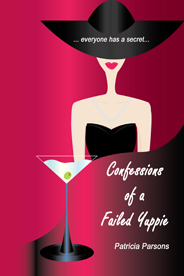
One tactic mentioned in the story is of an author who commissioned a jewelry artist to make necklaces that are featured on her book’s cover as well as a new perfume based on one of her fictional characters. The amount of work and money involved for an author in doing this is staggering to consider.  This, however, reminded me of an event in the provenance of one of my recent ‘new’ books Confessions of a Failed Yuppie.  Stick with me for a few minutes!

If you’ve been reading Backstory for a few years or even months, you might have realized that the “backstory” I’m trying to tell is the anchor of my own experience in writing and publishing.  More than that, though, my objective is to explore the issues that are important to all of us who are more than passingly interested in reading – and writing.  Sometimes I rant about things that have annoyed me; sometimes I tell you a story of my experience.  Sometimes I tell you a real backstory to my writing: what inspired it, how it developed, what happened next.  This post is one of those true backstories.

In the early 1990’s I was on a rant about the Yuppie lifestyle.  So I decided to write a book about it – but rather than a non-fiction examination of the phenomenon, which would have been more akin to my writing experience at the time, I decided to write a novel – a satire of sorts.  I felt strongly, though, that I wanted it published no matter what, so I did what self-publishing authors did at that time, I sent it to a vanity publisher.  (For the working definition of a vanity publisher, you might want to surf back to last week’s post: The confusing world of 21st century publishing jargon: A glossary for writers).

In due course, a box full of hard-cover copies of Yuppie arrived on my doorstep.  What to do with them?  Those were the days before book promotion through online networking channels was de rigeur.  Indeed, there were no social media channels.  Just imagine such a world!  I decided that the first order of business would be to have a book launch.  But before the launch, I’d need some “merchandise.”

The old Yuppie cover and the mug: "I confess: I'm a failed yuppie" with a "reject" stamp!
The old Yuppie cover and the mug: “I confess: I’m a failed yuppie” with a “reject” stamp!

I created a design for the front of T-shirts and for mugs and had dozens of these pieces of paraphernalia created – all at my own expense, of course – and had them available on the day of the pary.  I also had a poster-sized blow-up of the cover of the book so that it could be the focal point of the party, next to the book-shaped cake that adorned the dining room table.  I then created a guest list and sent out invitations.

As parties go, the event was a great success.  We had door prizes of T-shirts that the guests obligingly sported and everyone went home with a signed copy of the book.

As the weeks went by, a number of the guests told me that they had enjoyed the book and when was I going to write another one?

The book, naturally enough, never sold.  Getting a self-published book reviewed in those days was not next to impossible, it was completely impossible.  And since there were no social networks available to promote it, short of taking out advertisements at great expense (I did that once) and going door-to-door with a pile of books (which didn’t sit well with my personality), the book would languish with thousands of others.  And so it did.  Until last year.

Writers have lots of finished and unfinished manuscripts hiding on their hard drives or taking up space in filing cabinets.  I know that most of us should toss most of it, but sometimes a manuscript draws us back and that’s how I felt about Yuppie.

So, I took out the hard-cover copy with its tattered edges and began to write rewrite the book.  It’s now a 21st century Yuppie story, and taking advantage of the digital advances, I decided to make it available once again.

Two decades in the making, Confessions of a Failed Yuppie lives again, and it starts with a definition of Yuppie:


“YUPPIE”: A Definition

Acronym for Young Urban Professional, usually occurring in a married pair (often male/female but not necessarily). Categorized as upper middle class or at least moving in that direction, ambitious, well-educated.  Characterized by excessive concerns about appearances.  Lightly narcissistic.  May have money or at least leverage.  But not necessarily. Normal habitat is the urban condo, sometimes the single-family dwelling of dubious heritage in a downtown area with a postage stamp for a yard, for which a bidding war took place prior to acquisition.  Yuppies with children often move to larger, more impressive dwellings.  Diet consists mainly of cocktails, organic kale and the latest gastronomic fad.  Would not be caught dead in a North-American-produced automobile brand.  Skis in winter, does hot yoga, plays squash (it’s making a come-back), and quietly brags all year round. Widely thought to have become extinct in the early 1990’s.  Not so much.

Maybe you’d like to read the rest.  Or not.