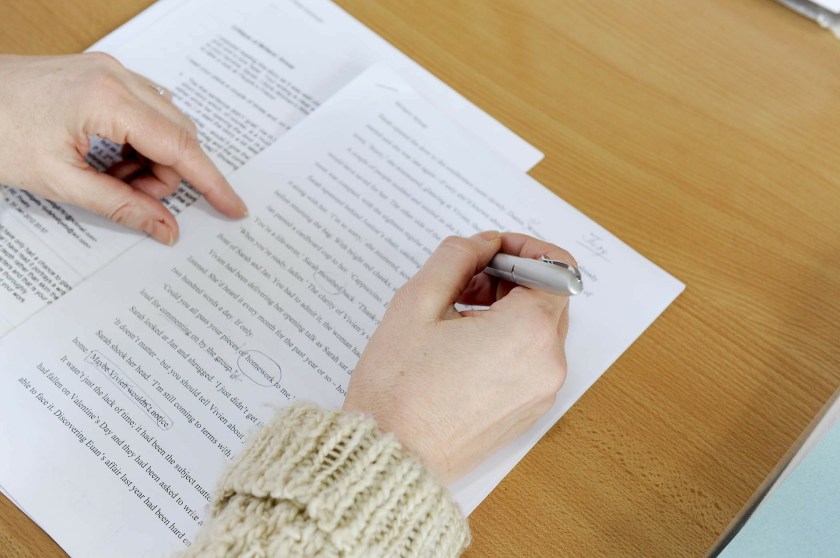
If you’ve been writing for even a short time, you’ve probably already heard the term “query letter.” If not, let me introduce you to one of the most important tools in a writer’s toolbox.
If you’re a writer seeking an agent or publisher for a book or a freelance writer trying to place magazine or blog pieces in publications, you’ll have to learn to write a query letter. This letter has a specific objective: to interest the recipient in your work sufficiently for them to want to see more of it.
A well-crafted query letter is crucial because it often serves as the first impression of your manuscript and you as an author. Since agents and editors receive numerous queries every week, you’re going to have to have a letter that makes you stand out. Do you know how to write a compelling, professional query? I’ve been writing query letters for almost four decades, and in this episode of WRITE. FIX. REPEAT. I’m sharing five tips to help you write a killer one.
The authors of an interesting article in The Guardian newspaper in 2018 about the inner workings of writers’ journals said this: “Note-taking is not just a method for remembering. It is a way a writer tells himself, or herself, a story―and this becomes a process of life, a mode of being.”[1]
But this story-to-self is unpublishable. And that’s where we begin.
Your notebooks and journals serve several purposes, but one of them is NOT to be published. Ever. They are for your eyes only. That’s the beauty of them. They are probably also the only time you write long-hand these days. I know a few writers write without a computer, but that’s not who I’m talking to here. I believe that a writer needs a pen-and-paper journal or two (or three).
I have five tips to help you make better use of your notebooks and journals. (Skip to the bottom to see me talk about these tips).
1 – Choose your writing instrument carefully.
Your pen (or pencil if you prefer) should glide across the paper. If it doesn’t, you won’t write as much or as often. There should be no scratching at all.
2 – Use it every day.
I mean it. Every day. Without fail. (well, almost veery day) Write something. Try Natalie Goldberg’s approach from her wonderful book Writing Down the Bones for writing practice. Start with “I remember…” and keep your hand moving for 10 minutes.
3 – Turn it into your artistic ritual.
Twyla Tharp’s book The Creative Habit (which I’ve mentioner before) has a wonderful section on artist’s rituals. For example, composer Igor Stravinsky had to sit at his piano and play a Bach fugue every morning before he began work. Julia Cameron, author of the now-classic The Artist’s Way, talks about “morning pages” for writers: a ritual that gets the creative mind in the mood. Make your daily journal writing your own personal ritual.
4 – Have more than one.
This is my approach. I have one for gathering snippets. One for each project I’m working on or thinking about. A “big-idea” book. I reach for one or the other several times of day as I sit at my computer when I see, hear or think of ideas don’t belong in that particular manuscript.
5 – Regularly review your journals to mine them for inspiration.
Your jotted notes that capture your thoughts and observations are a treasure trove of ideas. Think of them as a treasure chest you can open whenever you want, whenever you’re suffering from writer’s block, whenever you’re looking for new ideas. Remember that you were impressed enough by the thought to write it down. Why did it impress you? Go back and figure it out.
Is your notebook a diary? It can be, but for most writers, it doesn’t seem to be. Use it to try things and remember things. But just never publish it. And remember, it is the one piece of writing you’ll do that is unhackable!
Seventeenth-century philosopher Blaise Pascal once wrote the following:
“I would have written a shorter letter, but I did not have the time.”
Clearly, he had an innate sense that tight writing takes time―and is preferable in many ways. The concept of “writing tightly” is one that all writers have to come to terms with at some point in a writing career. The reason this is so important is simple: tight writing is more likely to be published.
When an editor tells you that you need to tighten your writing, what does that mean? If you think it means to trim your narrative of all unnecessary words and phrases, then you’d be right.
Tight writing is important because it compels the reader through your copy, whether it’s your book, feature article, blog post, or advertising copy. Loose, wordy writing slows the forward motion of the story and bores readers.
In this week’s video, I explain my five tips.
Tips summarized:
Use fewer prepositional phrases.
Eliminate filler words.
Use strong stand-alone words instead of weak words padded by adverbs.
Remove redundancies.
Read everything you write out loud and listen to it carefully.