Posted in Ideas generation, Reading

The things that shape us: Books & their stories

Green Darkness: The original cover from 1972. I remember it well.

From time to time I wonder if what I read as a child and young adult has had any impact on what I write today – or on what I like to read.  It would make sense that it would, since what we read and experience do influence us in many other ways (our beliefs, attitudes etc.).  It’s in my mind right now because I’m currently re-reading a book that was one of my favorites back in the early 1970’s and has stayed in my mind for many years (it has also made me wonder if books I loved years ago would feel the same to me now.)

The book is Anya Seton’s classic historical novel Green Darkness.  I remember the feeling of the book more clearly than the content of the story.  I remember being swept up in it as the characters move from the 20th century to the 16th and back.  It’s a bit of a romance I guess, but it’s the historical detail and the characters that paint the picture for me.  As I read it now, with the benefit of maturity (I guess), I’m struck by the writing this time around.  Seton is a classic historical novelist who died in 1990 but not before writing more than a dozen books, many of which were bestsellers, and several of which were subsequently made into movies.  But, back to my original musing: has this book that I first read thirty years ago influenced my writing?

I think it probably has – but it’s difficult to say which came first – the reading or the influence.  Why did I choose the book in the first place?  I think my sister recommended it, but if I were not interested in historical fiction I would likely have ignored her – God knows I have ignored other recommendations she has made over the years!

So, there must have been something that compelled me to read and enjoy historical fiction at that time – long before I ever considered writing it.  Somehow, though, that love of reading historical fiction has manifested itself in my love of research and writing in this area, and not because I studied history in university.  I did not.  So if Anya Seton’s work (after Green Darkness I read several others all of which I enjoyed), influenced me, what other kinds of books influenced me?  Or at least, what are the most memorable books I read over the years?

At the top of the list – more of a favorite than Green Darkness – is Rebecca by Daphne DuMaurier.  If asked to identify my favorite all-time book, this is it.  It is, of course, now a classic (originally published in 1938) and it has been made into a move more than once.

Eighth Moon: Today's cover with its sub-title.

I also remember a book called Eighth Moon by Sansan as told to Betty Bao Lord which I notice now has a sub-title (I’m certain it did not when I read it – I wonder if we need sub-titles these days to select books).  The modern sub-title is The True Story of a Young Girl’s Life in Communist China and it takes me back a very long time.

I know that I read a lot of books back then, but this is the only one I remember.  I can remember particular aspects of the book, like when she had to work in fields where human feces were used as fertilizer, and that’s going back a very long time in my life.  I read it in junior high school.

Eight Moon: The original cover -- the one I can actually remember!

I can only imagine how I found the story so divergent from my own life experience with this young woman who was about my age at the time of the story.

I can’t really articulate what it is about the book that it is the only one I remember from that point in my life, but I’m sure that remembering is reason enough to think it has influence.

What books influenced your work?

Posted in Grammar, Writing craft

“Grammar is important”…really?

I was listening to the CBC (Canadian Broadcasting Corporation) noon-time ‘open-mouth’ show on the radio as I drove from one appointment to another on Monday.  The guest ‘expert’ that day happened to be a grammar expert: I missed the introduction, but I inferred that he was a high school English teacher.  He and the host discussed various aspects of grammar,  and people called in with their grammar-related questions, as well as their pet peeves.  In his attempt to avoid the jargon as he put it, his explanations of why certain English grammar rules are what they are lost something in the translation making it difficult to view his explanations with much credibility.

The show ignited my inspiration to write this blog post and then, oddly (is grammar in the air this week?), colleague Alison Delorey wrote a blog post on our students’ newsletter on the very same topic.  Truthfully, though, her post is on grammar as style and you should read it.  She suggests that “Grammar can be creative, interesting and exploratory…” and I agree with her; my concern in response to the call-in show, though, is that grammar is first and foremost a framework or structure for verbal communication in general.  Grammatical mistakes frequently result in failure to communicate, and so your message, whatever it may be, is lost.

A caller to the radio show guest asked him the simple question: What is the difference in usage between ‘bring’ and ‘take’?  It was his answer to this particular question that started to get me riled up about over-simplification of the rules.

His response was to tell her that “I bring” and “You take.”  I started thinking about this as the caller also tried to process this new information.  I was thinking that this couldn’t possibly be right since you can also bring clarity to a situation (you wouldn’t’ ‘take’ clarity to a situation), and I can take action on something (I wouldn’t ‘bring’ action).  Clearly you can also decline both of these words:  I bring, you bring, he brings etc.   So, it sent me flying to Margaret Shertzer’s The Elements of Grammar (a kind of companion to Strunk and White’s classic  Elements of Style, and my bible for all things stylish (although not my wardrobe!).

According to The Elements of Grammar the difference between the two words is this: to bring means to convey toward (the speaker); whereas to take means to carry from (the speaker).[1]  There, now I feel better.  He had over-simplified it and muddied the ability of the speaker to convey a message.

Although messages can be the victim of the grammar-challenged among us, for me it’s often more of a simple stylistic issue – which takes us back to Alison’s point.  In fact, most of the grammar mistakes that I find particularly annoying (somewhat like the sound of fingernails on a chalkboard in my world) are personal peeves.  So, now it’s my chance to rant a bit.

For the love of god, let us stop turning nouns into verbs!  It’s beginning to get out of hand.  One curmudgeonly grammarian on the internet came up with examples that even I haven’t even heard.  “I’m going to suicide,”  “after I enema it all out”, for example, then this grammarian questions when we stopped “writing” books and began “authoring” them.  Hmm.

Now if I could just banish the word “impact” used as a verb in my students’ writing, I think that I will have had an impact on (not impacted) their style!

But that’s just me.

[BTW The title “Grammar is Important” is the title of my grammar text from elementary school – other books have come and other books have gone, but I still have this one on my bookshelf from about grade four.  What does that say about me?]


[1] Shertzer, Margaret. 1986. The elements of grammar. New York: The Macmillan Publishing Company, p. 144.

Posted in Author web sites

Author web sites: Need to have, nice to have or nuts to have?

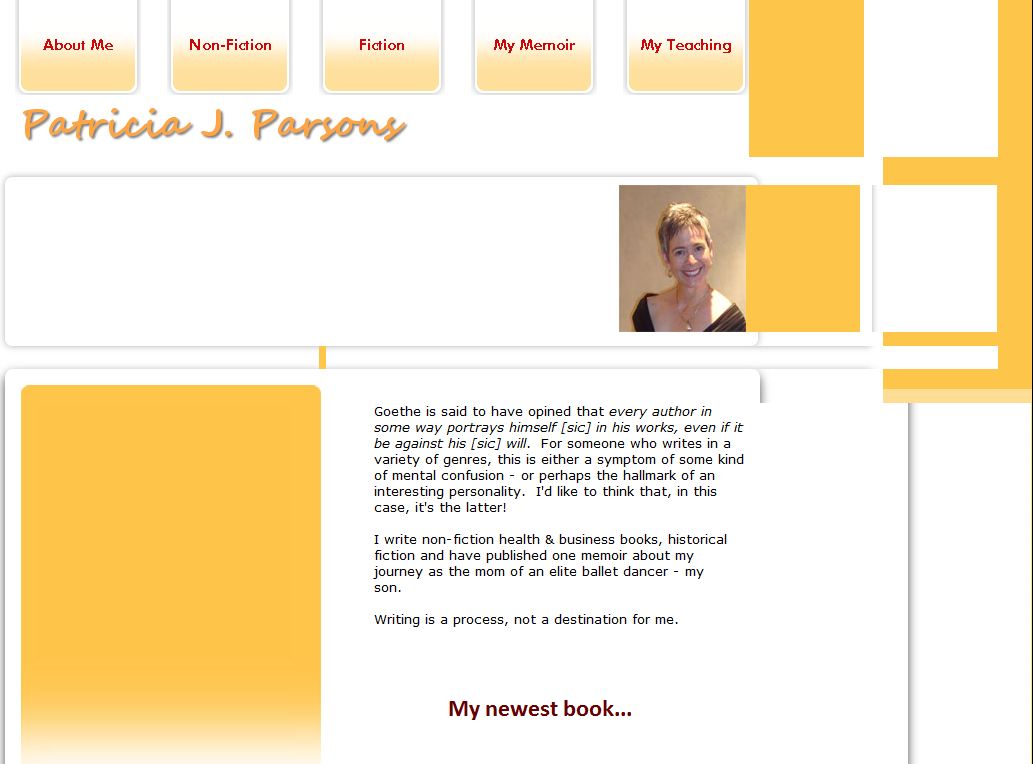
An author web site...

J.K. Rowling has quite a web site.  It’s flashy; it’s imaginative; it’s just the kind of web site you might think that creator of the Harry Potter brand ought to have.  And I have no doubt that her myriad fans visit it when they are in need of all things JKR.  However, what’s the point of the unknown author having a personal web site (beyond the obvious ego-massaging aspect?)

In general terms, and in these days of social media, you have to be clear that a web presence is just that – a web ‘presence.’  It is present – no more, no less.

A web presence is usually a static site where organizations or people can hang information.  If they seek to be dynamic in nature or to engage others (in the case of authors – presumably your readers), then they need to be connected to opportunities for encouraging this engagement:  an author blog (present site included), a forum of some kind (perhaps a Facebook page where discussion can take place on the ‘wall’), a wiki (wherein you might engage your readers to help you create a piece of writing – but that’s a bit odd in my view.  (Just odd enough that I might try it.)

The Huffington Post ran an article earlier this year that explores just this question.  The article focused on an interview with Anik LaFarge who is the author of The Author Online: A Short Guide to Building Your Website, Whether You Do it Yourself (and you can!) or You Work With Pros. Just as you might imagine, the discussion of the pros and cons is hardly balanced: the interview subject is, after all, in the business of creating author web site, so naturally she thinks that they fall into my “need to have” category.  The one thing she does suggest that seems completely useful is this: there’s no point in having a web site if you don’t use it.  Couldn’t agree more.  I think that the question of using it, though, has two components.  First, the author has to use it, and then the readers have to use it.

An author’s use of his or her web site manifests itself in a couple of activities.  First, the author needs to ensure that the site has useful information that is updated on a regular basis for those who do happen to stumble upon it.  Second, the author needs to get that web site into search engines so that it can actually be found.

As far as readers are concerned, they need to use it to become engaged with the author, something that many authors in days gone by, weren’t really interested in.  Times have changed.  I suppose readers use authors’ web sites to get the backstory on current work, to find out what’s coming up and to get background on the author.  Those would be three kinds of content that could be found. However, how often do you as a reader actually visit the web site for an author you like?

As a reader I never seek out and visit author web sites.  Do you?

As a writer, I think that my web site tells certain people that I’m a serious writer and that I have accomplished a few things.  Who, though, are those certain people?  Agents?  Film makers?  New publishers?  I don’t know the answer.

My own web site caused me considerable soul-searching.  Did I need one?  What would be its objective?  Who would read it (a bit like the question of who will read your book)?  Who will design/maintain/update it? Was it worth it?

It seemed like a no-brainer.  These days, if your work is in the public view, whether you’re an organization or an individual, if you’re not on the web, in some sense, you don’t exist.  Perhaps that’s a bit strong, but it does make a point.

The truth is that an author web site is a place for me to send interested individuals whom I meet at parties etc. who specifically ask if there’s anywhere they can read about me.  So, if I meet you at a party and you happen to ask what I do (I usually don’t talk about myself unless asked these days) and then you’re interested enough to ask where you can find out more information, I’ll probably send you to my web site.  But do I think thousands of people are visiting it monthlly?  I’m smart enough about web sites to be sure of the answer: NO.

There is one thing I know for sure: a web site will not make you a rich and famous writer.  But what I don’t know is if you can become a rich and famous author without one.  That’s if you want to be rich and famous.