Posted in Backstory, Books

Books we keep, books we toss: Helen Gurley Brown’s is a keeper

Unlike most book lovers I know, I have culled my bookshelves mercilessly over the years.  I always think that someone else could be enjoying those books that just sit there on the shelves for so long, so I donate them to used book stores, libraries and anywhere else that might appreciate those books.  I hope that my own books have found new audiences in these ways.  But when I look at my shelves and see those books that I’ve actually kept for the long haul, one jumped off the shelf at me this morning.

It is a pocket-book version of Helen Gurley Brown’s 1982 classic Having it All.  You can have her Sex and the Single Girl, but I’ll take Having it All.  Of course it jumped out because the venerable Ms. Brown died yesterday at 90.

I graduated from Cosmo to Vogue and now More (for women over 40) many years ago, but I always appreciated Helen Gurley Brown’s fundamental feminist advice – despite the fact that Gloria Steinem and Betty Friedan (among many others) thought of her brand of feminism more as the “lipstick” type than the ‘real’  type as Simon Houpt wrote this morning in the Globe & Mail.  Give it a rest, all you militant feminists; Helen had a thing or two to say about female empowerment and equality, even if it was framed by thoughts of sex and beautiful clothes.

As the editor of a widely –circulated and wildly successful young women’s magazine, Ms. Brown was a powerful woman if ever there was one, and I can’t help but wonder the extent to which all those things that influence us in our younger years are there in our older minds when we contemplate our writing.  My main characters in my novels all do seem to emerge as women ahead of their time, with interests in pursuing lives that were not supposed to be women’s territory.  And these are women who make their mark.

Earlier this summer Anne-Marie Slaughter stirred up the “having it all” squabble in a big way with her (extremely wordy) piece in The Atlantic.  In “Why Women Still Can’t Have it All” she wrote, “I still strongly believe that women can ‘have it all’ (and that men can too)…But not today…” as a consequence of the way “…America’s economy and society are currently structured…”[1]

Ms. Brown, back in 1982, with her brand of lipstick feminism, suggested that “having it all” meant the following:

  • “To love and be loved by a desirable man or men;
  • To enjoy sex;
  • To be happy in your work – and maybe even famous;
  • To make money — possibly a lot;
  • To look great;
  • To have wonderful, loyal friends;
  • To help your family;
  • To be free from most anxiety;
  • Never to be bored
  • Maybe leave the world a better place”[2]

I don’t know about you, it may be a bit simplistic, but this is as good a description of women having it all as I have ever seen (of course having or not having children was not part of Helen’s equation). Hmm…it also seems like the formula for her Cosmo magazine, Oprah’s everything, and chick lit.  Maybe that’s one of my influences.  Now back to my “women’s novel” manuscript and a few new ideas that spring to mind this morning.

Posted in Creativity, Ideas generation

Measuring a year – In a [writer’s] life

My view as I sat on our dock this morning thinking about birthdays in the past and what this year might bring.

Today is my birthday.  I’ve never been daunted by the number of candles on the cake.  I am the age I am, I’ve always thought.  Twenty, thirty, forty – they were just numbers.  But July 10 is always New Year’s Day for me.  How I take stock of the year has evolved over the years, though.

Several years ago (perhaps more than several now – that’s what birthdays do to you!), we experienced the Broadway musical Rent while traveling in New York.  More specifically, my husband and I were dragged there by our then-seventeen-year-old son, the dancer (the one who made me the ballet mom I wrote about in my memoir published a couple of years ago).  For those of you who haven’t had the pleasure, Rent is a modern-day version of the opera La Boheme (sort of).  It is set in an artistic ghetto-like area of presumably New York that’s populated by a variety of down-trodden artists…well, you really had to be there.

The most memorable piece of music in it is a song that you’ve probably heard since.  It’s called Seasons of Love and it asks the question: How do you measure a year in a life?  There are 525,600 minutes, but that’s not enough, is it?

I measure my years in the things that inspired me: the people in my life, the places we traveled, the things we accomplished, and by the legacy I’ve left.  So, this past year has been full of inspirations – inspirations that should begin to populate my writing and my other work.

I could write a book about a trans-Atlantic ocean liner, since I started my year on a Queen Mary 2 voyage.  Or perhaps I could pair this with the historical Queen Mary which I visited in California later in the year, and write about a stowaway in the late 1930’s.  Or maybe I could write about a Canadian dancer in Europe (heaven knows I traveled part of this year’s journey with one).  Maybe I could write a travel book about cruises – it seems to be the subject so many web surfers are interested in.  Or maybe I’ll write about an accidental university professor – because that’s what I am!

In the end, I think I’ll spend today thinking about all of this and contemplating Murray McLauchlan’s song The Second Half of Life.  Because as he says, that’s when the fun begins.  “The most important time may not be from nine-to-five…”  Oh, he is so right! Now that’s a great name for my new book.

Posted in Backstory

My writing ‘girlfriends’: Now Nora’s gone

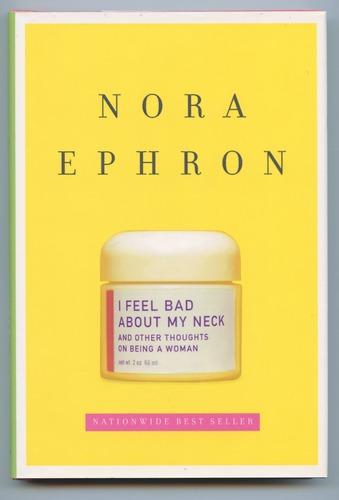
I am a woman who would rather poke her eyes out with a red-hot poker than spend an evening with a bunch of women.  The ubiquity of magazine articles extolling the virtues of our ‘girlfriends’ have never resonated with me.  My girlfriend preference is for the arms-length, mentor type.  And one of those women whose work has inspired (and I daresay influenced me) died last week.  I’m talking of course about Nora Ephron.

I don’t think that her influence on me was in my conscious mind until I read about her death and thought, “We’ve lost a good one.”  Then I started thinking.

In all of my writing (of the non-academic type), my protagonists (whether fictional or real) are strong women, feminist types, ahead of their times or just plain wise.  Although she may have been best known to the masses as a screenwriter, it wasn’t her movies that inspired me – it was her journalistic career and her books.

I first read Heartburn in 1983 or ’84, soon after it was published.  Relating a seriously funny take on the break-up of a perfect marriage, the book resonated with me partly because I had escaped a (less-than-perfect) marriage myself only a few years earlier, and I found her witticisms so spot-on that she captivated me for the long-term.  When I think about some of her most valuable pieces of advice over the years, I’m almost alarmed how much I agree with her.

When she said, “I am continually fascinated at the difficulty intelligent people have in distinguishing what is controversial from what is merely offensive,” I found myself nodding in agreement.

And then there was advice for living: “Oh, how I regret not having worn a bikini for the entire year I was twenty-six. If anyone young is reading this, go, right this minute, put on a bikini, and don’t take it off until you’re thirty-four.”  Yes, I should have done that.

But of course, she also said, “Above all, be the heroine of your life, not the victim.”

Amen.  And I don’t feel bad about my neck.  Yet.  Sigh.