Someday I’m going to write a Christmas book. But since I also plan to try my hand at a travel book, perhaps I’ll write a Christmas travel book.
I’ve been thinking about this over the past week as I get ready to head out on the annual Christmas pilgrimage to visit our peripatetic son who now dances with Les Ballets de Monte Carlo in Monaco. Spending Christmas in a hotel might not be something that many of you would like to do, but I hardly know how to spend Christmas any other way at this point in my life! So, I think I’ll write about Christmas in a hotel. I’m going to think about that over the next couple of weeks, but before I leave, I thought I’d give my writing blog readers a bit of a Christmas gift — a book recommendation and a Christmas travel story.
Have you read Skipping Christmas? At fewer than 200 pages in a small format, it’s one of John Grisham’s lesser known books. However, if you’re a Christmas movie junkie, you sort of know the story. Hollywood turned his gem of a book into Christmas with the Cranks. I wish they had kept the title and a bit more of the soul of the book. Grisham’s story-telling has a lot more depth than the scriptwriter’s has; you should order the book, pour yourself a drink of your choice, and curl up with it before the onslaught of the season begins in earnest.
We tried to skip Christmas one year… I now invite you to our travel blog to read about it. Merry Christmas – or whatever other kind of holiday you might be celebrating. Just click on the Christmas tree…
Green Darkness: The original cover from 1972. I remember it well.
From time to time I wonder if what I read as a child and young adult has had any impact on what I write today – or on what I like to read. It would make sense that it would, since what we read and experience do influence us in many other ways (our beliefs, attitudes etc.). It’s in my mind right now because I’m currently re-reading a book that was one of my favorites back in the early 1970’s and has stayed in my mind for many years (it has also made me wonder if books I loved years ago would feel the same to me now.)
The book is Anya Seton’s classic historical novel Green Darkness. I remember the feeling of the book more clearly than the content of the story. I remember being swept up in it as the characters move from the 20th century to the 16th and back. It’s a bit of a romance I guess, but it’s the historical detail and the characters that paint the picture for me. As I read it now, with the benefit of maturity (I guess), I’m struck by the writing this time around. Seton is a classic historical novelist who died in 1990 but not before writing more than a dozen books, many of which were bestsellers, and several of which were subsequently made into movies. But, back to my original musing: has this book that I first read thirty years ago influenced my writing?
I think it probably has – but it’s difficult to say which came first – the reading or the influence. Why did I choose the book in the first place? I think my sister recommended it, but if I were not interested in historical fiction I would likely have ignored her – God knows I have ignored other recommendations she has made over the years!
So, there must have been something that compelled me to read and enjoy historical fiction at that time – long before I ever considered writing it. Somehow, though, that love of reading historical fiction has manifested itself in my love of research and writing in this area, and not because I studied history in university. I did not. So if Anya Seton’s work (after Green Darkness I read several others all of which I enjoyed), influenced me, what other kinds of books influenced me? Or at least, what are the most memorable books I read over the years?
At the top of the list – more of a favorite than Green Darkness – is Rebecca by Daphne DuMaurier. If asked to identify my favorite all-time book, this is it. It is, of course, now a classic (originally published in 1938) and it has been made into a move more than once.
Eighth Moon: Today's cover with its sub-title.
I also remember a book called Eighth Moon by Sansan as told to Betty Bao Lord which I notice now has a sub-title (I’m certain it did not when I read it – I wonder if we need sub-titles these days to select books). The modern sub-title is The True Story of a Young Girl’s Life in Communist China and it takes me back a very long time.
I know that I read a lot of books back then, but this is the only one I remember. I can remember particular aspects of the book, like when she had to work in fields where human feces were used as fertilizer, and that’s going back a very long time in my life. I read it in junior high school.
Eight Moon: The original cover -- the one I can actually remember!
I can only imagine how I found the story so divergent from my own life experience with this young woman who was about my age at the time of the story.
I can’t really articulate what it is about the book that it is the only one I remember from that point in my life, but I’m sure that remembering is reason enough to think it has influence.
I recently became the founding editor-in-chief of a new academic journal. Although this might not seem all that exciting to the average writer, it has opened my wide eyes even further on the topic of the “right fit” between writers and publishers. I am stupefied by the astounding lack of research that prospective writers do about the theme and focus of the journal and our manuscript requirements. Do writers who want to be published – regardless of whether they are writing an academic article or a fantasy novel – not have the intellectual capacity to grasp the concept of editorial fit, and that they need to do at least a modicum of information-gathering to check this out?
The truth is that I’ve had a surprising number of submissions to the journal that are (in no particular order of importance): longer than the maximum length for our manuscripts (and I’m not talking about a few hundred words; I’m talking about three to four times longer than our editorial guidelines clearly state); only peripherally related to the focus and objectives of the journal and then only if you really squint at the manuscript; not formatted in any way that resembles the guidelines that are clearly posted on the front page of the journal’s web site. I don’t think I need to go on.
If you are a writer (like me) and you want to be published (like me) there are lessons to be learned about finding the right publisher – the one with the right fit. Because if you don’t, the publisher will simply send you a rejection slip and that’s so hard on the ego and a waste of your time! I’ve been published by a variety of publishers – types, sizes and countries (USA, Canada, UK), and along the way, I’ve learned a few things about finding that important right fit. The first two steps I recommend are as follows:
Find a publisher that actually publishes in the genre that you want to sell to them. This seems like a no-brainer to me. The very first time I wanted to sell a book to a publisher, I knew that it would be pointless to send it to a publisher with no interest in books about health-related topics. Publishers usually do make a statement on their web site (on the prospective author page) about what they do and do not publish.
Find a publisher whose books are targeted toward the same reader that yours is. And forget about writing to the publisher’s needs rather than the audience you intend for the book. When I first started writing, I was clearly focused on health-themed trade books for that nebulous “general public.” I had an idealized notion that I would “educate” the masses about health issues, so I had to find a publisher whose books reflected that. I had to examine their current and back-list to see what they’d done before – because publishers are not likely to see your book as the one that pushes them toward a different audience. If they only publish children’s books, then forget about your romance novel!
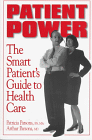
My first-ever book published by a now-defunct Toronto publisher. I had to do research to find the right fit.
Now that you’ve narrowed your search and have a list of publishers whose list reflects the type and readership of your own material, you still have a few more steps before you can submit your work.
Research their submission requirements. This is very important. (who knew writers were so lax about this!) It is the packaging of your ideas, and if it doesn’t conform to their particular guidelines, it means that they are likely to reject your work. If you’re submitting non-fiction, you’ll need to determine exactly what they’re looking for in terms of a book proposal – the format, content & length. Not all publishers want the same things, but all of them cover some important bases: Can you succinctly state the purpose and market for your book? What is it about? Why are you the right one to write it? How is it structured? What’s in each chapter? When will it be finished? How long will it be? If you’re submitting fiction, do they actually accept unagented books? How much of the novel do they want to see? If you send too much, they might not read it.
Make sure that your query conforms exactly to their requirements.This is a non-negotiable issue for unpublished writers. And, frankly, why would you not follow their guidelines in preparing your submission? It shows that you are professional, you are smart and you are interested enough in them as your potential publisher that you took the time to educate yourself about them.
Submit the query in precisely the method they prefer. Do they accept email submissions? If so, should it be an attachment or a query in the body of the email? Or must you fill out an online form? Must you send a hard copy? How many copies do they need? Do they want a self-addressed, stamped envelope for a response and/or return of the materials? When I first started writing and sending materials out to publishers, this latter approach was the only way they could be submitted, and some publishers actually continue this antiquated approach. That meant making photocopies and sending large envelopes with folded pre-addressed and stamped envelopes inside, and waiting months for a response in the mail. (Truth is you might still wait months even with an emailed submission.)
Send your query to the right person if at all possible. Do a little research and find out which of the editors actually acquires (and therefore presumably enjoys) the kind of material you are sending. Then you can address your query to the right individual which is far preferable to sending it to the info@ email address on the web site.
Keep meticulous records of where and to whom you send a query. This will really help you to see a pattern of publishers and their needs, and it will ensure that you do not look unprofessional by sending a query to a publisher who has already rejected you. Very embarrassing.
After following all of these rules, I still get responses from publishers that say things like: “This is a very interesting proposal. It just doesn’t seem to fit in with our publishing program at this time.” B**s***. What the editor is really saying is that they just don’t like it. Their “publishing program” as such doesn’t really change much. So, don’t let verbiage like this fool you into thinking that “at this time” might mean “perhaps another time.” It doesn’t. You just move one. And when that email comes saying, “We like this proposal very much. We’d like to consider publishing your book,” you know that your prep work has paid off!
I actually sent out a book proposal this past week myself. It’s one of those books that I’ve been mulling over and keeping notes about for a few years. When I sent it in, the publisher replied asking me where I had learned of this publisher. I had done my homework. I was alerted to this particular niche publisher through a group I belong to on the business network site LinkedInwhich I’ve recently begun to see as a serious contender for writing leads. Then I did my homework. I researched the publisher, the books they’ve published, their authors (a number whom are people whose work I admire), and the publisher himself. I wanted to know his background. I told him all this – including the part about researching him.
His response was that I seemed to have the ideal credentials to be writing the book I proposed. We’ll see. I’ll let you know how the road to this one progresses.