Posted in Publishing, Traditional Publishing, Writing, Writing books

Writer: Know Thyself!

I was perusing my bookshelf this morning (in truth I was looking for a couple of books with the right spine width to wedge under a door my husband was re-installing – but I digress), when I happened upon one of my favourite old books. Over the years I’ve culled my book collection mercilessly, but there are a few that still remain on my shelf. Written by literary agent John Boswell, this one has remained one book that I do re-read from time to time, just to keep me grounded as a writer.
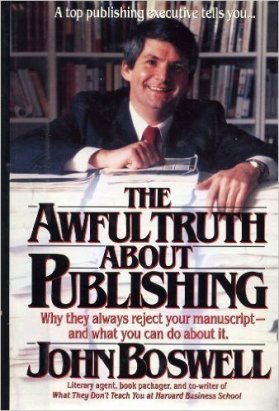
the awful truthIt is titled The Awful Truth About Publishing: Why they always reject your manuscript – and what you can do about it. In spite of its age (it was published in 1986 by Warner Books), and the concomitant fact that it was published long before the advent of the eBook era and the avalanche of self-publishing, it remains one of the best reads to help a writer with her head in the clouds to keep her feet on the ground – which is the only place to be if any real success is to follow.

As I cracked the cover (hard cover at that) I opened the book at Chapter 4: “The Awful Truth About Yourself.” And it does seem to me in these days when the “cult of the amateur” shrouds just about every facet of artistic endeavour (movie-making, music production and, yes, you guessed it, writing) it might be worthwhile for aspiring and other writers to do a bit of navel-gazing. Are we always aware of the truth about ourselves? Based on some of the drivel I’ve read recently, coupled with the book-marketing noise on the Web, it seems that many “writers” are, indeed, blind to some truths about themselves. And I put myself in that category from time to time.

Boswell offers this: “Writing, for the gifted few, is an art, and the chances of reaching this level are about as good as they are of becoming a prima ballerina or a major league second baseman” (The awful truth about publishing, p. 41). I love to be reminded that writing is indeed one of the arts, a factoid that seems to be forgotten by those among us who harp on ‘authorpreueurship’. While I’m all for the notion of self-help even in writing, let’s be clear that if you’re writing a book with the clear objective of making money, then this isn’t art.  It’s content creation and it’s okay. But it isn’t art. Some of my own work – or at least work in progress – seems to bend in that direction, while other work is simply seeing if I can create a piece of art that will entertain and perhaps even provoke.

He then goes on to make a statement that, had he been able to gaze into a crystal ball and see the future of publishing as we know it today he would have realized is even more profound. “Fortunately,” he writes, “…writing is also a craft and one which can indeed be learned by almost anyone. But…it is still not something that can be learned overnight, or a skill that pops into your head, fully honed once you ’get around’ to putting your publishable thoughts on paper…” (p. 41). And here is where it gets really muddy these days.

Boswell poses a question that I’ve often asked my own students – and use to ask myself. Do you want to be an “author” or do you want to write? It’s much the same question as do you want to write, or simply to “have written”? And these days we might also ask: do you want to be a writer or a content creator? One is not fundamentally better than the other, but they are different. They have different objectives, processes and audiences. In my view it’s really only a matter of knowing yourself. I’m trying.

[I’ve written about ‘content creators ‘ here  https://backstorywriting.wordpress.com/2014/06/04/are-you-a-writer-or-a-content-creator/ ]

Posted in Self-Publishing, Writing

10 Common Mistakes of Self-Published Writers

oopsOkay, we’ve all made mistakes. And I doubt that there’s a writer among us who has yet to experience a misstep in his or her writing career. Throughout my (long) writing and publishing history, I’ve made my share of doozies (To read about one of them see The dumbest publishing decision I ever made), but to broaden my observations even further, I’ve observed a long litany of mistakes among my fellow authors as well. Here are the ten I believe to be the most common.

  1. Publishing a first (or even second) draft. As a new writer, you might think that your writing is just fine the way you put it onto the page or computer screen. It isn’t. Believing in the infallibility of a first draft is the hallmark of an inexperienced writer. The more experienced you get, the better your writing gets. And the better your writing gets, the more you realize that the first draft (or even second) is not the draft you want ANYONE to read – not even your beta readers. Have a bit of respect for their time.
  2. Failing to take the time for writing practice – without publishing a single word of it. Just like figure skaters, pianists and dancers to name only a few, writers need lots of practice before any of their words should see the light of day. It’s a question of quality.
  3. Believing that basic building blocks of writing – grammar, spelling and syntax come immediately to mind – aren’t important. I’ve actually heard neophyte authors on online forums arrogantly suggest that readers don’t care about these things if the story is a good one. I beg to differ. Many care a lot and you should too. It is impossible to convey the right message/story if you and your readers are not using the language in the same way. Remember the book Eats Shoots and Leaves? If you don’t, you need to read it. Immediately.
  4. Failing to carefully copy-edit. Or even better, failing to hire a professional copy-editor to do it for you. New writers don’t seem to know the difference between a substantive edit (which gets you from draft one to two to three etc.) and a final copy-edit. Every book out there – even ones that are professionally copy-edited – can harbor typos and other errors that are missed at this stage in the publishing process. That doesn’t make it okay for you to publish a book that hasn’t been edited in this fine fashion.
  5. Designing your own book cover (without even a modicum of design experience or talent). If you do have graphic design experience, then I think you should go ahead and design your cover. In fact, you are probably the best one to do it since you know the book intimately. However, without this kind of background, you need to step away to avoid a book cover that makes it onto sites like Lousy Book Covers or in articles like Kindle Cover Disasters: the world’s worst ebook artwork . Readers do garner a lot of information about a book from its cover. Primarily they decide if they want to read it. Or not.
  6. Failing to do a final format check after conversion of a Word file to PDF for publication. I’ll admit it – I’m guilty of this one. Before I realized that PDF’s would read some of the background formatting that I could no longer see in the Word document, I blithely thought that once I had done a final review of the Word document, that was enough. Not so much. That PDF needs a careful final review before hitting the ‘publish’ button.mistakes
  7. Disregarding the importance of writing and carefully editing the book’s online description. Mother of God! How many times have I read online book descriptions with typos?! Sentence structure problems?! Grammatical errors?! Of course not to mention those ones that fail to provide even a modicum of persuasive copy.
  8. Continually tweeting “Buy my book, buy my book.” This is beyond annoying to those of us who would otherwise like to follow your contributions to Twitter. Once in a while it’s fine to promote your book, but don’t do it in every tweet. And don’t do it every single, blasted time you contribute to a LinkedIn Author discussion. This is beyond irritating. (For more on this rant of mine read When book promotion gets annoying.)
  9. Failing to understand that you need to connect to readers online – not a whole lot of other writers who are equally trying to sell their books. Unless your book is directed to writers (uh…hem…some of mine are) you’re barking up the wrong tree.
  10. Apologizing for being self-published. Can we all just stop it? If you write well and provide readers with a quality product that respects them, you don’t need to apologize for how it got into their hands. Readers who love your books don’t care.

I think that creating quality material in whatever genre, and providing it to readers with respect are the two most important parts of being a writer – regardless of who publishes your work.

Posted in Writing, Writing craft

When is a book too long?

big bookI just started reading a book that clocks in at over 900 pages.  900 pages!  Just imagine that.  Before I bought it I read the online reviews on Amazon.  The reviews were good but one issue kept cropping up: the book was too long.  In fact, this particular novelist is known for her long books, usually in the vicinity of 500-600 pages.  I’d read several before.  I haven’t read a book that long since I read Herman Wouk’s wonderful “Winds of War” which is over 1000 pages in pocket paperback size.

This got me thinking:  How long should a book really be?

If you are to believe Chuck Sambucino (whose work in Writer’s Digest I do admire), any book over 110,000 words is too long.[1]  This seems entirely too didactic to me unless we’re talking about specific genres such as children’s books.  That would mean that many very famous and well-loved masterpieces are “too long.”  Of course, any bad piece of writing is too long even at 60,000 words which he further suggests is too short.  It’s not that cut and dried.

Kurt Vonnegut reputedly gave this advice to writers: “Start as close to the end as possible,”[2] which suggests to me that there is likely a place in every story that is the best place to enter it.  Indeed, I believe that this applies equally to non-fiction and fiction.  Starting too far from the end means that you’ll include far too much extraneous material.

I really don’t believe that here is any ideal length. If a story sustains itself for a long session, then that’s probably right.  However, over the years I’ve challenged students to take their best 1000 words for example, and edit it ruthlessly down to half that length.  Then, I’ve said, you’ve got really tight writing.  You have to do it without losing the message of the piece and leave out every extraneous word.  They hate it because they want to keep every bon mot, every personal device and turn of phrase.

When William Faulkner said, “In writing, you must kill your darlings,” this is exactly what he meant.  (Note: This phrase has been variously attributed to Anton Chekov and Oscar Wilde, among many others. I’m going to stick with Faulkner.)

Not every word we write needs to make it to our reader.  Keeping unnecessary material suggests to me one of two things: either you are a serious narcissist who believes that every word you write is precious, or you are seriously in need of an editor.  And in that royal “you” I include myself sometimes.  We all do it.  I’ve even argued with editors about their opinions on some things to leave out. They usually win.

For beginning writers, I think that the biggest pitfall in keeping the story to the essentials is including too much backstory.  Backstory is for us – the writers – so that we can come to know and animate in our own imaginations our characters and the places they where they live and breathe.  This applies equally to fiction and non-fiction.  Knowing how to reveal and how much to reveal is the key to a tight story.  When I’m reading I can always tell when a writer wants the reader to know just how much research he or she put into a story.  And I shouldn’t be able to sense that.   Just as in our interactions with people around us, our interactions with books can have TMI: too much information.

I think that it’s wise to understand that your notebook s and the material contained in them are first and foremost for you, the writer.  Making a decision about how much of that you need to share with your readers is one of the keys to good writing.

I’ll let you know how I feel about the 900-word book – if I ever get through it!

[1] Chuck Sambucino. Word Count for Novels and Children’s Books: The Definitive Post. Writers’ Digest online. http://www.writersdigest.com/editor-blogs/guide-to-literary-agents/word-count-for-novels-and-childrens-books-the-definitive-post

[2] Kurt Vonnegut: 8 Basics of Creative Writing. http://www.writingclasses.com/InformationPages/index.php/PageID/538