Posted in Publishing, Traditional Publishing, Writing, Writing books

Writer: Know Thyself!

I was perusing my bookshelf this morning (in truth I was looking for a couple of books with the right spine width to wedge under a door my husband was re-installing – but I digress), when I happened upon one of my favourite old books. Over the years I’ve culled my book collection mercilessly, but there are a few that still remain on my shelf. Written by literary agent John Boswell, this one has remained one book that I do re-read from time to time, just to keep me grounded as a writer.
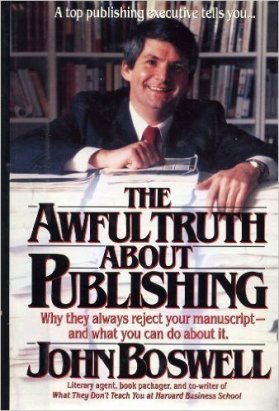
the awful truthIt is titled The Awful Truth About Publishing: Why they always reject your manuscript – and what you can do about it. In spite of its age (it was published in 1986 by Warner Books), and the concomitant fact that it was published long before the advent of the eBook era and the avalanche of self-publishing, it remains one of the best reads to help a writer with her head in the clouds to keep her feet on the ground – which is the only place to be if any real success is to follow.

As I cracked the cover (hard cover at that) I opened the book at Chapter 4: “The Awful Truth About Yourself.” And it does seem to me in these days when the “cult of the amateur” shrouds just about every facet of artistic endeavour (movie-making, music production and, yes, you guessed it, writing) it might be worthwhile for aspiring and other writers to do a bit of navel-gazing. Are we always aware of the truth about ourselves? Based on some of the drivel I’ve read recently, coupled with the book-marketing noise on the Web, it seems that many “writers” are, indeed, blind to some truths about themselves. And I put myself in that category from time to time.

Boswell offers this: “Writing, for the gifted few, is an art, and the chances of reaching this level are about as good as they are of becoming a prima ballerina or a major league second baseman” (The awful truth about publishing, p. 41). I love to be reminded that writing is indeed one of the arts, a factoid that seems to be forgotten by those among us who harp on ‘authorpreueurship’. While I’m all for the notion of self-help even in writing, let’s be clear that if you’re writing a book with the clear objective of making money, then this isn’t art.  It’s content creation and it’s okay. But it isn’t art. Some of my own work – or at least work in progress – seems to bend in that direction, while other work is simply seeing if I can create a piece of art that will entertain and perhaps even provoke.

He then goes on to make a statement that, had he been able to gaze into a crystal ball and see the future of publishing as we know it today he would have realized is even more profound. “Fortunately,” he writes, “…writing is also a craft and one which can indeed be learned by almost anyone. But…it is still not something that can be learned overnight, or a skill that pops into your head, fully honed once you ’get around’ to putting your publishable thoughts on paper…” (p. 41). And here is where it gets really muddy these days.

Boswell poses a question that I’ve often asked my own students – and use to ask myself. Do you want to be an “author” or do you want to write? It’s much the same question as do you want to write, or simply to “have written”? And these days we might also ask: do you want to be a writer or a content creator? One is not fundamentally better than the other, but they are different. They have different objectives, processes and audiences. In my view it’s really only a matter of knowing yourself. I’m trying.

[I’ve written about ‘content creators ‘ here  https://backstorywriting.wordpress.com/2014/06/04/are-you-a-writer-or-a-content-creator/ ]

Posted in Writing, Writing books

Maybe you shouldn’t be a writer

[Excerpted from Who Will Read Your Book?  The Unknown Writer’s Guide to the Realities of Writing & Publishing forthcoming from Patricia Parsons]

This is worth considering.  If you want to be a writer, and are considering who you are as a writer, it might be a useful exercise to consider all the reasons you shouldn’t write a book.  If you do this and at the end still believe that you should write your book and work to get it published, then you’ll be stronger as you move through the process.

Lots of people have put together lists of why you shouldn’t write. For example Susannah Breslin, writing in Forbes online, suggests the following three reasons you shouldn’t write: (1) you’re not good at it; (2) it’s too hard; and (3) it’s too hard to make money.[i] These are all valid points in my view. What’s so interesting is that in a later post, she says that her short piece on why you shouldn’t be a writer is the one that readers hated most.[ii]  It seems those who want to write a book don’t want to be told the reasons why they shouldn’t pursue it.  But you do need to hear this before you move forward.

Blogger Karen Yates has a few more ideas about why you shouldn’t write that book.  She suggests that you back away from that computer if (1) you want to write because you think it will be fun or easy; (2) you want to write because you have a lot of Twitter followers; (3) you think the topic is one you think you can sell even if you’re not passionate about it; (4) if you can’t take criticism (she says editorial: I think you need to have a thick skin in general); and/or (5) you’re not willing to promote your book.[iii] Again, these are all good considerations.

After a couple of decades of writing books myself, I’ve determined that people should write if they want to: what they shouldn’t necessarily do is publish.  If you want to write, remember that it will be a difficult process, but go ahead regardless of what anyone tells you.  Then take that manuscript and put it away to read in your dotage.  Don’t try to sell it to a publisher, and under no circumstances should you self-publish it. That is unless you remember the following which are my personal reasons that should give wannabe writers pause.

Do not publish your writing even one of the following statements applies to you:

  1. You’re writing as a form of catharsis. That’s what your private, personal journals are for.
  2. You’re writing because you’re angry about something. At least don’t publish anything until the anger subsides and you can look at the matter more objectively.
  3. You’re writing on a topic only because you think it will sell. If you are not passionate about it, it’s not worth writing about.
  4. You don’t believe that writers read. Any published writer worth his or her salt reads a lot and reads widely.
  5. You aren’t willing to do the research that will be necessary regardless of genre.
  6. You aren’t willing to work to continually improve your writing.
  7. You think that you’ll simply sit down in front of the computer and the words will flow.
  8. You can’t stand revising.
  9. You don’t have a thick skin.
  10. You spend more time talking to others in person and online about your writing than you do writing.

Once you have looked inward and can honestly say that none of these statements applies to you, it’s time to get on with finishing your book.


[i] Susannah Breslin.  Why you shouldn’t’ be a writer. Forbes online.  http://www.forbes.com/sites/susannahbreslin/2012/06/12/why-you-shouldnt-be-a-writer/

[ii] Susannah Breslin. Why you should be a writer. Forbes online. http://www.forbes.com/sites/susannahbreslin/2013/03/30/why-you-should-be-a-writer-2/

[iii] Karen Yates. 5 reasons you shouldn’t write that book.  http://goo.gl/S8L05l


Posted in Book publishers, Writing books

What writers need to know about literary piracy and copyright infringement in the digital age

pirateI was surfing the net the other day and happened upon one of my books – I mean that in the truest sense.  I actually happened upon one of my books – in its entirety, cover scan included, every page in a PDF file posted for all to access.  I immediately copied the URL and emailed my publisher in London.  The rights editor got back to me very quickly indicating that this “piracy” would be uploaded to their “infringement portal” and that a take-down notice would be sent immediately.

Unbeknownst to me, my publisher (and presumably others) has this portal that identifies sites like this that pirate copyrighted material, and they are proliferating as we speak.  This one was a new one to them, not already identified (BTW it was www.gendocs.ru – if you have a book out there, you might want to check it).   So I started to do a little research about the current state of online piracy.

Remember when the music industry clamped down and put Napster out of business?  It seems that some of the same activities have been happening in the literary world, but these sites continue to proliferate.  Here are the things that I learned from doing a bit of research.

  1. Your book may well be pirated.
  2. Even if your book is available only in hard copy, it may still be pirated. Literary pirates can procure book-scanning software easily. The book that I stumbled on is available also as an eBook, but this looked like a scan of the hard copy.
  3. There has been an exponential growth in online literary piracy since 2009.
  4. Although there is now a well-established anti-literary-piracy movement on the part of publishers, as fast as one site is shut down, another one pops up.
  5. Piracy sites may have no ethical concerns about ‘stealing’ your book, but evidently they are very concerned about being sued. This means that when approached to cease and desist, they usually do, taking down the identified book.
  6. If you are published by a traditional publisher, they will have an on-going anti-piracy effort (something you should probably ask them about – I didn’t), although some new sites get by as in the case where I identified a previously unknown one for my publisher.
  7. If you are self-published, you can search for your book regularly or better yet set up an on-going Google search for it. If it pops up on a pirate site, you can prepare and send your own take-down letter by identifying the site’s “copyright officer.”

It always saddens me that people think there is something different about stealing intellectual property – music, writing, choreography – than in stealing your cell phone, your car, your wallet.  But there is no difference.  I like to protect my work, and I hope you think enough of your own work to protect it too.