Posted in Publishing, Traditional Publishing, Writing, Writing books

Writer: Know Thyself!

I was perusing my bookshelf this morning (in truth I was looking for a couple of books with the right spine width to wedge under a door my husband was re-installing – but I digress), when I happened upon one of my favourite old books. Over the years I’ve culled my book collection mercilessly, but there are a few that still remain on my shelf. Written by literary agent John Boswell, this one has remained one book that I do re-read from time to time, just to keep me grounded as a writer.
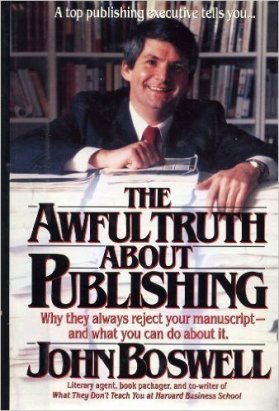
the awful truthIt is titled The Awful Truth About Publishing: Why they always reject your manuscript – and what you can do about it. In spite of its age (it was published in 1986 by Warner Books), and the concomitant fact that it was published long before the advent of the eBook era and the avalanche of self-publishing, it remains one of the best reads to help a writer with her head in the clouds to keep her feet on the ground – which is the only place to be if any real success is to follow.

As I cracked the cover (hard cover at that) I opened the book at Chapter 4: “The Awful Truth About Yourself.” And it does seem to me in these days when the “cult of the amateur” shrouds just about every facet of artistic endeavour (movie-making, music production and, yes, you guessed it, writing) it might be worthwhile for aspiring and other writers to do a bit of navel-gazing. Are we always aware of the truth about ourselves? Based on some of the drivel I’ve read recently, coupled with the book-marketing noise on the Web, it seems that many “writers” are, indeed, blind to some truths about themselves. And I put myself in that category from time to time.

Boswell offers this: “Writing, for the gifted few, is an art, and the chances of reaching this level are about as good as they are of becoming a prima ballerina or a major league second baseman” (The awful truth about publishing, p. 41). I love to be reminded that writing is indeed one of the arts, a factoid that seems to be forgotten by those among us who harp on ‘authorpreueurship’. While I’m all for the notion of self-help even in writing, let’s be clear that if you’re writing a book with the clear objective of making money, then this isn’t art.  It’s content creation and it’s okay. But it isn’t art. Some of my own work – or at least work in progress – seems to bend in that direction, while other work is simply seeing if I can create a piece of art that will entertain and perhaps even provoke.

He then goes on to make a statement that, had he been able to gaze into a crystal ball and see the future of publishing as we know it today he would have realized is even more profound. “Fortunately,” he writes, “…writing is also a craft and one which can indeed be learned by almost anyone. But…it is still not something that can be learned overnight, or a skill that pops into your head, fully honed once you ’get around’ to putting your publishable thoughts on paper…” (p. 41). And here is where it gets really muddy these days.

Boswell poses a question that I’ve often asked my own students – and use to ask myself. Do you want to be an “author” or do you want to write? It’s much the same question as do you want to write, or simply to “have written”? And these days we might also ask: do you want to be a writer or a content creator? One is not fundamentally better than the other, but they are different. They have different objectives, processes and audiences. In my view it’s really only a matter of knowing yourself. I’m trying.

[I’ve written about ‘content creators ‘ here  https://backstorywriting.wordpress.com/2014/06/04/are-you-a-writer-or-a-content-creator/ ]
Posted in Book launches, Books

So, who will really read your book?

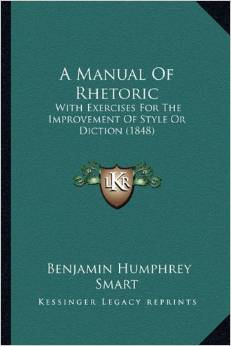
In 1848 a writer named B.H. Smart produced a book quite improbably titled: Manual of rhetoric: with exercises for the improvement of style or diction, subjects for narratives, familiar letters, school orations, &c.: being one of two sequels to “Grammar on its true basis”.  It was published in London by Longman, Brown, Green and Longmans and is reputed to be the oldest publication that could be reasonably described as a writing manual.  Since then, manual after manual has been produced with the objective of improving writing everywhere.

The first writing manual

Today, all you need to do is plug the search term “writing manuals” into Amazon’s search function and you’ll be greeted with almost 12,000 hits; if you plug in “writers’ guides” you’ll be rewarded with almost 19,000.  Within these search results there are the direct successors of Smart’s manual such as the Chicago Manual of Style (originally published in 1906) which, along with the Publication Manual of the American Psychological Association, is one of the go-to, required writing manuals for academic and scholarly writers throughout the English-speaking world.  In addition to these specific style guides there are books for poets, science and technical writers, novelists, memoirists, romance writers, creators of creative non-fiction and every other conceivable type of writer one could imagine.  From the style guides and how-to manuals for specific genres the writers’ guides begin to become more esoteric with books like Anne Lamott’s Bird by Bird: Some Instructions on Writing & Life, and Natalie Goldberg’s iconic Writing Down the Bones: Freeing the Writer Within, to the more recent offering from Stephen King, On Writing: A Memoir of the Craft where writers weave their personal stories around writing advice to inspire would-be writers.  If you’re a writer or aspiring writer yourself, you probably own a few of these – or at least in my view, you should!  All of this seems to be in spite of American journalist and writing guru William Zinsser’s pointed comment in his own best-selling writing guide On Writing Well, that most people have no idea how poorly they write.

Poor writing or not, the rush to publish in the 21st century is more like a torrent where the flood-gates, in the form of agents and editors, are no longer needed to stop the outpouring of book-length publications, for better or for worse.  Writers are flocking to self-publishing with a vengeance.  A quick troll through the social media communities, groups and networks of “writers” suggests that the era of co-dependency is upon us in a way never before imagined as writers look to one another for guidance and moral support in their publishing endeavors.  Rather than being connected to publishers, mentors or readers, they are connected to other writers – all as unknown as they are.

What’s truly puzzling, though, is how no one seems to notice their members who are spelling, grammar and stylistically-challenged, not to mention devoid of talent.  At least they’re not admitting it with their continual five-star reviews of every piece of drivel produced by their peers.  Yet, within all of this publishing-related noise, there are truly unique and important voices that need to find a way out of the slush.  What they all need is a reality check.  I’d like to help to provide that. And help those unique and important voices find their way out of the noise.  So, I’ve written yet another manual – well it’s sort-of a manual.

WWRYB CoverThe purpose of my new book is to provide a tough-love reality check on the vagaries of the new publishing models for aspiring writers while at the same time providing you with a kind of road map based on my experience as a writer, writing teacher, traditionally-published author and indie author.

For my blog readers who have been here a while, you might recognize some of the foundational material in the book – it did evolve from this blog (there’s a whole other story, isn’t it?  Turning blogs into books.  I could tell you…).   There is a whole lot more, though, and I’ve tried to tell readers my own story of making it onto the traditional publishing merry-go-round, and then dabbling in self-publishing.  Along the way, I learned a lot and this experience, coupled with my  research over the years as as a university prof, has resulted in this book.

Here’s the book trailer.  Let me know what you think.

Posted in Backstory, Book launches, Book promotion

Making old manuscripts live again

An old manuscript gets a 21st century makeover.

Earlier this week Jennifer Alsever wrote a piece for CNN Money called “Guerrilla Marketing for Books.”  A cautionary tale for would-be authors, it tells the story of shrinking promotional budgets at traditional publishing houses and the lengths to which authors now must go to get their books to stand out from the ever-increasing numbers of both traditionally and self-published books.  The truth is, it has been ever thus – unless you are a big-name author.

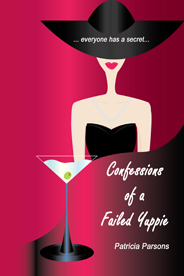
One tactic mentioned in the story is of an author who commissioned a jewelry artist to make necklaces that are featured on her book’s cover as well as a new perfume based on one of her fictional characters. The amount of work and money involved for an author in doing this is staggering to consider.  This, however, reminded me of an event in the provenance of one of my recent ‘new’ books Confessions of a Failed Yuppie.  Stick with me for a few minutes!

If you’ve been reading Backstory for a few years or even months, you might have realized that the “backstory” I’m trying to tell is the anchor of my own experience in writing and publishing.  More than that, though, my objective is to explore the issues that are important to all of us who are more than passingly interested in reading – and writing.  Sometimes I rant about things that have annoyed me; sometimes I tell you a story of my experience.  Sometimes I tell you a real backstory to my writing: what inspired it, how it developed, what happened next.  This post is one of those true backstories.

In the early 1990’s I was on a rant about the Yuppie lifestyle.  So I decided to write a book about it – but rather than a non-fiction examination of the phenomenon, which would have been more akin to my writing experience at the time, I decided to write a novel – a satire of sorts.  I felt strongly, though, that I wanted it published no matter what, so I did what self-publishing authors did at that time, I sent it to a vanity publisher.  (For the working definition of a vanity publisher, you might want to surf back to last week’s post: The confusing world of 21st century publishing jargon: A glossary for writers).

In due course, a box full of hard-cover copies of Yuppie arrived on my doorstep.  What to do with them?  Those were the days before book promotion through online networking channels was de rigeur.  Indeed, there were no social media channels.  Just imagine such a world!  I decided that the first order of business would be to have a book launch.  But before the launch, I’d need some “merchandise.”

The old Yuppie cover and the mug: "I confess: I'm a failed yuppie" with a "reject" stamp!
The old Yuppie cover and the mug: “I confess: I’m a failed yuppie” with a “reject” stamp!

I created a design for the front of T-shirts and for mugs and had dozens of these pieces of paraphernalia created – all at my own expense, of course – and had them available on the day of the pary.  I also had a poster-sized blow-up of the cover of the book so that it could be the focal point of the party, next to the book-shaped cake that adorned the dining room table.  I then created a guest list and sent out invitations.

As parties go, the event was a great success.  We had door prizes of T-shirts that the guests obligingly sported and everyone went home with a signed copy of the book.

As the weeks went by, a number of the guests told me that they had enjoyed the book and when was I going to write another one?

The book, naturally enough, never sold.  Getting a self-published book reviewed in those days was not next to impossible, it was completely impossible.  And since there were no social networks available to promote it, short of taking out advertisements at great expense (I did that once) and going door-to-door with a pile of books (which didn’t sit well with my personality), the book would languish with thousands of others.  And so it did.  Until last year.

Writers have lots of finished and unfinished manuscripts hiding on their hard drives or taking up space in filing cabinets.  I know that most of us should toss most of it, but sometimes a manuscript draws us back and that’s how I felt about Yuppie.

So, I took out the hard-cover copy with its tattered edges and began to write rewrite the book.  It’s now a 21st century Yuppie story, and taking advantage of the digital advances, I decided to make it available once again.

Two decades in the making, Confessions of a Failed Yuppie lives again, and it starts with a definition of Yuppie:


“YUPPIE”: A Definition

Acronym for Young Urban Professional, usually occurring in a married pair (often male/female but not necessarily). Categorized as upper middle class or at least moving in that direction, ambitious, well-educated.  Characterized by excessive concerns about appearances.  Lightly narcissistic.  May have money or at least leverage.  But not necessarily. Normal habitat is the urban condo, sometimes the single-family dwelling of dubious heritage in a downtown area with a postage stamp for a yard, for which a bidding war took place prior to acquisition.  Yuppies with children often move to larger, more impressive dwellings.  Diet consists mainly of cocktails, organic kale and the latest gastronomic fad.  Would not be caught dead in a North-American-produced automobile brand.  Skis in winter, does hot yoga, plays squash (it’s making a come-back), and quietly brags all year round. Widely thought to have become extinct in the early 1990’s.  Not so much.

Maybe you’d like to read the rest.  Or not.