Posted in Writing

When words lose their meaning: Everything is awesome

I really hate it when perfectly good words are stripped of their meaning as a result of inappropriate and over use. Here’s what I wrote about this on the Moonlight Press blog…

Patricia J. Parsons's avatarMoonlight Press

Have you noticed something? Everything these days is awesome.
Your coffee order at Starbucks is, “Awesome!” or so says the barista. You’ve just
told the drycleaner that you’re dropping off two suit jackets. That, too, is “Awesome.”
The sad truth is that when everything is awesome, nothing is awesome.

When did those of us who publish books get so crabby? But we
are crabby about this kind of devaluation of formerly useful words.

Many years ago, we were the ones who cringed every time
someone said that something was “groovy.” We just gritted our teeth and hoped
that the day would come when it would die out. It did.

But now we have a bigger problem because the word we are
having a problem with is a real word that has a specific definition that dates
to the sixteenth century. “Groovy” on
the other hand, has a somewhat looser…

View original post 305 more words

Posted in Backstory, Uncategorized, Writing, Writing books

Reviving old manuscripts: 5 things a writer might consider

life without endMany years ago – in a former lifetime even before my academic career – I worked in the field of organ transplantation. I was called an “organ procurement officer.” An odd title, you say? Yes, odd indeed. My responsibilities included overseeing the transplant coordinators who were tasked with ensuring donor organs made it to appropriate recipients (kidneys and livers mostly in those days), and the public education programming for increasing organ donations. This latter responsibility involved developing strategic promotion plans, writing about organ donation and making copious numbers of public presentations. All in a day’s work.

While I was working in the field I became fascinated with the myriad ethical dilemmas posed by the transplantation process itself, but more so by the way the health professionals involved in transplantation demonstrated a kind of fervour, often bordering on the religious, about their chosen medical field. It was this fascination that led me to research and write my very first non-fiction book many years ago.

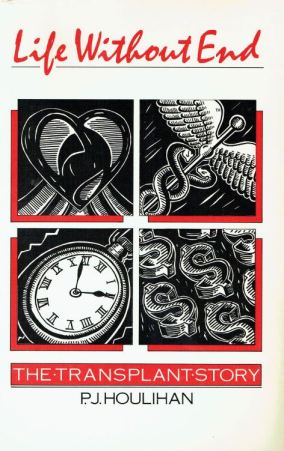
Life Without End: The Transplant Story was my take on the ethics and politics of organ transplantation in Canada at the time, and I think it’s fair to say that not all of what I wrote made the folks I had worked with happy. Some of them were very unhappy indeed.

That was my last job in the real world before I started my academic career, but stories about organ transplantation never really left my monkey mind. So, not long after that first book was published I started writing a novel about what might happen if that kind of religious fervour about transplantation got out of hand. When I finished the manuscript I shopped it around to agents which resulted in finding one who actually loved the story and decided to take it on. She did her job (or at least I guess she did – we never did meet only talked on the phone), sending me detailed lists of where she had sent the manuscript and what the results were. She never did sell it, so I filed it away in the depths of my electronic writing files and almost, but not quite, forgot about it.

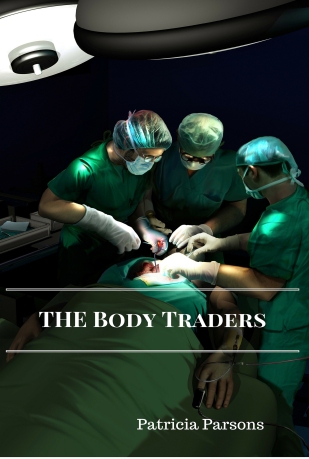
With the advent of electronic publishing the idea of reviving old manuscripts in my files began to take shape. I’m a firm believer, though, that not everything we write needs to be published, or even should it be published. Sometimes our writing is either for our eyes only (or ought to be) or it is our writing practice. I had never thought of this novel as being practice, though; rather I had believed it was ready to make its way out into the world. So I finally decided that The Body Traders would see the light of day.THE Body Traders cover FINAL for print front
First I reread it and found that I still loved the story. Then I spent a lot of time over the past year rewriting and updating it. You can well imagine that a book written more than a decade ago would need a tweak or two: for example, back when I worked in transplantation we carried pagers – no one even had a cell phone! Updating was indeed required!

I considered shopping it again, but in the end decided to self-publish. So, what did I learn from this process? I learned that there are several things you need to consider when deciding to revive an old manuscript.

  1. Ask yourself why you want to publish it now. Do you just want to see it in print (electronic or otherwise)? If the answer is yes, I suggest you need a better reason. There are a lot of books out there these days that no one will ever read. If you really don’t care if anyone else reads it, perhaps you need to put it away. “Publication” and “publish” both refer to “public” meaning that the work should be for the public.
  2. Reread it to see if you still feel as enthusiastic about it now as you did when you finished it. If you don’t, put it back in the electronic drawer and step away.
  3. Analyse it for it currency. Are the ideas still resonant? Will current readers appreciate the themes? If you aren’t sure, ask someone whose opinion you value to read it. Perhaps even consider beta readers.
  4. Edit the manuscript for specifics that will bring the details up to date. For example, if the protagonist still uses payphone, unless it’s part of a quirky character trait, you need to do a bit of updating.
  5. When you have finished the rewrite based on your own analysis, feedback from others’ and your update, read it again to see if you still feel enthusiastic. If the answer is yes, you’re ready to press the publish button!
Posted in Writing craft

Eight common delusions of unknown writers

stack of books

There are lots of little lies we all tell ourselves regardless of our art, craft or career.  Sometimes we even share these little lies with others.  Over the past quarter of a century in the trenches of writing books, teaching writing and publishing, I’ve told myself any number of little lies – lies such as “the editor is wrong,” or “I could design a better cover than this one,” or “this first draft is pretty good.”  Sometimes all I need is a swift mental slap up the side of the head by someone whose literary opinion I trust to know that these truly are lies.  These days I notice that the more people who think of themselves as writers, the more the list of those little lies grows.

I belong to a number of very interesting online writers’ and authors’ groups, mainly on LinkedIn and a few on Facebook.  I had the misfortune the other day to read an excerpt posted by a young woman (at least she looks to be a young woman from her photo) of her new self-published book.  To say that it was abysmal would be an understatement.  Where do I begin?  Should I describe her sentence structure mistakes, her appalling lack of any grasp of writing transitions, her continual use of dangling participles to the point that I had no idea what many of her sentences were trying to say – or should I jump directly to the preposterous situation in which the heroine finds herself?  A modicum of research would have led this young writer to a more realistic and therefore more compelling story.  And this is the point at which I sigh and worry about the lack of quality control in self-published writing.  As I’ve said before…

the problem that faces writers and would- be writers in the 21st century is that it is actually possible to publish every bit of genius and garbage that we produce.  And it needs to be said that we all produce some garbage, but only a few produce works of genius.  Most of us inhabit that place somewhere between those two extremes in our usual writing

Maybe we’re not really lying to ourselves: perhaps many unknown wannabe writers are actually living in a dream world where certain delusions govern their behavior.  So, based on 25 years of experience and anecdotal observation, I offer you my eight common delusions of unknown writers:

  1. Talent is over rated. Anyone can be a successful writer. The sad truth is that although talent is not enough, it is necessary for success. And this is true of any field. However, along with that talent, you need to work hard, develop your craft and practice before you’re ready for prime time.
  2. grammar copyNo one cares about grammar. I beg to differ. Everyone cares about grammar; it’s just that some of them don’t know about it. First there are the grammar police readers who will think you a complete idiot if you demonstrate a lack of command of the language. The second group is those who note that you are making grammatical errors and will tell everyone who might otherwise read your book to stay away. Then there are those who wouldn’t know a grammatical error if it came up and bit them, but they do know when they don’t understand the meaning of something. It seems to me that you want to be able to convey a particular message or story and to do that accurately, we all need a shared understanding of the use of our language. Period. Get out the grammar book.
  3. I write better than most people. Can you hear me laughing? This is so untrue as to be hilarious. I have spent almost a quarter of a century teaching and marking university students’ writing – and these are students whose writing will form a very large part of their careers. I’ve seen many good writers who need just a bit of sharpening; but more often I’ve seen honor students who don’t know that their writing is a problem. As American writing guru William Zinsser says, “Most people have no idea how badly they write.” And if you don’t know who he is, stop reading and go immediately to Amazon and order his book On Writing Well. Then read it.
  4. Thousands of Twitter followers guarantee success. Now I’m grinding my teeth. If would-be writers spent as much time practicing their writing and having it edited by someone who knows what he or she is doing rather than amassing thousands of Twitter followers, success would be more likely. Most of our followers are not potential readers; rather they are other writers who are using Twitter for exactly the same reason you are.
  5. I don’t need an editor. Au contraire. Everyone needs an editor. My arguments over the years with editors notwithstanding, I am singularly unable to completely free my own work of errors, typographical and otherwise. I have never met a writer who didn’t need an editor.
  6. If my friends think my idea is great, so will everyone else. I just have one question for you: how did you get friends with such deep knowledge (backed up by data) about how your target readers will think at any given time? The rest of us would love to know. Your friends are your friends for a reason and if you hope that your book will garner more readers than your circle of friends, you’ll have to open your mind beyond that circle.
  7. I don’t need to plan my writing, I just need to write. Well, you do need to write, but this kind of unplanned writing is called “writing practice” or “journaling” and it isn’t for public consumption. If, however, you plan to publish, you need to think about the writing, as well as ‘do’ the writing. The amount of planning you need, however, is very variable. It depends on genre, process and your own writing style. For example, if you write non-fiction, it needs considerable research and a complete outline (fleshed out into a complete proposal if you’re planning a traditional publishing route) before you even write word. Even fiction can benefit – and especially genres like historical fiction that follow a time-line and need extensively researched background. Plotting for mysteries and thrillers also helps the writing process. That said, once the writing begins, it need not stick to the outline!
  8. I don’t have time to read. If you don’t have time to read, then you don’t have time to write, and you shouldn’t. Writers are readers. They read in their own writing genre. They cross-read. They read to do research. They read to flesh out or even come up with ideas. They read to improve their own writing. They read to get to know the competition. They read to get to know what their target readers like. They read to see what sells. They read because they love language and books are important to them.

There you have them.  My eight delusions.  Now I’m going to go back to my incomplete manuscript and convince myself that indeed, I do need and editor.  And soon.