Posted in Self-Publishing, Writing

10 Common Mistakes of Self-Published Writers

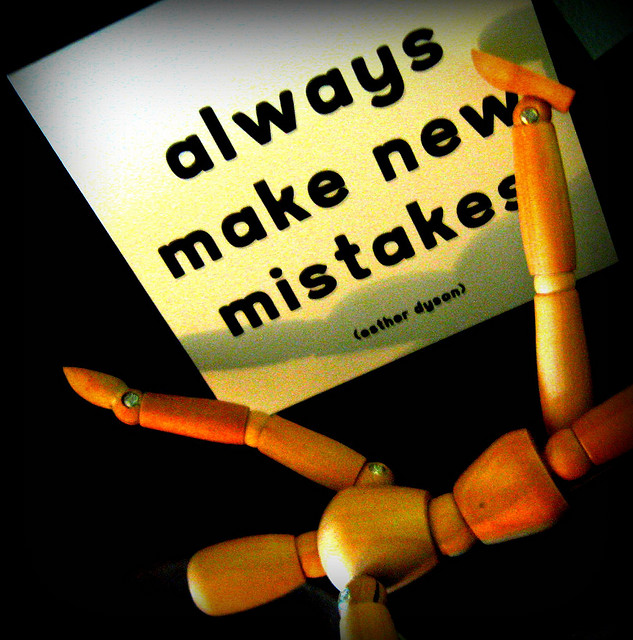
oopsOkay, we’ve all made mistakes. And I doubt that there’s a writer among us who has yet to experience a misstep in his or her writing career. Throughout my (long) writing and publishing history, I’ve made my share of doozies (To read about one of them see The dumbest publishing decision I ever made), but to broaden my observations even further, I’ve observed a long litany of mistakes among my fellow authors as well. Here are the ten I believe to be the most common.

  1. Publishing a first (or even second) draft. As a new writer, you might think that your writing is just fine the way you put it onto the page or computer screen. It isn’t. Believing in the infallibility of a first draft is the hallmark of an inexperienced writer. The more experienced you get, the better your writing gets. And the better your writing gets, the more you realize that the first draft (or even second) is not the draft you want ANYONE to read – not even your beta readers. Have a bit of respect for their time.
  2. Failing to take the time for writing practice – without publishing a single word of it. Just like figure skaters, pianists and dancers to name only a few, writers need lots of practice before any of their words should see the light of day. It’s a question of quality.
  3. Believing that basic building blocks of writing – grammar, spelling and syntax come immediately to mind – aren’t important. I’ve actually heard neophyte authors on online forums arrogantly suggest that readers don’t care about these things if the story is a good one. I beg to differ. Many care a lot and you should too. It is impossible to convey the right message/story if you and your readers are not using the language in the same way. Remember the book Eats Shoots and Leaves? If you don’t, you need to read it. Immediately.
  4. Failing to carefully copy-edit. Or even better, failing to hire a professional copy-editor to do it for you. New writers don’t seem to know the difference between a substantive edit (which gets you from draft one to two to three etc.) and a final copy-edit. Every book out there – even ones that are professionally copy-edited – can harbor typos and other errors that are missed at this stage in the publishing process. That doesn’t make it okay for you to publish a book that hasn’t been edited in this fine fashion.
  5. Designing your own book cover (without even a modicum of design experience or talent). If you do have graphic design experience, then I think you should go ahead and design your cover. In fact, you are probably the best one to do it since you know the book intimately. However, without this kind of background, you need to step away to avoid a book cover that makes it onto sites like Lousy Book Covers or in articles like Kindle Cover Disasters: the world’s worst ebook artwork . Readers do garner a lot of information about a book from its cover. Primarily they decide if they want to read it. Or not.
  6. Failing to do a final format check after conversion of a Word file to PDF for publication. I’ll admit it – I’m guilty of this one. Before I realized that PDF’s would read some of the background formatting that I could no longer see in the Word document, I blithely thought that once I had done a final review of the Word document, that was enough. Not so much. That PDF needs a careful final review before hitting the ‘publish’ button.mistakes
  7. Disregarding the importance of writing and carefully editing the book’s online description. Mother of God! How many times have I read online book descriptions with typos?! Sentence structure problems?! Grammatical errors?! Of course not to mention those ones that fail to provide even a modicum of persuasive copy.
  8. Continually tweeting “Buy my book, buy my book.” This is beyond annoying to those of us who would otherwise like to follow your contributions to Twitter. Once in a while it’s fine to promote your book, but don’t do it in every tweet. And don’t do it every single, blasted time you contribute to a LinkedIn Author discussion. This is beyond irritating. (For more on this rant of mine read When book promotion gets annoying.)
  9. Failing to understand that you need to connect to readers online – not a whole lot of other writers who are equally trying to sell their books. Unless your book is directed to writers (uh…hem…some of mine are) you’re barking up the wrong tree.
  10. Apologizing for being self-published. Can we all just stop it? If you write well and provide readers with a quality product that respects them, you don’t need to apologize for how it got into their hands. Readers who love your books don’t care.
I think that creating quality material in whatever genre, and providing it to readers with respect are the two most important parts of being a writer – regardless of who publishes your work.
Posted in Book marketing, Book promotion, Electronic Publishing, Ethics

When is a bestseller not a bestseller?

bestseller 2So, what does it take to be a bestselling writer? In fact, what does it take for a book to be a bestseller? Have you ever gazed on the New York Times bestseller list, or the Amazon list of today’s best sellers and wondered how these books got there?  I know I have, and even more to the point, recently I’ve often wondered what it really means when an author’s LinkedIn or Twitter profile says “bestselling author of…” and I’ve never heard of them. The truth is that whatever you may have thought through the years, whatever you infer from those “bestselling” monikers, all bets are off.  The landscape has changed.  It ain’t what it used to be. And that’s important – for readers.  And for writers who actually care.

So I did some research (you’re welcome).

What is a bestseller?

Let’s begin by going back to definitions – dictionary and other.  The Oxford English Dictionary, arguably one of the premier arbiters of word meanings in our language, says that a bestseller is “[a] book or other product that sells in very large numbers.”[1]  Okay, this definition implies that there ought to be some kind of quantitative measure of what it takes to be a bestseller, although falling short of actually telling us what that number might be.  However, the phrase “very large numbers” does have some resonance, n’est ce pas?

Back as far as 1955 a bestseller was defined as “a book for which demand, within a short time of that book’s initial publication, vastly exceeds what is then considered to be big sales.”[2] Again the concepts both of high demand and bigger than “big” sales.

Next, we’ll join the twenty-first century and see what other online definitions might offer to us in our quest for understanding.  Of course, next stop Wikipedia which says this:

“A bestseller is a book that is identified as extremely popular by its inclusion on lists of currently top selling or frequently borrowed titles that are based on publishing industry and book trade figures and library circulation statistics and then published by newspapers, magazines, or book store chains.”[3]

Wikipedia further suggests that the term is evidently not associated with any specific number of sales and that the term is often applied rather “loosely” often as a marketing ploy, but that it does, in fact, refer to a book that is “extremely popular.”

It seems, then, that a real bestseller is a popular book in high demand with high sales.  As reasonably intelligent readers (or writers) we can conclude that a book isn’t a bestseller unless it sells lots and lots of copies.  So how is it possible that so many of these online self-published authors suggest that they are bestselling authors?   Remember what I said earlier?  The landscape has shifted.  Dramatically.

The Making of a Bestseller

In the past few years, it’s become clear that there are ways of manipulating online book sales figures to artificially create a bestseller, thereby giving the author marketing cred, even if it is a bit disingenuous.  However, don’t be fooled into thinking that this is just a recent, eBook phenomenon.

Back in 1995, two ambitious consultants wrote a book titled The Discipline of Market Leaders which was published by Addison-Wesley. Rather than let it languish in a warehouse or gather dust on bookstore shelves only to be returned if unsold (the dreaded ‘returns’ of the book selling business – don’t get me started), the authors decided to figure out a way to get that book on the New York Times bestseller list so that they could use this as a springboard to marketing themselves as consultants, and thereby make more money.  As business experts, they were willing to make a financial investment and take the risk that it would have a big payout in the end.

In summary (you can read the whole story in the online archive of Business Week linked in my footnotes below[4]) they spent $250,000 buying 10,000 copies of their own $25 book from small and large bookstores throughout the US resulting in it climbing to #8 on the NYT bestseller list where it stayed for 15 weeks and peaked at #1 on the BusinessWeek list.  The results of this manipulation were spectacular for their consulting business: speaking engagements, new clients, future book deals.  Illegal?  No.  Unethical?  Clearly.  Readers draw the conclusion that a book on the top of the bestseller list has made it there on its own merits.  When it didn’t, those who colluded to get it there are effectively lying.  That was then.  This is now.  And the opportunities for this kind of manipulation are even more available.

amazon bestsellerIn 2013 Publisher’s Weekly tried to get bestseller numbers from Amazon, but were unsuccessful, so they decided to try to figure it out by looking at the status of a couple of books over the course of two weeks.  They began with the hypothesis that was widely held that a book would have to sell 300 copies a day to reach the top five on Amazon’s list and found that this wasn’t far off, but that it varies considerably depending on the time of year.[5]  For example, in holiday sales times, the numbers would have to be higher.  Nevertheless, if you can get approach this level of sales for a day or two, whatever ranking you achieve on the bestsellers list sticks with the book based on the Amazon algorithm.  And there you have a “bestseller” that doesn’t even come close to the definitions above, nor the connotation associated with it by potential readers.  So, just about anyone can use the term bestselling author based on just about any criteria he or she decides applies.  Hmm.

So, when is a best seller not a best seller?

A few years ago, my husband and I wrote a piece on our travel blog The Discerning Travelers about when a perk (from an airline, a hotel etc. via loyalty programs) is not a perk.  We concluded that a perk is not a perk when everyone has it (for our full explanation read The ups and downs of travel loyalty programs: When is a perk not a perk?).  It loses its real meaning.

I submit to you that when everyone is a so-called bestselling author, no one is.  And that is sad.  I’d love to be a bestselling author, but I’m more interested in being a writer.  When the term bestseller now applies to everyone and his or her dog, I don’t really care about that anymore.  How about you?

[1] http://www.oxforddictionaries.com/us/definition/american_english/bestseller

[2] Steinberg, S. H. 1955. Five Hundred Years of Printing. as quoted in Wikipedia.

[3] http://en.wikipedia.org/wiki/Bestseller

[4] Did dirty tricks create a bestseller? August 7, 1995. Business Week (from the online web archive), http://goo.gl/lmqR9y

[5] Gabe Habash. March 10, 2013.  How Many Copies Does It Take To Be an Amazon Bestseller? Not So Much. http://goo.gl/ULwI6a

Posted in Self-Publishing

Ethical issues in self-publishing: Why you should care

j0321197It’s probably safe to say that most of us don’t think about ethics on a daily basis — at least not consciously.  But every once in a while we see, read or hear something that makes us think that something is not quite “right.”  Something about it makes us feel that it’s just wrong.  That something might be perfectly legal, but still doesn’t feel right.  That’s your own internal ethical compass telling you to look at the issue more closely. The problem is, often when we ought to see something as not quite right, we don’t even notice.  Self-publishing comes to mind.

Writers have been self-publishing for many years. Mark Twain, Edgar Allen Poe, Beatrix Potter and Virginia Wolff come immediately to mind, giving self-publishing what should be a kind of positive cache.  However, the image of self-publishing has, over the years, diminished in the eyes of many — the media, literary critics and even many readers are among those who often carry a negative prejudice toward self-published works and their authors.  This bad reputation is not always unjustified. There are myriad ethical transgressions perpetrated by self-publishers every day. These are the activities and people who give everyone a bad name.

Historical novelist Jane Steen in her article Opinion: Why We Need to Talk About Ethics in Self-publishing suggested we should be concerned about ethics because “we owe it to our readers,” but perhaps even more importantly,”we owe it to ourselves. Our indie career is not just about the books we write—it’s about the person we are.” Improving the image of self-published works is important to their (and the authors’) broader acceptance, and in the end it has to be said, success as an author.

My own personal experience and observations suggest that there are a few key areas that have contributed to negative perceptions and that are ethical minefields for indie authors. They are behaviors to be avoided at all costs.

  1. Writing 5-star reviews for crappy books. It is beyond irritating to buy a well-reviewed book only to find it riddled with stylistic errors (grammar, punctuation, sentence structure etc.) at a minimum, and be practically unreadable at the worst. Some indie authors write these reviews for others to ensure glowing reviews for their own publications.  This is dishonest and therefore unethical.  Don’t do it.
  2. Asking friends and family to write glowing reviews for your books.  This is hardly third-party endorsement.  These individuals are biased, and will likely want you to succeed so their reviews are not objective.  Readers are looking for objective, honest recommendations.  This is unethical. Don’t do it.
  3. Buying reviews.  Since the surge in self-published books, a whole industry has grown up for paid book reviews.  You can find thousands of review writers more than willing to write and post (for a fee of course) glowing reviews for you. This disingenuous practice can also be used by traditionally published authors.  Any way you look at it, it is a dirty practice and should be avoided at all costs.  Dishonest.  Unethical.  Don’t do it.
  4. Flooding the ebook stores with appallingly poor, ill-conceived ebooks.  There is another cottage industry that has grown up around the notion of simply writing ebooks on anything you can think of simply to generate income.  This is one of the most insidious ways that the reputation of all self-published authors is dragged through the mud.  Unless you are an expert on your subject matter, step away from the computer with that brilliant idea for an ebook. Unethical.  Don’t do it.
  5. Over-inflating your wonderfulness and success.  This is so problematic in the self-publishing industry.  Every time someone sells themselves to me as “best-selling” or “award-winning,” I get out Mr. Google and have a look.  That award should have been from a credible, well-known organization and you had better have had a best-seller on the New York Times (or equivalent) best-seller list or you’re padding.  This is dishonest.  Unethical.  Don’t do it.  (If you want to see how even being on these lists can be dishonest, read Here’s How You Buy Your Way Onto The New York Times Bestsellers List)

There have been a number of bloggers who have suggested codes of conduct for self-published authors.  They are worth reading and are among the following list of pieces you should read if you care about your reputation as a self-published author.