
I already know what ‘serious’ writers are going to say: chicklit is ‘dumb’ by definition. I beg to differ; however, I also think that the derision isn’t entirely without foundation. My own reading and writing habits have led me to this conclusion. But let’s start in broader terms to address the question of whether writing and the literature that is the result has, overall, suffered from the dreaded ‘dumbing down.’ Many believe so.
In a 2015 piece by Stephen Carter, a Blomberg View columnist (he also happens to be both a law professor at Yale and a novelist), he quotes prominent science fiction writer Ursula K. Leguin who refers to what she sees as the twenty-first century formulaic creation of best sellers in this way: “The readability of many best sellers is much like the edibility of junk food…I believe that reading only packaged microwavable fiction ruins the taste, destabilizes the moral blood pressure, and makes the mind obese.”[1]
Of course she refers to the influence of Amazon and its well-pondered algorithm for determining best-seller status. Carter, however, isn’t buying it. He believes that perhaps a more important part of the issue is that readers’ tastes have changed; attention spans are shorter. Perhaps we have done it to ourselves. But others take a different view.
There is much grumbling in the ‘serious’ writers’ communities about the perceived negative impact of self-publishing on current literature; there is a significant sentiment (not held by all self-described serious writers, I might add) that it has been the proliferation of unedited self-published books that has had the most serious effect.
One online writer has suggested that “with self-publishing it seems like the editors have all disappeared. Ten or more books on recent New York Times Best Sellers List are there because the millions of fanboys and fangirls have bought their hero’s book…maybe the bar is set a bit too low.”[2]
So there seem to be two issues that people consider to be characteristics of ‘dumbed-down literature.’ The first one (and a big one for people like me who have taught writing over the years) is the issue of actual command of the language including grammar, syntax, spelling, word choice and all those things that our English teachers tried to inculcate in us over the years. The second one is the substance – or lack thereof – of the books that are popular today.
In my view, the truth is that quality writing can be practiced in any genre from literary fiction to popular erotica and everything in between. The topic seems secondary; if you’re passionate about writing it, you’re good at it, and your readers love it (or at least the first two if your readers haven’t found you yet), then I say write on. Even if what you write is derided by some as merely ‘chick lit.’
In general, the term chick lit means any literature that appeals mostly to women. So, what’s wrong with that? Does that make it dumb? If chick lit is dumb, then women are dumb by extension. Don’t say that to my face. But has even literature aimed at women been dumbed down? I have a personal hate on for many pieces of chick lit and it isn’t for the reasons you might think.
In my view, women are infantilized by their chick lit not so much by the stories or the writing, but byu the covers. Have you looked at any lately? I’ve been examining them as we contemplate the design of my new book which is women’s fiction. Is this really how women see themselves?


Well, I’m a smart woman and I write #litforintelligentchicks. In fact, I love to read chick lit, but I can’t get to your really great story if I feel infantilized by the dumb cover – whether it’s an illustration or a stock photo depicting a sweaty clinch and a few bits of a six-pack.
Okay, my rant is over. Back to the drawing board for that new cover.
Sources:
[1] Stephen L. Carter. June 11, 2015. Don’t Blame Amazon For Dumbing Down Literature. Bloomberg View. https://www.bloomberg.com/view/articles/2015-06-11/why-ursula-k-le-guin-s-amazon-pan-is-only-half-right
[2] Self-publishing and the Dumbing Down of Literature. http://www.dailykos.com/story/2015/11/21/1452940/-Self-Publishing-And-The-Dumbing-Down-Of-Literature
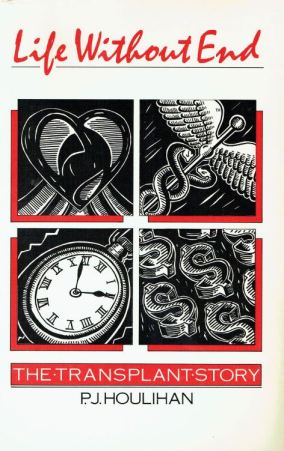 Many years ago – in a former lifetime even before my academic career – I worked in the field of organ transplantation. I was called an “organ procurement officer.” An odd title, you say? Yes, odd indeed. My responsibilities included overseeing the transplant coordinators who were tasked with ensuring donor organs made it to appropriate recipients (kidneys and livers mostly in those days), and the public education programming for increasing organ donations. This latter responsibility involved developing strategic promotion plans, writing about organ donation and making copious numbers of public presentations. All in a day’s work.
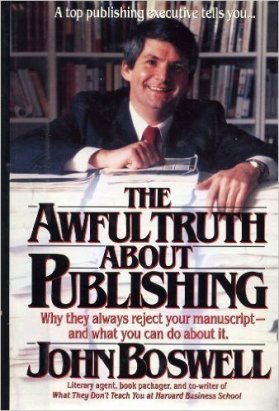 It is titled The Awful Truth About Publishing: Why they always reject your manuscript – and what you can do about it. In spite of its age (it was published in 1986 by Warner Books), and the concomitant fact that it was published long before the advent of the eBook era and the avalanche of self-publishing, it remains one of the best reads to help a writer with her head in the clouds to keep her feet on the ground – which is the only place to be if any real success is to follow.
 Patricia J. Parsons