Posted in Book marketing, Book promotion, Ethics

Is “book blurbing” Ethical?

[originally published March 19, 2026, on LinkedIn]

After forty years of writing and almost three decades of teaching applied ethics to university students, I’ve seen many questionable practices and habits. One of the most grating practices, which seems increasingly pervasive, is the habit of publishers and authors asking other authors to endorse their books.

You’ve seen them. They are the pages of two and three-liners from famous and not-so-famous authors of other books who say wonderful things about the book you’re contemplating. Whether they make a difference is an issue I’ll get to later, but for now, I’m considering the ethical implications of this practice.

These endorsements have more recently been dubbed “blurbs,” which is odd since the definition of a blurb was always that short, three-paragraph description on the back of a book that would make you want to read it. Nevertheless, the practice of endorsing another author’s books is called “blurbing.” You’ve all seen them. They are the flattering sentences on a cover or an inside page that call the book brilliant or insightful, a masterwork, unputdownable. You know the drill.

However, the ethical foundation of this practice is far shakier than the industry is willing to admit.

At its core, this “blurbing” operates within an unspoken economy of reciprocity. Today I endorse your book, and, of course, tomorrow, you endorse mine. No one is asked to sign a contract, and no obligation is explicitly stated. Still, the expectation hangs in the air, and that expectation matters. It subtly but powerfully compromises the independence of the endorsement. What appears to the reader as an objective assessment is, in many cases, part of a professional exchange.

The ethical question begins here. Endorsements are meant to signal genuine evaluation. They borrow the credibility of one author to support another author’s work. But when that credibility gets tangled up in a network of mutual benefit, it becomes difficult to distinguish authentic praise from strategic politeness. This potential lack of authenticity is where it begins to border on deception—lying. Even when the blurb is sincerely meant, the surrounding culture of reciprocity casts doubt. And in ethics, perceived conflicts of interest can be just as damaging as real ones.

Consider how this would be judged in other fields. In academia, undisclosed reciprocal endorsements would raise serious concerns. In journalism, they would be unacceptable. In corporate governance, they would trigger conflict-of-interest policies. Yet in publishing, the practice is normalized, and dare I say, encouraged.

Defenders of the practice would argue that authors only blurb books they genuinely admire. I suppose that may be true in some cases. But the system doesn’t require it to be true, and that’s the point. When participation in the blurb economy is tied to visibility, access, and goodwill within the industry, the pressure to comply can outweigh the commitment to be honest, brutally so if necessary. Declining to blurb can feel like a professional risk.

On the other hand, offering one can feel like a strategic necessity. That still doesn’t make it an ethical practice. And sometimes authors are actually required by their publishers to solicit “blurbs.” Could that culture be changing?

There have been reports of a few publishers removing this contractual requirement, but authors are still inclined to collect them. Do they do it to sell books, or is the reason more personal? Is it an ego boost for an author to see another author proclaim the book as a masterpiece?

Then there’s the practical question that lingers in my mind. Do blurbs actually influence readers?

Anecdotally, many readers have grown skeptical. Familiar names appear repeatedly across covers, often praising vastly different books in nearly identical language. The effect is less persuasive than performative. Instead of guiding readers, blurbs risk becoming background noise. They are then merely a part of the packaging rather than a meaningful signal of quality.

If that’s the case, the ethical compromise begins to look even less defensible. Why maintain a system that muddies credibility without delivering demonstrable value?

In my view, publishing would be better served by moving away from author blurbs altogether. Let books stand on their own merits. Let critics, credible reviewers, and readers provide assessments free of professional reciprocity.

Authors, of all people, understand the power of words. When a sentence of praise appears in a book or on a book cover, it should mean to the reader exactly what it seems to mean, and what the reader expects it to mean. It should be an independent, unsolicited judgment. As a reader, I’d look forward to that. In the meantime, I’ll continue to ignore all those endorsements and read a sample. Then I’ll know if it’s worth buying.

Posted in Book launches, Fiction Writing, Writing books

Travel Inspires Writing – Again!

It’s not the first time this has happened, and it’s not likely to be the last. I find myself on an absorbing trip (because I love to travel and even write about it), and the next thing I know, the experience and the locale inspire a story. In my view, travel is one of the most inspiring experiences for writers. But that’s just me.

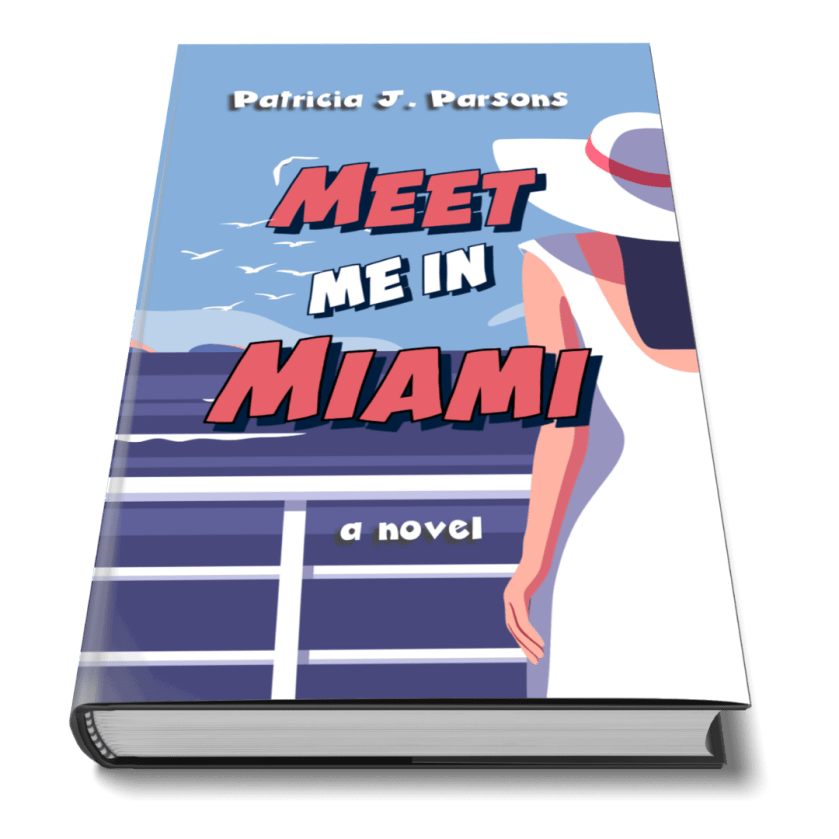
Two summers ago, a ten-day cross-island trip in Newfoundland inspired a book that seems to have started a new series. We Came From Away: That Summer on “The Rock” was inspired by a combination of that trip experience and the fact that my mother turned 100 years old that year. (She’s now 102!). Then, last year, my husband and I spent a month travelling in Brazil on a cruise up the Brazilian coast, into the Amazon River, and onto Miami. It seemed that the characters in We CAme From Away hadn’t finished with me yet. Now there’s a sequel: Meet Me in Miami.

February 1 seems like a great day for some armchair travel to a tropical location, doesn’t it? So, I’m inviting you along for some of that travel. Here’s the new book launching today.

What travels from your past might inspire a story … and a book?

Here’s what it’s about:

Life may not offer do-overs, but it might offer second chances.

Dr. Claire Barrett has it all. At least it seems that way to everyone but Claire. A successful doctor with two almost grown and successful children, an international reputation as one of the world’s finest pediatric surgeons, Claire at age fifty is as beautiful, stylish and driven as ever. She prides herself in making the best decisions to have gotten her where she is today. She did it all herself and from her home base in St. John’s, Newfoundland. But there is one decision that rankles. She should never have allowed Peter O’Brien to get away. She should never have agreed to the divorce. Was it her only mistake? Now she has a plan to fix that. She will win him back.

Eliza Houlihan Cohen, a New Yorker by way of Canada’s east coast, is a successful cookbook author. After years of putting up with her philandering husband Jake and his whining mother, she has finally broken free. And now that she’s met Dr. Peter O’Brien, she wonders if she might take another chance on love.

Eliza hates Miami, but when Peter asks her to take a cruise with him, ending in Miami, and she asks her daughter Izzy to meet her there for a holiday, Eliza decides she can cope. By the time her cruise through the Amazon reaches Miami, Eliza will wish she had never laid eyes on Peter’s ex-wife, Claire. The question is, though, will she feel the same about Peter?

Vanity, conceit and a single-minded pursuit of career goals, though, will only take you so far in this life. There comes a time when you must face the fact that everything is not about you.


It’s available from Amazon (which the cover above is linked to) or any other online retailer you like.

And … if you haven’t read We Came From Away yet …

Nora Houlihan’s children have been long gone from their family home in Newfoundland. Now, she is about to turn 100 and wants her children and grandchildren to find out what they’ve been missing on her beloved island. So, she arranges for her “come-from-away” family members to take a cross-island tour before her birthday party. By the time they are finished, they will be forever changed—and nothing in the family will ever be the same.

They say you can choose your friends, but you can’t choose your family. The question is this. If you could pick your family, would YOU choose yours?

Posted in Book promotion, Self-Publishing

Who will buy your book?

Someday I hope to write a book where the royalties will pay for the copies I give away. — Clarence Darrow

freeOh how I empathize with Clarence Darrow.  I cannot tell you how many books I’ve given away over the years, and these days of the hideous deluge of ‘free’ eBooks as promotional tools makes the problem even worse.  I often wonder how many of other writers’ relatives and friends actually buy their books.

My family, for example, largely feels that they are entitled to receive free copies of my books.  Well, with the most recent one, I decided that this wasn’t going to happen anymore.  Even my 91-year old mother didn’t get a copy (to be fair, I really didn’t really want her to read it – to much *sex*).  The only family member who actually received a hard copy (and that was after he downloaded and paid for an e-book) was my 25-year old son who was one of my final editors.  His keen eye and firm grasp of the English language made him an ideal beta reader for which I paid him.  The least I could do was to give him a copy of the book when he was home from London last weekend.

Should I give it away?

Then there are all those other copies we give away.  And this refers equally to my books (and your books) published by traditional publishers and the self-published ones.  These are the review copies.

There is little doubt that review copies are important, however, it can get out of hand.  In addition it seems to me these days that we need to be vigilant that a so-called reviewer does not feel obligated to be a bit less critical of a book that he or she has received gratis.  (Although some bloggers seem to think that a free book might end up as a more critical review.  Not sure why.)

When I wrote the piece When is a book review not a book review? I was thinking about these kinds of issues.  So, we need to consider carefully how many books we give away for free in the hope of acquiring a positive review.

And then there are those free book giveaways that started this rant.  There is little doubt that giving books away can help you to accrue new readers: sometimes, readers who would otherwise pass over your books might try them and like them, then return to buy future offerings.  So that seems like a good investment in marketing.  We need to be very mindful, however, that if as writers we don’t value our work, we can hardly expect others to value it either.  In fact, many readers are just as likely to troll the online bookstores seeking only free books, never returning to your work when the book is not free.  There is no actual hard data on either of these situations although you’ll find plenty of anecdotal stories extolling the virtues of giving away your work.

It would be my greatest wish that writers value their work.  I often wonder if writers who don’t value their work know in their hearts that it isn’t really that good.  There is a difference, however, between the writing a book specifically for yourself and to give away to others, and one you hope to sell.  This is the kind of book you may write simply hoping that a few others might benefit from it in one way or another.

It is quite a different matter to work hard on a piece of writing that you hope readers, unknown to you at this point, will buy, read and appreciate.  This is the kind of work that we have to stop giving away so freely.

So, fellow writers, keep a very careful count of how many copies of your work you give away and the return on that investment.  I’d love to know how it has worked for you.  Perhaps we can build a database of information.  There are marketing reasons to give your work away, but that needs to be balanced by a sense of value.  Tread carefully.

It might be worth remembering what Jules Renard once wrote:

Writing is the only profession where no one considers you ridiculous if you earn no money.”

Now I think I’ll surf over to Amazon and set up a free book giveaway and see what happens!!


For a few different perspectives on this issue, here are some ideas from other sources:

Why Successful Authors Are Giving Their Books Away for Free  http://www.huffingtonpost.com/simone-collins/why-successful-authors-ar_b_4115300.html

Why publishers should give away eBooks   http://www.roughtype.com/?p=1573