Posted in Backstory, Uncategorized, Writing, Writing books

Reviving old manuscripts: 5 things a writer might consider

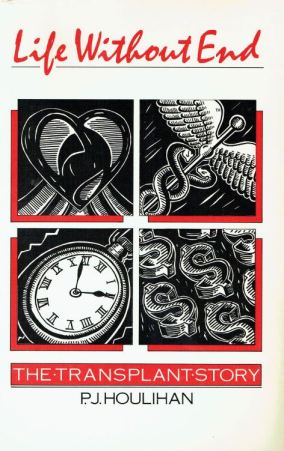
life without endMany years ago – in a former lifetime even before my academic career – I worked in the field of organ transplantation. I was called an “organ procurement officer.” An odd title, you say? Yes, odd indeed. My responsibilities included overseeing the transplant coordinators who were tasked with ensuring donor organs made it to appropriate recipients (kidneys and livers mostly in those days), and the public education programming for increasing organ donations. This latter responsibility involved developing strategic promotion plans, writing about organ donation and making copious numbers of public presentations. All in a day’s work.

While I was working in the field I became fascinated with the myriad ethical dilemmas posed by the transplantation process itself, but more so by the way the health professionals involved in transplantation demonstrated a kind of fervour, often bordering on the religious, about their chosen medical field. It was this fascination that led me to research and write my very first non-fiction book many years ago.

Life Without End: The Transplant Story was my take on the ethics and politics of organ transplantation in Canada at the time, and I think it’s fair to say that not all of what I wrote made the folks I had worked with happy. Some of them were very unhappy indeed.

That was my last job in the real world before I started my academic career, but stories about organ transplantation never really left my monkey mind. So, not long after that first book was published I started writing a novel about what might happen if that kind of religious fervour about transplantation got out of hand. When I finished the manuscript I shopped it around to agents which resulted in finding one who actually loved the story and decided to take it on. She did her job (or at least I guess she did – we never did meet only talked on the phone), sending me detailed lists of where she had sent the manuscript and what the results were. She never did sell it, so I filed it away in the depths of my electronic writing files and almost, but not quite, forgot about it.

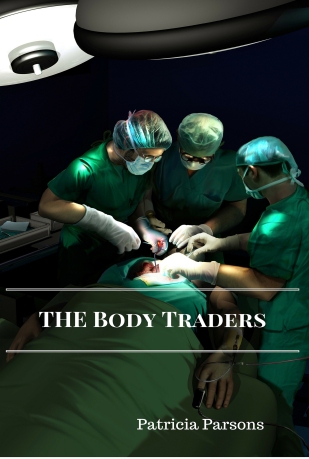
With the advent of electronic publishing the idea of reviving old manuscripts in my files began to take shape. I’m a firm believer, though, that not everything we write needs to be published, or even should it be published. Sometimes our writing is either for our eyes only (or ought to be) or it is our writing practice. I had never thought of this novel as being practice, though; rather I had believed it was ready to make its way out into the world. So I finally decided that The Body Traders would see the light of day.THE Body Traders cover FINAL for print front
First I reread it and found that I still loved the story. Then I spent a lot of time over the past year rewriting and updating it. You can well imagine that a book written more than a decade ago would need a tweak or two: for example, back when I worked in transplantation we carried pagers – no one even had a cell phone! Updating was indeed required!

I considered shopping it again, but in the end decided to self-publish. So, what did I learn from this process? I learned that there are several things you need to consider when deciding to revive an old manuscript.

  1. Ask yourself why you want to publish it now. Do you just want to see it in print (electronic or otherwise)? If the answer is yes, I suggest you need a better reason. There are a lot of books out there these days that no one will ever read. If you really don’t care if anyone else reads it, perhaps you need to put it away. “Publication” and “publish” both refer to “public” meaning that the work should be for the public.
  2. Reread it to see if you still feel as enthusiastic about it now as you did when you finished it. If you don’t, put it back in the electronic drawer and step away.
  3. Analyse it for it currency. Are the ideas still resonant? Will current readers appreciate the themes? If you aren’t sure, ask someone whose opinion you value to read it. Perhaps even consider beta readers.
  4. Edit the manuscript for specifics that will bring the details up to date. For example, if the protagonist still uses payphone, unless it’s part of a quirky character trait, you need to do a bit of updating.
  5. When you have finished the rewrite based on your own analysis, feedback from others’ and your update, read it again to see if you still feel enthusiastic. If the answer is yes, you’re ready to press the publish button!
Posted in Publishing, Traditional Publishing, Writing, Writing books

Writer: Know Thyself!

I was perusing my bookshelf this morning (in truth I was looking for a couple of books with the right spine width to wedge under a door my husband was re-installing – but I digress), when I happened upon one of my favourite old books. Over the years I’ve culled my book collection mercilessly, but there are a few that still remain on my shelf. Written by literary agent John Boswell, this one has remained one book that I do re-read from time to time, just to keep me grounded as a writer.

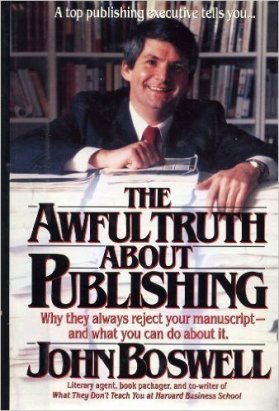
the awful truthIt is titled The Awful Truth About Publishing: Why they always reject your manuscript – and what you can do about it. In spite of its age (it was published in 1986 by Warner Books), and the concomitant fact that it was published long before the advent of the eBook era and the avalanche of self-publishing, it remains one of the best reads to help a writer with her head in the clouds to keep her feet on the ground – which is the only place to be if any real success is to follow.
As I cracked the cover (hard cover at that) I opened the book at Chapter 4: “The Awful Truth About Yourself.” And it does seem to me in these days when the “cult of the amateur” shrouds just about every facet of artistic endeavour (movie-making, music production and, yes, you guessed it, writing) it might be worthwhile for aspiring and other writers to do a bit of navel-gazing. Are we always aware of the truth about ourselves? Based on some of the drivel I’ve read recently, coupled with the book-marketing noise on the Web, it seems that many “writers” are, indeed, blind to some truths about themselves. And I put myself in that category from time to time.

Boswell offers this: “Writing, for the gifted few, is an art, and the chances of reaching this level are about as good as they are of becoming a prima ballerina or a major league second baseman” (The awful truth about publishing, p. 41). I love to be reminded that writing is indeed one of the arts, a factoid that seems to be forgotten by those among us who harp on ‘authorpreueurship’. While I’m all for the notion of self-help even in writing, let’s be clear that if you’re writing a book with the clear objective of making money, then this isn’t art.  It’s content creation and it’s okay. But it isn’t art. Some of my own work – or at least work in progress – seems to bend in that direction, while other work is simply seeing if I can create a piece of art that will entertain and perhaps even provoke.

He then goes on to make a statement that, had he been able to gaze into a crystal ball and see the future of publishing as we know it today he would have realized is even more profound. “Fortunately,” he writes, “…writing is also a craft and one which can indeed be learned by almost anyone. But…it is still not something that can be learned overnight, or a skill that pops into your head, fully honed once you ’get around’ to putting your publishable thoughts on paper…” (p. 41). And here is where it gets really muddy these days.

Boswell poses a question that I’ve often asked my own students – and use to ask myself. Do you want to be an “author” or do you want to write? It’s much the same question as do you want to write, or simply to “have written”? And these days we might also ask: do you want to be a writer or a content creator? One is not fundamentally better than the other, but they are different. They have different objectives, processes and audiences. In my view it’s really only a matter of knowing yourself. I’m trying.

[I’ve written about ‘content creators ‘ here  https://backstorywriting.wordpress.com/2014/06/04/are-you-a-writer-or-a-content-creator/ ]

Posted in Self-Publishing, Writing

10 Common Mistakes of Self-Published Writers

oopsOkay, we’ve all made mistakes. And I doubt that there’s a writer among us who has yet to experience a misstep in his or her writing career. Throughout my (long) writing and publishing history, I’ve made my share of doozies (To read about one of them see The dumbest publishing decision I ever made), but to broaden my observations even further, I’ve observed a long litany of mistakes among my fellow authors as well. Here are the ten I believe to be the most common.

  1. Publishing a first (or even second) draft. As a new writer, you might think that your writing is just fine the way you put it onto the page or computer screen. It isn’t. Believing in the infallibility of a first draft is the hallmark of an inexperienced writer. The more experienced you get, the better your writing gets. And the better your writing gets, the more you realize that the first draft (or even second) is not the draft you want ANYONE to read – not even your beta readers. Have a bit of respect for their time.
  2. Failing to take the time for writing practice – without publishing a single word of it. Just like figure skaters, pianists and dancers to name only a few, writers need lots of practice before any of their words should see the light of day. It’s a question of quality.
  3. Believing that basic building blocks of writing – grammar, spelling and syntax come immediately to mind – aren’t important. I’ve actually heard neophyte authors on online forums arrogantly suggest that readers don’t care about these things if the story is a good one. I beg to differ. Many care a lot and you should too. It is impossible to convey the right message/story if you and your readers are not using the language in the same way. Remember the book Eats Shoots and Leaves? If you don’t, you need to read it. Immediately.
  4. Failing to carefully copy-edit. Or even better, failing to hire a professional copy-editor to do it for you. New writers don’t seem to know the difference between a substantive edit (which gets you from draft one to two to three etc.) and a final copy-edit. Every book out there – even ones that are professionally copy-edited – can harbor typos and other errors that are missed at this stage in the publishing process. That doesn’t make it okay for you to publish a book that hasn’t been edited in this fine fashion.
  5. Designing your own book cover (without even a modicum of design experience or talent). If you do have graphic design experience, then I think you should go ahead and design your cover. In fact, you are probably the best one to do it since you know the book intimately. However, without this kind of background, you need to step away to avoid a book cover that makes it onto sites like Lousy Book Covers or in articles like Kindle Cover Disasters: the world’s worst ebook artwork . Readers do garner a lot of information about a book from its cover. Primarily they decide if they want to read it. Or not.
  6. Failing to do a final format check after conversion of a Word file to PDF for publication. I’ll admit it – I’m guilty of this one. Before I realized that PDF’s would read some of the background formatting that I could no longer see in the Word document, I blithely thought that once I had done a final review of the Word document, that was enough. Not so much. That PDF needs a careful final review before hitting the ‘publish’ button.mistakes
  7. Disregarding the importance of writing and carefully editing the book’s online description. Mother of God! How many times have I read online book descriptions with typos?! Sentence structure problems?! Grammatical errors?! Of course not to mention those ones that fail to provide even a modicum of persuasive copy.
  8. Continually tweeting “Buy my book, buy my book.” This is beyond annoying to those of us who would otherwise like to follow your contributions to Twitter. Once in a while it’s fine to promote your book, but don’t do it in every tweet. And don’t do it every single, blasted time you contribute to a LinkedIn Author discussion. This is beyond irritating. (For more on this rant of mine read When book promotion gets annoying.)
  9. Failing to understand that you need to connect to readers online – not a whole lot of other writers who are equally trying to sell their books. Unless your book is directed to writers (uh…hem…some of mine are) you’re barking up the wrong tree.
  10. Apologizing for being self-published. Can we all just stop it? If you write well and provide readers with a quality product that respects them, you don’t need to apologize for how it got into their hands. Readers who love your books don’t care.

I think that creating quality material in whatever genre, and providing it to readers with respect are the two most important parts of being a writer – regardless of who publishes your work.