Posted in Book marketing, Book promotion, Electronic Publishing, Ethics

When is a bestseller not a bestseller?

bestseller 2So, what does it take to be a bestselling writer? In fact, what does it take for a book to be a bestseller? Have you ever gazed on the New York Times bestseller list, or the Amazon list of today’s best sellers and wondered how these books got there?  I know I have, and even more to the point, recently I’ve often wondered what it really means when an author’s LinkedIn or Twitter profile says “bestselling author of…” and I’ve never heard of them. The truth is that whatever you may have thought through the years, whatever you infer from those “bestselling” monikers, all bets are off.  The landscape has changed.  It ain’t what it used to be. And that’s important – for readers.  And for writers who actually care.

So I did some research (you’re welcome).

What is a bestseller?

Let’s begin by going back to definitions – dictionary and other.  The Oxford English Dictionary, arguably one of the premier arbiters of word meanings in our language, says that a bestseller is “[a] book or other product that sells in very large numbers.”[1]  Okay, this definition implies that there ought to be some kind of quantitative measure of what it takes to be a bestseller, although falling short of actually telling us what that number might be.  However, the phrase “very large numbers” does have some resonance, n’est ce pas?

Back as far as 1955 a bestseller was defined as “a book for which demand, within a short time of that book’s initial publication, vastly exceeds what is then considered to be big sales.”[2] Again the concepts both of high demand and bigger than “big” sales.

Next, we’ll join the twenty-first century and see what other online definitions might offer to us in our quest for understanding.  Of course, next stop Wikipedia which says this:

“A bestseller is a book that is identified as extremely popular by its inclusion on lists of currently top selling or frequently borrowed titles that are based on publishing industry and book trade figures and library circulation statistics and then published by newspapers, magazines, or book store chains.”[3]

Wikipedia further suggests that the term is evidently not associated with any specific number of sales and that the term is often applied rather “loosely” often as a marketing ploy, but that it does, in fact, refer to a book that is “extremely popular.”

It seems, then, that a real bestseller is a popular book in high demand with high sales.  As reasonably intelligent readers (or writers) we can conclude that a book isn’t a bestseller unless it sells lots and lots of copies.  So how is it possible that so many of these online self-published authors suggest that they are bestselling authors?   Remember what I said earlier?  The landscape has shifted.  Dramatically.

The Making of a Bestseller

In the past few years, it’s become clear that there are ways of manipulating online book sales figures to artificially create a bestseller, thereby giving the author marketing cred, even if it is a bit disingenuous.  However, don’t be fooled into thinking that this is just a recent, eBook phenomenon.

Back in 1995, two ambitious consultants wrote a book titled The Discipline of Market Leaders which was published by Addison-Wesley. Rather than let it languish in a warehouse or gather dust on bookstore shelves only to be returned if unsold (the dreaded ‘returns’ of the book selling business – don’t get me started), the authors decided to figure out a way to get that book on the New York Times bestseller list so that they could use this as a springboard to marketing themselves as consultants, and thereby make more money.  As business experts, they were willing to make a financial investment and take the risk that it would have a big payout in the end.

In summary (you can read the whole story in the online archive of Business Week linked in my footnotes below[4]) they spent $250,000 buying 10,000 copies of their own $25 book from small and large bookstores throughout the US resulting in it climbing to #8 on the NYT bestseller list where it stayed for 15 weeks and peaked at #1 on the BusinessWeek list.  The results of this manipulation were spectacular for their consulting business: speaking engagements, new clients, future book deals.  Illegal?  No.  Unethical?  Clearly.  Readers draw the conclusion that a book on the top of the bestseller list has made it there on its own merits.  When it didn’t, those who colluded to get it there are effectively lying.  That was then.  This is now.  And the opportunities for this kind of manipulation are even more available.
amazon bestsellerIn 2013 Publisher’s Weekly tried to get bestseller numbers from Amazon, but were unsuccessful, so they decided to try to figure it out by looking at the status of a couple of books over the course of two weeks.  They began with the hypothesis that was widely held that a book would have to sell 300 copies a day to reach the top five on Amazon’s list and found that this wasn’t far off, but that it varies considerably depending on the time of year.[5]  For example, in holiday sales times, the numbers would have to be higher.  Nevertheless, if you can get approach this level of sales for a day or two, whatever ranking you achieve on the bestsellers list sticks with the book based on the Amazon algorithm.  And there you have a “bestseller” that doesn’t even come close to the definitions above, nor the connotation associated with it by potential readers.  So, just about anyone can use the term bestselling author based on just about any criteria he or she decides applies.  Hmm.

So, when is a best seller not a best seller?

A few years ago, my husband and I wrote a piece on our travel blog The Discerning Travelers about when a perk (from an airline, a hotel etc. via loyalty programs) is not a perk.  We concluded that a perk is not a perk when everyone has it (for our full explanation read The ups and downs of travel loyalty programs: When is a perk not a perk?).  It loses its real meaning.

I submit to you that when everyone is a so-called bestselling author, no one is.  And that is sad.  I’d love to be a bestselling author, but I’m more interested in being a writer.  When the term bestseller now applies to everyone and his or her dog, I don’t really care about that anymore.  How about you?

[1] http://www.oxforddictionaries.com/us/definition/american_english/bestseller

[2] Steinberg, S. H. 1955. Five Hundred Years of Printing. as quoted in Wikipedia.

[3] http://en.wikipedia.org/wiki/Bestseller

[4] Did dirty tricks create a bestseller? August 7, 1995. Business Week (from the online web archive), http://goo.gl/lmqR9y

[5] Gabe Habash. March 10, 2013.  How Many Copies Does It Take To Be an Amazon Bestseller? Not So Much. http://goo.gl/ULwI6a

Posted in Self-Publishing, Vanity Publishing

Self-publishing versus vanity publishing: What’s the difference anyway?

publishing word cloudBefore self-publishing had any kind of credibility (one of my assumptions here is that it has risen a notch or two on the credibility barometer in recent years,) it was referred to strictly as vanity publishing.  Presumably it was vain for an author to pay to have his or her book published.  I’ve never been sure why it isn’t vanity recording when a musician pays to have a CD recorded and subsequently distributed, but perhaps that is another discussion.

According to a man by the name of Jonathon Clifford, he coined the phrase vanity publishing around 1960.[1] Clifford’s lifetime crusade was for honesty in the vanity publishing world.  It is true that over the years, authors who could not get – or did not try to get – mainstream publishers (often now referred to as traditional or legacy publishers) would pay to have their work produced, and those vanity publishers would suggest to the authors that they could, perhaps, just maybe, probably get rich.  That was the problem. As Clifford says:

“If you cannot find a mainstream publisher to publish your work at their expense, you must look on the whole process of publishing not as money invested to make you a return, but as money spent on a pleasurable hobby which you have enjoyed and which has provided you with well-manufactured copies of your book. If you do also manage to make a small profit, then that should be looked upon as an unforeseen and unexpected bonus”[2]

Things haven’t really changed all that much.  At the end of the day, most writers – even those traditionally published – make less than $5000 a year, indeed most make much less than that.  Today, the notion of the vanity press (versus other self-publishing options) seems to be tied into the issue of promises made by these entities – promises that they cannot possibly keep.  So, the term self-publishing has arisen to take the place of vanity publishing, and it seems to have taken on a less pejorative connotation.

Self-publishing, from the author’s point of view though, is exactly the same as vanity publishing.  The author pays.  And any author who thinks a publisher, regardless of whether they make you pay or they pay you, can predict much less guarantee sales success of your book, is naïve in the extreme.  Unless you have a name that is widely recognized, there is no way to predict sales.  This is where my personal skepticism begins to creep into the relationship between author and publisher.  But, it is now time for me to come clean as they say. Stack of Books

What seems like a hundred years ago now, I did take up with one of those vanity publishers two years after my first non-fiction book was published by a ‘real’ publisher.

The book was called Confessions of Failed Yuppie.  And it was funny.  It was nothing like what I had written previously, nor like anything I have written since (although I did recently re-write it and make it available as an e-book).  The vanity press I chose was one of the big ones in New York.  They took my seriously substantial fee and provided me with two cartons of the 130-page, hard-covered books.  I was thrilled.  But something kept me from mentioning its provenance to anyone – although I’m not sure anyone would have cared.  Many of my friends read the book and told me that they were amused.  I even still get a small check every year from the Public Lending Right Commission[3] in Canada because there are copies of it in libraries across the country.  Anyone want to read it?

So, what’s wrong with this kind of model?  What makes a vanity-published book, or a self-published book less worthy than a book published via the more traditional publishers?  In a word, quality – but not necessarily quality of the content, story, theme or writing.  It is often the quality of the editing as well as the production values – the cover and interior design mainly.  The problem with self-publishing is that it permits you to publish without any kind of quality controls.

In the grand scheme of things, I believe that self-published books, and books published by as-yet-to-be-created business models that include the authors, will, indeed be the way of the future.  I think that these models will find ways to enhance both the quality and the reputation of the products.  Until then, those of us who are concerned about quality will continue to write, publish, market and hope that our work will stand on its own in the eyes of the readers.

Professor Dana Weinberg, co-author of the 2014 report Digital Book World and Writer’s Digest Survey[4] commented as follows:

“Publishing a book for sale is a matter of both art and commerce. I would argue that for most writers publishing is not only about money; it’s about a lot of other things including touching readers and sharing stories, but the money is important in a lot of ways.”[5]

It seems that not much has changed for authors and their love of writing since Jonathan Clifford wrote about vanity publishing.  And perhaps it never will.

[This post is largely — but not entirely — excerpted from Who Will Read Your Book? The Unknown Author’s Guide to the Realities of Writing & Publishing]

[1] Vanity Publishing: Advice & Warning. http://www.vanitypublishing.info/

[2] Johnathon Clifford.  Vanity publishing – Advice ad warning.  http://www.vanitypublishing.info/

[3] Canada Council for the Arts. PLR Frequently asked questions. http://www.plr-dpp.ca/plr/faq.aspx

[4]What advantages do traditional publishers offer authors? 2014  http://store.digitalbookworld.com/advantages-traditional-publishers-offer-authors-t3591

[5] Alison Flood. 2014. Most writers earn less than £600 a year, survey reveals. The Guardian online.  http://www.theguardian.com/books/2014/jan/17/writers-earn-less-than-600-a-year

Posted in Book launches, Books

So, who will really read your book?

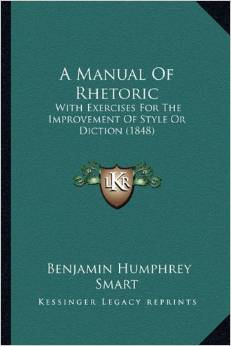
In 1848 a writer named B.H. Smart produced a book quite improbably titled: Manual of rhetoric: with exercises for the improvement of style or diction, subjects for narratives, familiar letters, school orations, &c.: being one of two sequels to “Grammar on its true basis”.  It was published in London by Longman, Brown, Green and Longmans and is reputed to be the oldest publication that could be reasonably described as a writing manual.  Since then, manual after manual has been produced with the objective of improving writing everywhere.

The first writing manual

Today, all you need to do is plug the search term “writing manuals” into Amazon’s search function and you’ll be greeted with almost 12,000 hits; if you plug in “writers’ guides” you’ll be rewarded with almost 19,000.  Within these search results there are the direct successors of Smart’s manual such as the Chicago Manual of Style (originally published in 1906) which, along with the Publication Manual of the American Psychological Association, is one of the go-to, required writing manuals for academic and scholarly writers throughout the English-speaking world.  In addition to these specific style guides there are books for poets, science and technical writers, novelists, memoirists, romance writers, creators of creative non-fiction and every other conceivable type of writer one could imagine.  From the style guides and how-to manuals for specific genres the writers’ guides begin to become more esoteric with books like Anne Lamott’s Bird by Bird: Some Instructions on Writing & Life, and Natalie Goldberg’s iconic Writing Down the Bones: Freeing the Writer Within, to the more recent offering from Stephen King, On Writing: A Memoir of the Craft where writers weave their personal stories around writing advice to inspire would-be writers.  If you’re a writer or aspiring writer yourself, you probably own a few of these – or at least in my view, you should!  All of this seems to be in spite of American journalist and writing guru William Zinsser’s pointed comment in his own best-selling writing guide On Writing Well, that most people have no idea how poorly they write.

Poor writing or not, the rush to publish in the 21st century is more like a torrent where the flood-gates, in the form of agents and editors, are no longer needed to stop the outpouring of book-length publications, for better or for worse.  Writers are flocking to self-publishing with a vengeance.  A quick troll through the social media communities, groups and networks of “writers” suggests that the era of co-dependency is upon us in a way never before imagined as writers look to one another for guidance and moral support in their publishing endeavors.  Rather than being connected to publishers, mentors or readers, they are connected to other writers – all as unknown as they are.

What’s truly puzzling, though, is how no one seems to notice their members who are spelling, grammar and stylistically-challenged, not to mention devoid of talent.  At least they’re not admitting it with their continual five-star reviews of every piece of drivel produced by their peers.  Yet, within all of this publishing-related noise, there are truly unique and important voices that need to find a way out of the slush.  What they all need is a reality check.  I’d like to help to provide that. And help those unique and important voices find their way out of the noise.  So, I’ve written yet another manual – well it’s sort-of a manual.

WWRYB CoverThe purpose of my new book is to provide a tough-love reality check on the vagaries of the new publishing models for aspiring writers while at the same time providing you with a kind of road map based on my experience as a writer, writing teacher, traditionally-published author and indie author.

For my blog readers who have been here a while, you might recognize some of the foundational material in the book – it did evolve from this blog (there’s a whole other story, isn’t it?  Turning blogs into books.  I could tell you…).   There is a whole lot more, though, and I’ve tried to tell readers my own story of making it onto the traditional publishing merry-go-round, and then dabbling in self-publishing.  Along the way, I learned a lot and this experience, coupled with my  research over the years as as a university prof, has resulted in this book.

Here’s the book trailer.  Let me know what you think.