 Many years ago – in a former lifetime even before my academic career – I worked in the field of organ transplantation. I was called an “organ procurement officer.” An odd title, you say? Yes, odd indeed. My responsibilities included overseeing the transplant coordinators who were tasked with ensuring donor organs made it to appropriate recipients (kidneys and livers mostly in those days), and the public education programming for increasing organ donations. This latter responsibility involved developing strategic promotion plans, writing about organ donation and making copious numbers of public presentations. All in a day’s work.
While I was working in the field I became fascinated with the myriad ethical dilemmas posed by the transplantation process itself, but more so by the way the health professionals involved in transplantation demonstrated a kind of fervour, often bordering on the religious, about their chosen medical field. It was this fascination that led me to research and write my very first non-fiction book many years ago.
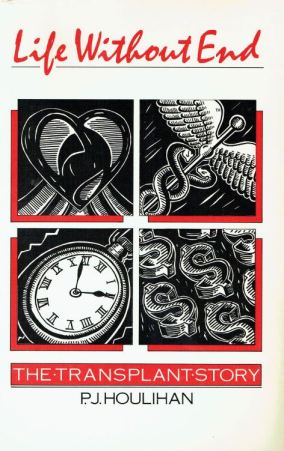
Life Without End: The Transplant Story was my take on the ethics and politics of organ transplantation in Canada at the time, and I think it’s fair to say that not all of what I wrote made the folks I had worked with happy. Some of them were very unhappy indeed.
That was my last job in the real world before I started my academic career, but stories about organ transplantation never really left my monkey mind. So, not long after that first book was published I started writing a novel about what might happen if that kind of religious fervour about transplantation got out of hand. When I finished the manuscript I shopped it around to agents which resulted in finding one who actually loved the story and decided to take it on. She did her job (or at least I guess she did – we never did meet only talked on the phone), sending me detailed lists of where she had sent the manuscript and what the results were. She never did sell it, so I filed it away in the depths of my electronic writing files and almost, but not quite, forgot about it.
With the advent of electronic publishing the idea of reviving old manuscripts in my files began to take shape. I’m a firm believer, though, that not everything we write needs to be published, or even should it be published. Sometimes our writing is either for our eyes only (or ought to be) or it is our writing practice. I had never thought of this novel as being practice, though; rather I had believed it was ready to make its way out into the world. So I finally decided that The Body Traders would see the light of day.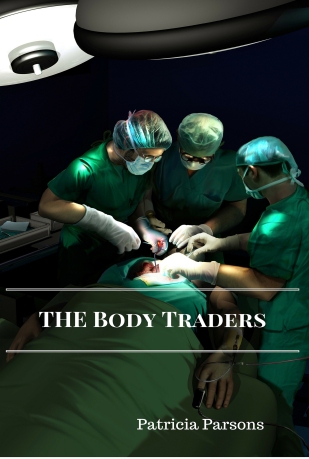
First I reread it and found that I still loved the story. Then I spent a lot of time over the past year rewriting and updating it. You can well imagine that a book written more than a decade ago would need a tweak or two: for example, back when I worked in transplantation we carried pagers – no one even had a cell phone! Updating was indeed required!
I considered shopping it again, but in the end decided to self-publish. So, what did I learn from this process? I learned that there are several things you need to consider when deciding to revive an old manuscript.
- Ask yourself why you want to publish it now. Do you just want to see it in print (electronic or otherwise)? If the answer is yes, I suggest you need a better reason. There are a lot of books out there these days that no one will ever read. If you really don’t care if anyone else reads it, perhaps you need to put it away. “Publication” and “publish” both refer to “public” meaning that the work should be for the public.
- Reread it to see if you still feel as enthusiastic about it now as you did when you finished it. If you don’t, put it back in the electronic drawer and step away.
- Analyse it for it currency. Are the ideas still resonant? Will current readers appreciate the themes? If you aren’t sure, ask someone whose opinion you value to read it. Perhaps even consider beta readers.
- Edit the manuscript for specifics that will bring the details up to date. For example, if the protagonist still uses payphone, unless it’s part of a quirky character trait, you need to do a bit of updating.
- When you have finished the rewrite based on your own analysis, feedback from others’ and your update, read it again to see if you still feel enthusiastic. If the answer is yes, you’re ready to press the publish button!
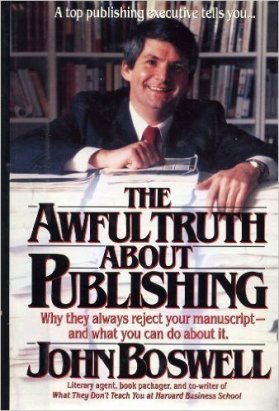 It is titled The Awful Truth About Publishing: Why they always reject your manuscript – and what you can do about it. In spite of its age (it was published in 1986 by Warner Books), and the concomitant fact that it was published long before the advent of the eBook era and the avalanche of self-publishing, it remains one of the best reads to help a writer with her head in the clouds to keep her feet on the ground – which is the only place to be if any real success is to follow.
 I should have known it wouldn’t work for me. I know that everyone else has transitioned into the new world of technology, and I have to say that I thought I was right up there with the most tech savvy of writers. But there’s one area of my writing life – and life in general – where I am singularly unable to evolve. I cannot seem to give up my real-paper daily planner.
 Patricia J. Parsons