 “Everyone is not your customer.” So says best-selling American author and speaker Seth Godin. I learned this lesson many years ago when I proposed my first non-fiction book to a publisher. In this post, I’d like to share with you a sample chapter from Who Will Read Your Book? The Unknown Writer’s Guide to the Realities of Writing & Publishing.
I hope you’ll let me know if you find it useful.
Books don’t sell themselves. This was probably the first reality of publishing that I learned. This was swiftly followed by its corollary: Someone has to sell them…and that someone is largely the author. This is a consideration that writers who wish to see their books read by adoring fans seem to have forgotten.
 Potential readers will never have the joy of reading the books that they have never heard about. We need to explore what book promotion really means in the industry overall and for individual authors. For me personally, my own experiences also drive home the fact that it doesn’t matter whether you are traditionally published, or you take on the job yourself: you still have to learn how to promote your own work. And you have to know who will read it.
The presumption that I make when delving into the notion of book promotion is that you actually would like someone to buy and read your book – or at least read it. I say this because as hard as it might be for some unknown writers to understand, it is not a foregone conclusion that all writers care about whether or not others will read their work. (Of course, you might well suggest that they should then not publish – which implies “public” work – but we’ll not go there at this time). For example, an academic, might publish something simply to have it on the public record knowing full well that the subject matter is discernible to a select few and there will be few readers. Even if you aren’t doing this to generate income from the actual published work, you probably do want others to read it so that you can accomplish other objectives.
For example, you might write and self-publish a book because you want to share something with the hope of helping others, and you don’t much care if you make any money – it’s a labor of love. Another reason for writing a book might be to promote your career and build your reputation as an expert in your field. This is what career self-help gurus sometimes refer to as your electronic business card. You write a short e-book utilizing your expertise; people download it for free, read it, like it and subsequently hire you to do whatever it is you do.
The bottom line is this: whether for love or money, if you want someone other than you and your immediate family to read this book, you have to promote it. People will not buy, download, read, think about or talk about your book if they do not know it exists. It’s as simple as that. The problem is that many writers don’t see themselves as marketers – and for good reason. They’re just not good at it. It’s time to hone your skills. And that starts with a plan.
The book promotion plan
There are two approaches – strategies if you will – to promoting your book: seat-of-the-pants-and-devil-may-care, or make-a-plan-and-implement-it. That’s it.
With a quarter of a century in the corporate communication strategy game, I’m not interested in the seat-of-the-pants etc. approach to book promotion. If you want others to read your book, you’ll have to find out who they are and figure out a way to make them take action by buying and reading your book.
There’s a theory about how people adopt new products and ideas. It’s called the “diffusion-of-innovation” theory, and in a nutshell it suggests the following as a generally, non-linear explanation of how we move to buy that book:

What this means is that people first have to become aware that the book exists. Then something has to pique their interest. The potential readers will then somehow evaluate the idea that they should read the book – perhaps by reading reviews or looking for recommendations from friends and networked acquaintances. They then try it out: either by examining the inside of the book online, downloading a sample, or even buying a copy. The notion of ‘adoption’ would mean that a reader who adopts this product would tell others about it and then await, with baited breath, your next book. A single, one-time purchase by someone who hates the book is not what you’re aiming for.
If we use this understanding of the general process that potential readers would go thorough, we can develop a framework to guide our book marketing. That framework will have several planks that include the following:
- Identifying and locating potential readers
- Deciding what you want to accomplish with them
- Developing the right messages for these potential readers
- Targeting these potential readers by using media they embrace
- Disseminating the messages to the readers
- Measuring the success based on what you wanted to achieve.
We’ll examine each component in turn.
Identifying and locating potential readers
What do you know about the people who might be interested in your book? Let’s begin by examining the potential reader for non-fiction.
If you did what I suggested in an earlier chapter and created that book proposal for a publisher or for yourself, you would have had to think about this before you even wrote the book. If, for one second, you think that your book is for everyone, you need to know right now that you’re wrong. No book is for everyone. That means that you’ll have to think carefully about what might be considered your book’s mission.
- What is your book intended to accomplish?
- How will it accomplish its goal?
- Who is the goal intended to target?
Once you can state these things, you have your book’s mission statement so to speak, and you can begin to figure out more details about the potential readership of your book.
Your work of fiction can be dealt with similarly, although creating a mission statement for a work of fiction is probably a bit more esoteric. You might not have a particular goal for the book other than entertaining readers with a good story – but I believe that this is a worthy one. How it will do that is through great story-telling. Who will read it and where you can find those potential readers will require just as much research as it does in finding readers for non-fiction.
Regardless of whether you are writing narrative or prescriptive non-fiction, genre fiction, literary fiction or even poetry, here are a few questions that you need to answer before you can move into the rest of the book promotion plan.
- Is this book for men or women or both?
- Is there a particular age group to which most potential readers are likely to belong?
- Will people with certain habits or interests be more likely to buy it?
- Do these readers in the group you’ve identified use the internet? Social media?
- Is it likely that your potential readers live in a specific country? State or province? City?
- Are they more likely to be urban or rural?
You begin to get the sense that you’re really painting a word picture of who these people are. Once you know that it is much easier to reach out to them.
When I was considering the promotional plan for my memoir about being a ballet mom, I had to consider all of these questions. The fact that it was published through the traditional route (submission-rejection-submission-acceptance etc.) didn’t change my responsibilities as an author. In the twenty-first century world of publishing, authors are responsible for the lion’s share of the book promotion work whether their books are published by traditional publishers or they publish them on their own. In Appendix 1 where I’ve shared the complete framework for the promotional plan, you’ll see that I’ve broken down the potential readers into a number of groups, all of whom have different perspectives. Each of these groups uses different routes through which a message about a new book can be communicated. And this leads us to the next step of the promotional planning process.
Your objectives and messages
Obviously, you want potential readers to buy and read your book. Clearly this is your primary objective. But is this all? Do you want them to view you as an expert in your field? Do you want them to see you as a writer whose work will propel them to buy more of your books? Do you want them to engage with you on your blog? On Twitter? Are you using this book to establish your credentials as a springboard to career progression?
These might seem like questions you can simply take for granted. They are not. Your well-thought-out answers to them can help enormously in trying to figure out what to say to these potential readers and where to find them.
You may never have thought about this, but different messages will resonate with different readers.
What do you really want to say to potential book reviewers? Do you want honest reviews (highly recommended), or do you want vanity reviews? Those are reviews that you hope to get from fellow unknown writers with a view to giving equally glowing reviews to their books. These are not reviews at all; rather they are advertisements. We’ll discuss book reviews more thoroughly in another chapter.
What do you really want to say to potential readers? The answer to this question will provide you with your book blurbs that will be part of the online description of your book and on its cover. This is a very important consideration in marketing. What you say in these blurbs and how they are written will either repel or attract readers. For example, when I read an online description of a book on a site like Amazon, if the blurb is poorly written, I expect the book will be equally poorly written. If it doesn’t accurately portray what the book is about, I might buy it and be severely disappointed resulting in me posting a bad review, or I might not buy it at all even though I might well enjoy it.
Sarah Juckes, writing on the Alliance of Independent Authors site suggests that writing your book’s blurb is the hardest part of the process because it requires you to condense “…your novel into a few, short paragraphs in a way that makes your book impossible to overlook.”[i] She then goes on to suggest some steps you can take for writing a great blurb including doing research, finding the right style and voice, ensuring you start with a synopsis, and editing. (The difference between a synopsis and a blurb: the synopsis summarizes the entire book, whereas the blurb never provides a spoiler; rather it entices you to want to read more).
Accuracy, clarity and style all play a part in creating a compelling message for potential readers.
Targeting your readers
This is where many new writers fail to plan, resulting in significant wasted time and effort. There is a tendency these days for new writers to spend an enormous amount of time on places like Twitter without giving much thought to whether or not that’s where their potential readers really are. In the next few chapters, we’ll examine these places in more depth. At this point, however, it’s important that writers understand that they might be wasting their time.
If, for example, your non-fiction book is designed for older adults, you’ll need to do some research to determine their use of the various media. You might find that your target readers rarely look to social media for book recommendations. Your genre fiction, on the other hand, might resonate well with specific groups on Facebook or Twitter. Or perhaps your readers usually buy their books at conventions or meetings.
The Guardian book blog published a great list of top book-recommendation sites on the web[ii] Reviewing this would help you to see where your readers go to find new books, and if you do some research on each of these sites, you’ll quickly determine which sites would be useful for you and how to go about getting your book featured there.
How successful was your plan?
Figuring this out depends on what you intended to accomplish from the outset. But it is worth doing a check once in a while to see how effective the elements of your plan were.
If you simply consider your objective to be a numbers game, that will be your yardstick. If, however, you want to build a reputation, a brand or a loyal following, your evaluation efforts will be more nuanced and longer-term. Whatever parameters you select to measure your success, remember that you’ll have to check in on how you’re doing from time to time to tweak your plan. As you move forward in promoting your book, you’ll find that some approaches will work better than others and you’ll want to make changes along the way.
The next few chapters will provide you with a discussion of exactly what kind of tactics you might include in your book marketing plan. Whatever you include, there is one element that cannot be stressed enough: start planning early. Book marketing planning should begin long before you actually release your book. In fact some of the tactics we’ll discuss in the next few chapters need to be executed before publication, while others simply need to be planned for implementation after that magic date.
[i] Sarah Juckes. October 4, 2013. How to write an effective blurb for a self-published book. http://www.selfpublishingadvice.org/how-to-write-an-effective-blurb-for-a-self-published-book/
[ii] Top book-recommendation platforms: What are your favourites? http://www.theguardian.com/books/booksblog/2014/may/10/top-book-recommendation-platforms-what-are-your-favourites
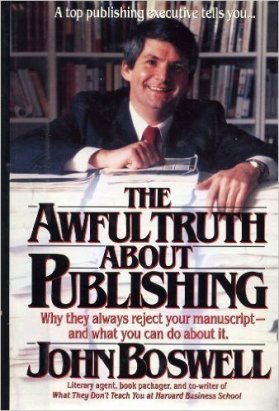 It is titled The Awful Truth About Publishing: Why they always reject your manuscript – and what you can do about it. In spite of its age (it was published in 1986 by Warner Books), and the concomitant fact that it was published long before the advent of the eBook era and the avalanche of self-publishing, it remains one of the best reads to help a writer with her head in the clouds to keep her feet on the ground – which is the only place to be if any real success is to follow.

 Patricia J. Parsons